Editorial
Research Report
Building the Case for Modern Public Sector Messaging


For most professional sports fans, it’s a dream to have teams competing across multiple playoff rounds. What could be better than your favorite basketball and hockey teams competing at the highest level late into the season?
Winning. Winning would be better. Believe me, I get it. I'm a Philly fan.
The emotional roller coaster of being a Philadelphia sports fan cannot be understated. Each year, as a season begins, we are filled with hope and excitement as we hear how “on paper,” this team looks like a contender. Every Philadelphia sports fan knows this feeling: the analysts say your team is elite, the numbers say the season was successful, and yet, somehow, you’re sitting on your couch at 11:37 p.m. wondering why the Sixers went down in four.
That disconnect between perceived success and lived experience isn’t just sports psychology. It’s the same perception gap companies struggle with every day in customer experience.
Way back in March, Medallia released its 2026 State of Customer Experience report, the data showed that while 66% of brands believed their CX was improving, only 17% of consumers agreed with that? That gap in brand perception was jarring AND alarming as it highlights the fact that wires are getting crossed somewhere. The outcomes are not living up to what the dashboard is telling us and in customer experience the outcomes and emotions are what matter.
In the same way that many organizations are finally getting the memo that insight generation without action is unhelpful at best and a waste of time and resources at worst, dashboards with metrics that don’t tie to customer outcomes are the death knell for a well-intended Voice of Customer program.
Too often, companies still mistake the following metrics with success:
Behind those metrics are the actual stories. The customer had to keep calling to solve the same problem. The root cause is a known issue that has remained unresolved for five quarters. Our customers are going out on social media to complain, and our brand perception is taking a hit.
Philadelphia sports fandom during playoff season is the perfect metaphor for the modern customer experience perception gap: organizations often believe they are delivering a successful experience because the indicators look strong, while customers (or fans) are left emotionally exhausted by the actual outcome.
Related Article: Record-Low Sentiment Is Rewriting the Customer Experience Playbook
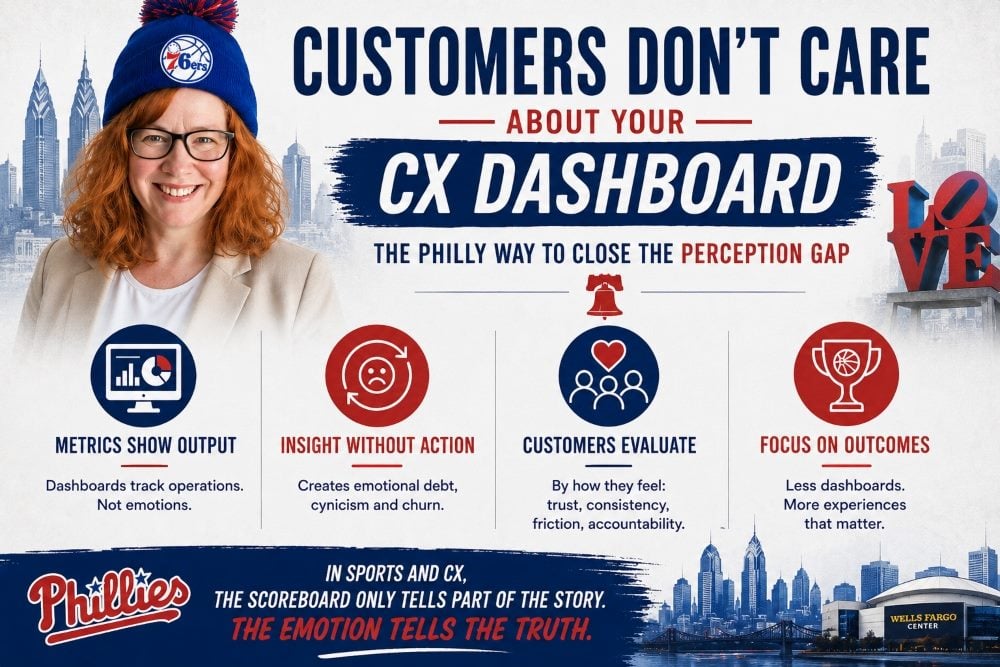
The Sixers can have MVP-level talent and a winning record and still leave fans devastated. Why? Because humans don’t evaluate experiences solely by inputs or statistics. They evaluate them by:
None of these factors are easily measured in the traditional way, but they are crucially important to understanding customer confidence and customer loyalty. In Philadelphia, the die-hards remember the collapse, the turnover, the missed opportunity much more than the regular season stats. Philly fans don’t want another think piece explaining why the team should have won. They want evidence the organization knows how to close.
Same goes for your customers. They will remember the failed handoff, the unresolved issues and the moment their trust was broken long after that dashboard is published.
Philadelphia sports teams often do an excellent job of generating hope. But when that hope doesn’t pan out, fans are left with deflated expectations. They hear things like “We will learn from this season,” “We will rebuild,” or “We will get mentally tough.” Or in those glorious seasons when expectations are met, they are conditioned to reset their expectations, hoping the same formula will create the same results. (Trust me, it usually doesn’t.)
Customers of brands often go through a similar cycle with companies sending surveys, collecting customer feedback and promising improvements. Hope springs eternal as companies promise to learn from their mistakes or take a human-centered approach. That concept of learning and changing is really at the heart of moving from insight generation to action orchestration, a theme that continues to resonate across the experience landscape.
As we find new, better, quicker and more efficient ways to collect and analyze data, the reasonable expectation should be that customer outcomes will follow. When that doesn’t happen, the emotional debt surfaces as cynicism, distrust and emotional fatigue. (And yes, the same is true for Philadelphia sports fans.)
The better the team, the more painful the loss. That’s also true in customer experience. The highest performing brands create:
Once that expectation is set and the experience fails, the disappointment hits harder. Philly fans react emotionally because expectation is the price of belief. When you truly love a brand, you expect more from them and failure to deliver hits differently. Customers often become more frustrated by the companies that they feel should know better than the ones who have regularly disappointed.
It’s important to remember that customers don’t care about your operational dashboard, no matter how much your executives do. Customers care about friction, confidence, trust and solving the problem. They also care about — and remember — how you made them feel during critical moments. If your current metrics don’t reflect these customer outcomes, then you’re missing the mark of creating an experience that generates loyalty and retention.
The following questions address common challenges CX, contact center and marketing leaders face when internal metrics diverge from the experiences customers actually report.
In both sports and customer experience, the scoreboard only tells part of the story. The emotion tells the truth.
Despite a fairly consistent level of heartbreak, Philly fans remain loyal, hopeful and invested. Philadelphia sports fans don’t need perfection. We just need proof the pain means something. Things like authenticity, connection and continual effort.
The same is very true when it comes to customer experience. Customers don’t usually require perfection from most brands or across most industries, but they do expect accountability, responsiveness and clear evidence that their needs are seen and considered. This requires companies to spend less time building dashboards and more time actioning what they know and turning that into customer outcomes that matter.
The perception gap closes when organizations stop measuring whether they delivered an experience and start asking whether customers actually felt it.
 Learn how you can join our contributor community.

Trish is an experience and innovation executive, practitioner and speaker who has spent the past 15 years driving cultural transformation and customer advocacy and employee engagement across diverse industries such as insurance, pharmaceutical distribution and financial services. Trish has led research and insights teams, implementing and evolving customer strategy, consumer insights and competitive intelligence capabilities.