News
Research Report
Building the Case for Modern Public Sector Messaging


Guided AI deployment. Help Agent launches quickly with prebuilt actions and setup.
Outcome-based pricing. Organizations pay only for autonomous customer issue resolutions.
Enterprise efficiency gains. Service leaders gain reduced setup complexity and cost alignment.
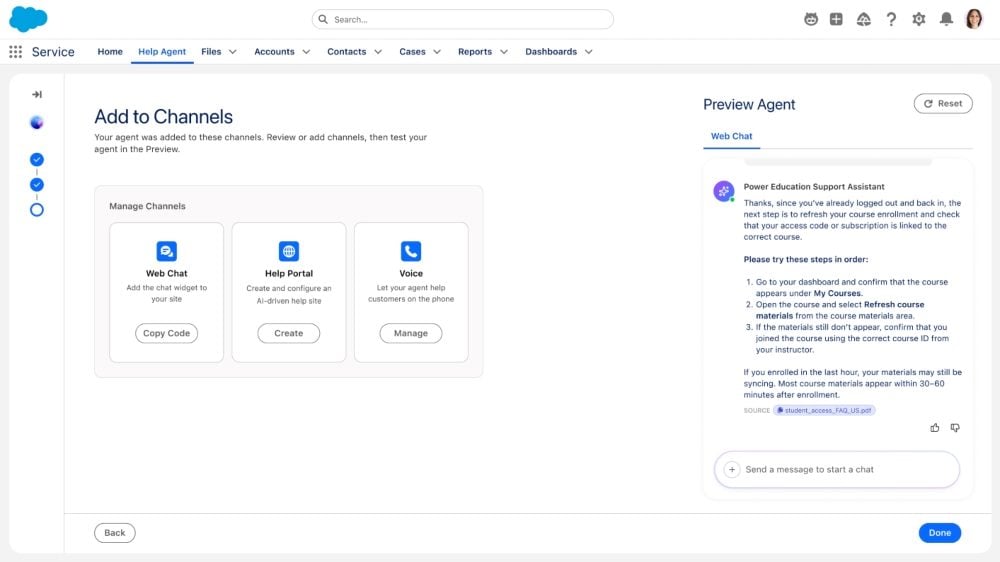
Salesforce on June 25 launched Agentforce Help Agent, an autonomous AI service agent built on the Agentforce 360 Platform. The product features guided setup, prepackaged workflow actions and omnichannel deployment across voice, web, portal and messaging — all configurable from a single screen, according to company officials.
The agent introduces pay-per-resolution pricing: organizations pay only when Help Agent resolves an issue autonomously from start to finish. If a customer requests human escalation or provides negative feedback, there is no charge. Salesforce said the model ties costs directly to successful outcomes rather than consumption or activity.
Salesforce also recently signed a definitive agreement to acquire Fin, a customer agent platform serving more than 30,000 companies globally. That transaction is expected to close in Q4 of Salesforce's fiscal year 2027, subject to customary closing conditions and regulatory clearance.
"PenFed is building toward a future where every member gets fast, self-driven and personalized service at scale, and Agentforce is making that real," Nicole LaCamp, SVP of Platform Strategy and Engineering at PenFed Credit Union, said in a statement. "With Agentforce, we've freed our team to focus on what matters most: understanding and anticipating member needs. We're excited about where Salesforce is headed with easier setup and outcomes-based pricing, because this kind of model means we only win when our members win."
Agentforce Help Agent ships with the following capabilities, according to Salesforce:
Capability | Description |
|---|---|
Pay-per-resolution pricing | Charges apply only when the agent autonomously resolves an issue end to end |
Guided setup & rapid deployment | Configurable in minutes across voice, web, portal and messaging channels |
Salesforce Knowledge grounding | Auto-grounds on existing knowledge; supports file upload and URL crawling |
Prepackaged workflow actions | Case management, appointment scheduling, order updates and account management |
Reimagined Customer Service Portal | Conversation-bar interface with dynamic cards and real-time data |
Salesforce has executed one of enterprise software's most aggressive agentic AI acquisition campaigns: an $8 billion Informatica close in November 2025 to fortify data infrastructure; a $3.6 billion deal for Fin, which claims a 76% end-to-end support resolution rate; a definitive agreement to acquire composable content platform Contentful, used by more than 4,800 brands; and AI workflow automation specialist Regrello. Earlier moves included acquiring Qualified for agentic marketing pipeline generation and co-leading a $1.5 billion investment in Genesys alongside ServiceNow.
On the product side, Salesforce launched Agentforce Contact Center in March, unifying voice, digital channels, CRM data and AI agents natively, and released Agentforce 3. Partnership expansions deepened integrations with OpenAI and Google, bringing Gemini into Agentforce 360. The company also launched AI Foundry in March for simulation and validation of enterprise agents.
FY2026 revenue reached $41.5 billion, up 10% year-over-year, while Q1 FY2027 revenue hit $11.1 billion, up 13%. Agentforce surpassed $1.2 billion in ARR across 18,500 customers — up 205% year-over-year.
Autonomous AI service agents are moving from pilot to production, reshaping how enterprises handle customer experience across channels, cost models and integration architecture.
Traditional support workflows force customers to re-explain context at every escalation point. Autonomous agents eliminate that friction by drawing on support tickets, purchase history, product usage and real-time system status — then reasoning, planning and executing resolution steps independently.
As earlier CMSWire reporting described, agents run inventory checks, warranty verifications and customer communications in parallel, escalating only when genuine complexity warrants human involvement.
Outcome-based pricing is gaining traction. At Relate 2026, Zendesk launched AI agents billed exclusively on verifiably resolved outcomes — not seats or interactions. HubSpot made a similar pivot, with omnichannel deployments cutting operational costs by up to 30% under pay-per-result structures.
Autonomous agents operate across voice, web, chat, email and messaging platforms including WhatsApp. Grounding on CRM knowledge bases is foundational — agents resolve up to 40% of inquiries when properly integrated with data and workflow APIs.
ServiceNow's autonomous CRM approach illustrates the architecture: agents connect to prepackaged actions across service, sales and field operations, replacing handoff-heavy processes with multi-step autonomous execution.
Organizations implementing autonomous AI systems reported a 28% improvement in issue resolution time and a 19% increase in first-contact resolution rates. Gartner predicted that by 2029, agentic AI will independently handle 80% of routine customer service inquiries, driving a 30% reduction in operational costs.
Salesforce, founded in 1999 in San Francisco, provides cloud-based CRM, sales, service, marketing and commerce applications within its Customer 360 platform, extended through acquisitions such as Slack, Tableau and MuleSoft.
 Have a tip to share with our editorial team? Drop us a line: