Editorial
Research Report
Building the Case for Modern Public Sector Messaging


In her recent article for CMSWire, "The Best CX Teams Have Ditched the Help Desk for a 'Hope Desk'," Vanessa Hering made a point that I was so glad to see made, especially in these current extremely demanding economic times.
While empathy, incorrectly in my mind, was previously seen as a "soft skill," as she observes, it is now an essential element especially for clients in vulnerable positions who could well require support due to factors such as financial stress, health crises or emergencies.
Empathy, therefore, becomes a retention strategy, a differentiator and a driver of genuine business outcomes. The reason is that teams that combine technology with human understanding build the kind of trust that automation alone can never manufacture.
As someone working mainly in the B2B sector in CX in the last ten years, I agree entirely.
Empathy is a capability. In a B2B context where sales cycles can be long and complex, it is vital for leaders to ensure that technical and engineering teams develop this as a skill, particularly in relation to active listening and the documenting of customer requirements. It is also vital for after-sales services where the ability to adequately resolve complaints and delivery failures impact on retention and satisfaction.
Empathy describes how well an individual or team can attune to another person's emotional reality in a given moment. I would like to build on Vanessa’s article because I believe that organizations that consistently deliver experiences people describe as memorable, trustworthy or even life-changing are not just training for empathy — they are designing for soul.
Editor's note: Key questions surrounding authenticity, empathy and organizational alignment in customer experience.
In my earlier piece on what the 1990s got right about customer experience, I explored how the original architects of CX understood something profound: customers do not experience strategies or organizational structures. They experience systems — the digital interfaces, service processes, support interactions and physical environments that those structures produce.
This is why experience design so often fails in practice. The empathy is present in the customer service representative's voice, but absent in the returns portal. The purpose statement on the wall speaks of care, but the performance metrics on the same manager's screen reward speed over understanding. The brand promise says one thing; the procurement decision that chose the cheapest chatbot says another.
These are not failures of empathy training. They are failures of systemic coherence. And they cannot be solved without also asking a harder question: does the organization that houses that hope desk have soul?
Soul is not a metaphor. It is something customers already recognize and employees already feel, even when neither can quite articulate why. It shows up as the difference between a brand that performs its values and one that actually lives them. Between a business that processes its customers and one that genuinely sees them.
Most organizations have a gap between what they say and what they do. That gap is felt in every interaction, every touchpoint and every moment of contact, and closing it is not a communications challenge. It is a leadership one.
The scale of that gap is more visible than ever. Gartner's most recent research find that only around 20% of employees are truly engaged at work. That is not a recruitment problem or a training problem. It is a soul problem — and it has direct consequences for the quality of every customer interaction those disengaged employees are part of. You cannot build a hope desk on a foundation of people who have stopped believing in the organization they represent.
As AI accelerates automation and distances organizations further from the human beings they serve, the risk is not simply that experiences become more impersonal. It is that organizations gain a new mechanism for performing care without actually practicing it.
The answer lies in whether authenticity, meaning and human values are authentically embedded and not just expressed in a mission statement. An experience has soul when one soul recognizes another. That recognition can happen in a customer service call. But it can also succeed or fail in a digital interface, a piece of packaging, a policy decision or a leadership communication for example.
Soul is either present throughout an organization or it is absent at the moments that matter most.
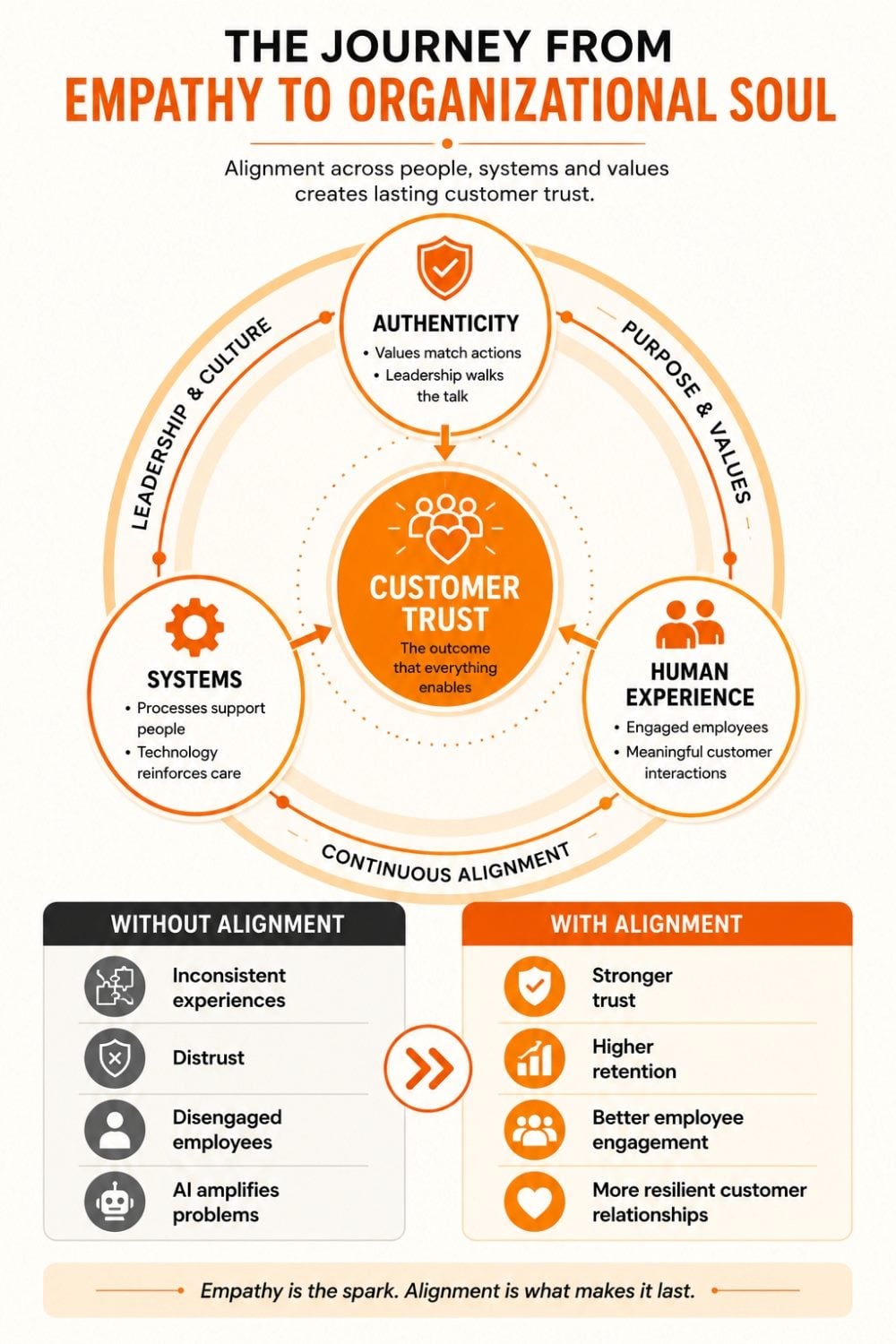
To help leadership teams think through this challenge in an integrated way, Maria Moraes Robinson and I developed the Holonomic Circle — a framework built around three concentric layers.
The Trinity of Authenticity sits at the center. We define authenticity as the maximum coherence between what a person says, what they mean and how they act. This applies equally to individuals, teams and organizations. Counterfeit authenticity, the perceptible gap between stated values and lived behavior, is something customers detect immediately, even if they cannot articulate why an experience felt hollow. The hope desk fails when the agent is genuine but the organization behind them is not.
Tools and Techniques forms the middle ring. This layer contains the systemic foundations that determine whether CX, employee experience and leadership experience initiatives actually work: customer journey mapping, empathy mapping, lifecycle design, voice of the customer programs. Most organizations have these tools. Fewer understand why they sometimes work and sometimes do not. This layer illuminates the underlying conditions such as whether purpose is coherent, whether meaning flows through the organization, or whether systems are designed for the human beings who use them or for internal convenience.
The Transcendentals make up the outer ring: being, relationships, beauty, truth, goodness and wholeness. The term "transcendental" was selected to highlight their role in elevating customer experience from beyond great to soulful. They are the qualities that distinguish experiences people genuinely remember from those they merely tolerate. Wholeness asks whether the customer experience is consistent across channels, teams and time and not just in isolated moments of excellent service. Truth asks whether an organization is honest with its customers, even when that honesty is commercially uncomfortable.
The goal of the Holonomic Circle is to inspire and facilitate ongoing conversations about what excellent, soulful experience actually requires.
What makes the Holonomic Circle distinctive is that it applies simultaneously across three dimensions of experience: Customer Experience, Employee Experience and what we term Leadership Experience, the inner lifeworlds of leaders where empathy is encountered in their lived experience.
Soul cannot be manufactured in one part of an organization and absent in another. Here are some questions that matter to your overall customer experience:
These questions are not meant to be answered once. They are designed to open sustained, cross-disciplinary dialogue enabling teams across sales, marketing, HR, product, and operations to collectively understand where coherence exists and where the gaps are.
How leadership, employees and customer-facing systems work together to create authentic experiences.
| Dimension | Key Question | What Success Looks Like |
|---|---|---|
| Authenticity | Do actions match stated values? | Customers experience consistency between promises and reality. |
| Leadership | Do leaders model the behaviors they promote? | Trust and accountability flow throughout the organization. |
| Employee Experience | Do employees find meaning in their work? | Higher engagement translates into better customer interactions. |
| Customer Experience | Do customers feel understood and respected? | Relationships extend beyond transactions. |
| Systems Design | Do processes support human needs? | Technology reinforces empathy rather than undermining it. |
| AI Adoption | Does automation reflect organizational values? | Efficiency improves without sacrificing authenticity. |
| Organizational Coherence | Are experiences aligned across departments? | Customers receive consistent treatment regardless of channel. |
The idea of the hope desk is a beautiful idea, and the practices Vanessa describes such as redefining success metrics, training for deep listening, empowering teams to solve rather than escalate, are essential. But they are most powerful when they sit within an organization that has done the harder work of aligning its authenticity, its systems and its transcendental qualities.
Empathy can exist in pockets. Soul has to be systemic. For this reason, it has to start with the most senior leaders and expressed across whole ecosystems.
Marcelo Castelli, Executive Chairman of Copersucar and a Forbes Top 25 CEO, expresses this eloquently in "Designing Customer Experiences with Soul":
“The concept of “experiences with soul” goes well beyond customer satisfaction. It invites us to reflect on how our corporate decisions resonate emotionally across the stakeholder ecosystem—employees, partners, communities and investors. In a world where trust and authenticity have become vital currencies, leading with an integral consciousness is more than a competitive advantage, it is a responsibility.”
If your CX team is already thinking about the hope desk, the next question is: what kind of organization does that desk belong to?
Because the organizations that will truly differentiate themselves in the age of AI are not simply those with more empathetic agents. They are those in which empathy, authenticity and human values run through the entire system, from the leadership team's boardroom to the moment a customer opens their door.
 Learn how you can join our contributor community.

Simon Robinson is one of the pioneers of customer experience, co-authoring the world’s first article on customer experience strategy in 1995. In the 1990s he was the business development manager responsible for smart phones at British Telecom (BT Cellnet/O2) and co-founder of Genie Internet, one of the UK’s first startup unicorns, developed inside BT Group.