News Analysis
Research Report
Building the Case for Modern Public Sector Messaging


Google's talked a lot this week about marketing and search experiences.
First, it was SEO still matters for generative AI search experiences.
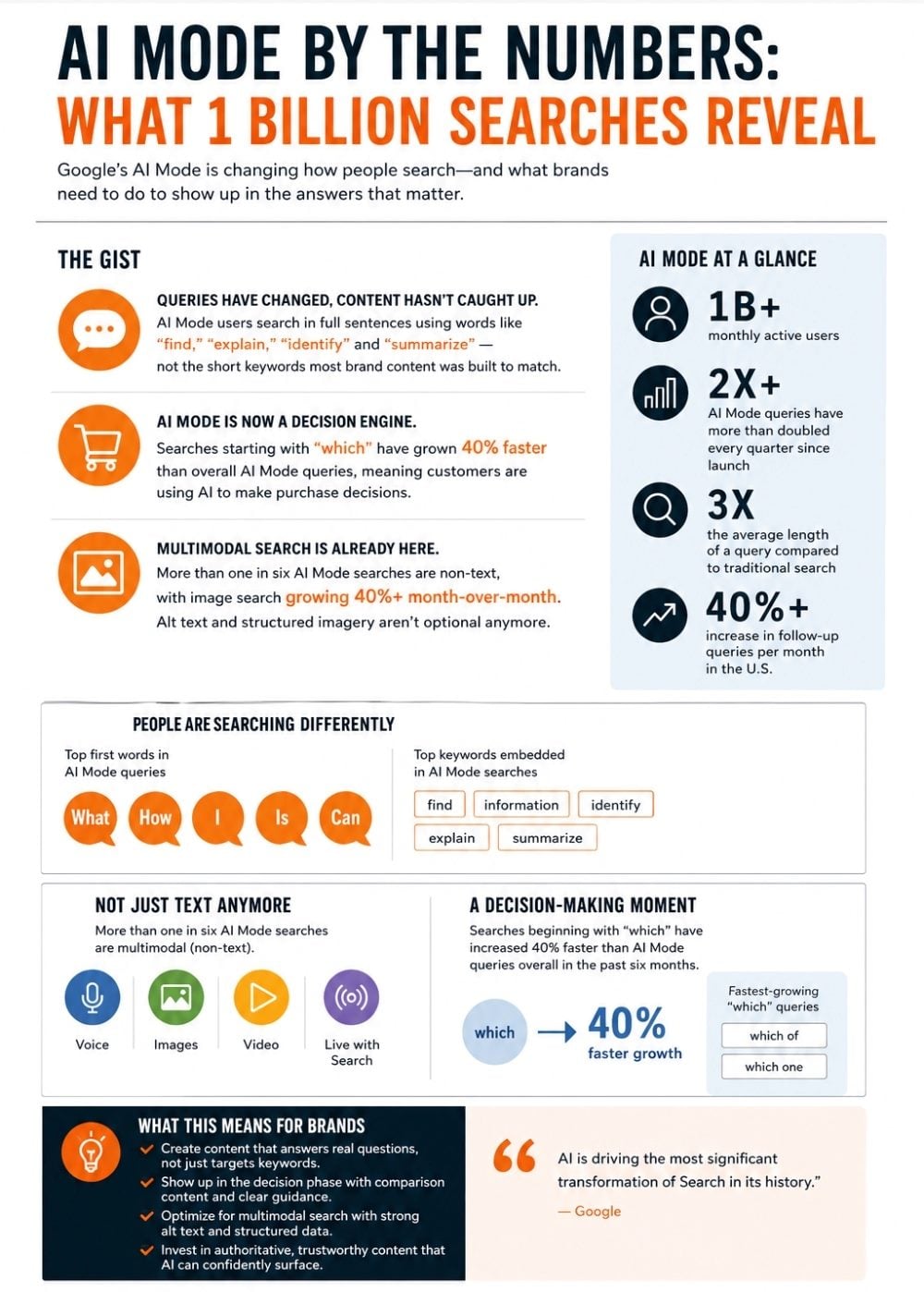
Now, it's findings on one year's worth of searches in Google's AI Mode, which now has 1 billion monthly active users. AI Mode queries have more than doubled every quarter since launch. Check out the full report here.
People search like your teen texts you parents out there: long-winded, 100 words when 10 will do, tons of back-and-forth; the average AI Mode search query is triple the length of a traditional search query. And follow-up queries in AI Mode have increased by more than 40% on average per month in the U.S.
And they're not just searching with text: voice, images, video and even going Live with Search in a natural, free-flowing conversation have emerged. More than one in six AI Mode searches are multimodal (non-text), and searches with image input are one of AI Mode’s fastest growing query types, growing by more than 40% month-over-month since launch, Google reports.
This is where the SEO conversation gets practical for CX and marketing leaders. Earlier this week, Google made the case that SEO still matters in the age of generative AI search — that authoritative content, credible sources and structured data remain the table stakes for appearing in AI-generated results. The AI Mode report reinforces why: Google's AI is surfacing answers from the web, and the brands that show up are the ones invested in content that directly answers questions people are actually asking.
The problem is, those questions look nothing like they used to. The top first words in AI Mode queries are "What," "How," "I," "Is" and "Can," according to the report. The top keywords embedded in searches: "find," "information," "identify," "explain" and "summarize." Those are not the clipped, keyword-stuffed phrases that SEO teams spent a decade optimizing for. They're the words of someone having a conversation — someone who expects to be understood, not just matched to a result.
CX and digital experience leaders should sit with that for a moment. Your customers and prospects are no longer hunting for your brand through two-word queries. They're asking AI to help them find things, identify options, explain concepts and summarize what they need to know. The question is whether your content — your product pages, your help center, your thought leadership — can answer those questions with enough depth and authority to earn a place in AI-generated responses.
Related Article: AEO, SEO, GEO: What's the Best Search Playbook?
Perhaps the most telling finding in the report for brands that sell things: AI Mode has quietly become a tool people use to decide. According to Google's Trends data, searches beginning with "which" have increased 40% faster than AI Mode queries overall in the past six months. The fastest-growing queries in that timeframe were "which of" and "which one" — the language of someone who has already done some research and is now ready to choose.
Probably means some of your content should factor in choices. "This tool or that tool." "This strategy or that strategy." We're doing that, too: i.e. Medallia vs. Qualtrics.
This is the moment in the customer journey that CX practitioners have always tried hardest to influence. And it's now happening inside an AI conversation. Shoppers, the report notes, often begin their journey in traditional Search and click into AI Mode to dive deeper. The top shopping categories where people ask follow-up questions within AI Mode include electronics, apparel, health and beauty, and home and garden. When they ask about stores, they want to know what's near them, what's in stock, and whether a retailer can meet a specific need in the moment.
Price, location, color, brand and availability are the top retail attributes people specify when shopping via AI Mode, according to the report. That's a checklist for every ecommerce and digital merchandising team: if that information isn't crawlable, structured and authoritative on your site, AI Mode may simply not surface you when a customer is ready to buy.
The report's "Do" section is worth special attention for marketers. Google says AI Mode queries related to planning have grown 80% faster than AI Mode queries overall in the past six months. People are using AI Mode to build travel itineraries, schedule fitness routines, plan dinner parties and manage household budgets. Brainstorming queries have grown 30% faster than overall AI Mode usage since launch.
What this means for brands: your customers are in planning mode more often than ever, and they're asking AI to help them. A restaurant that hasn't structured its content around attributes like "outdoor seating," "vegan options" or "private party room" — the top attributes people specify when asking AI Mode for dining recommendations, according to the report — is invisible to a new and rapidly growing segment of intent-driven searchers. The same logic applies across industries. Content that speaks to specific needs, specific contexts and specific decisions is what earns a place in AI-assisted planning.
There is one more finding that digital experience teams cannot defer: more than one in six AI Mode searches in the U.S. are already multimodal — meaning voice, image or video input rather than typed text, according to the report. Searches with image input are among AI Mode's fastest-growing query types, increasing more than 40% month-over-month since launch.
For brands, this is an accessibility and discoverability problem: Alt text, image metadata, structured product imagery and voice-friendly content formats are no longer nice-to-haves. If a customer photographs a product and asks AI Mode to find something similar, or speaks a complex request while browsing, the brands positioned to appear are the ones that have treated multimodal optimization as a present-tense obligation.
Google said SEO still matters. What the AI Mode report adds is the harder question: SEO for what kind of search, and for what kind of searcher?