Editorial
Research Report
Building the Case for Modern Public Sector Messaging


Editor's note: The Big Answer: It's never been easier for marketers to create content, but the customer signals they need to surface the right content at the right time are still getting lost. Without them, marketers don't have the context they need to optimize customer journeys. The solution to this challenge isn't to invest in more software or create more content. Instead, it's using existing tools in a new way.
Most organizations already have all the software, data, and content they need to solve the missing signal problem. What they need now is to evolve their workflows. It's already possible to create a contextual intelligence loop using AI. This loop then feeds customer signals back into marketing systems, enabling employees to act in ways that improve engagement.
With a contextual intelligence loop in place, customer journey mapping can shift from today's mostly frozen-in-amber, backward-looking practice to one that understands the customer's current journey and provides the right content to support them at each step. As Forrester analyst Joana de Quintanilha puts it, "customer journeys are no longer static artifacts; they're becoming management operating systems."
A contextual intelligence loop stitches together all the elements of the tech stack that touch the customer journey: journey platforms, CRMs and experience management tools. The result is a chained loop that can efficiently turn customer signals into structured data. That structured data then feeds into employee tools, enabling the system to deliver the right content to drive customer action. Employee insights also feed back into the customer experience as each new action takes place.
The result is continuous improvement in visibility into customer context across their journeys, so that marketers can better customize and deploy their content assets. Content is static, but context is situational. The better marketers get at serving situational content, the more engagement they can generate.
Related Article: Not Your Grandparents' Customer Journey
Support ticketing flow improvements offer a good example of how the contextual intelligence loop can work. For example, a product marketer notices a major drop-off in the checkout flow and finds that unclear messaging about financing may be causing it. The marketer can use AI agents to determine how many customers are encountering this issue, revise the content to clarify the financing options, and send the update to the digital experience platform.
The next step is to train the AI agents to proactively detect and address issues so they can:
Automating these steps saves the marketer time and allows them to focus on evaluating potential solutions rather than tracking down the causes.
The contextual intelligence loop can do more, too. By connecting the agentic system through Model Context Protocol (MCP), the marketer can also automate improvement-related updates to the organization's employee-facing SharePoint documentation, the customer-facing FAQ page and other information repositories. To close the loop and continue contextual intelligence gathering, the marketer can instruct the agents to measure the drop-off or bounce rate again in a few days or weeks to see whether the changes are improving the metrics.
Right now, most organizations handle all steps of the support ticketing flow improvement process manually. That can require weeks for each issue to be investigated, changed, updated and measured. Now it's possible to make these changes in hours, but only when marketers have the data and ownership to do so.
Most marketing teams are already using a CRM, DXP and ticketing tools. Some are already using journey orchestration platforms, as well as other tools and custom software for specific use cases. What these teams lack, in many cases, is ownership of the full customer data chain.
When a marketer spots a checkout drop-off tied to unclear financing language, the path to fix it usually runs through three departments. Marketing flags the issue. Support owns the FAQ that needs updating. Web ops owns the page where the financing copy lives. Each handoff takes days, so by the time the fix ships, the data that prompted it is two weeks old, and the marketer has moved on to the next fire.
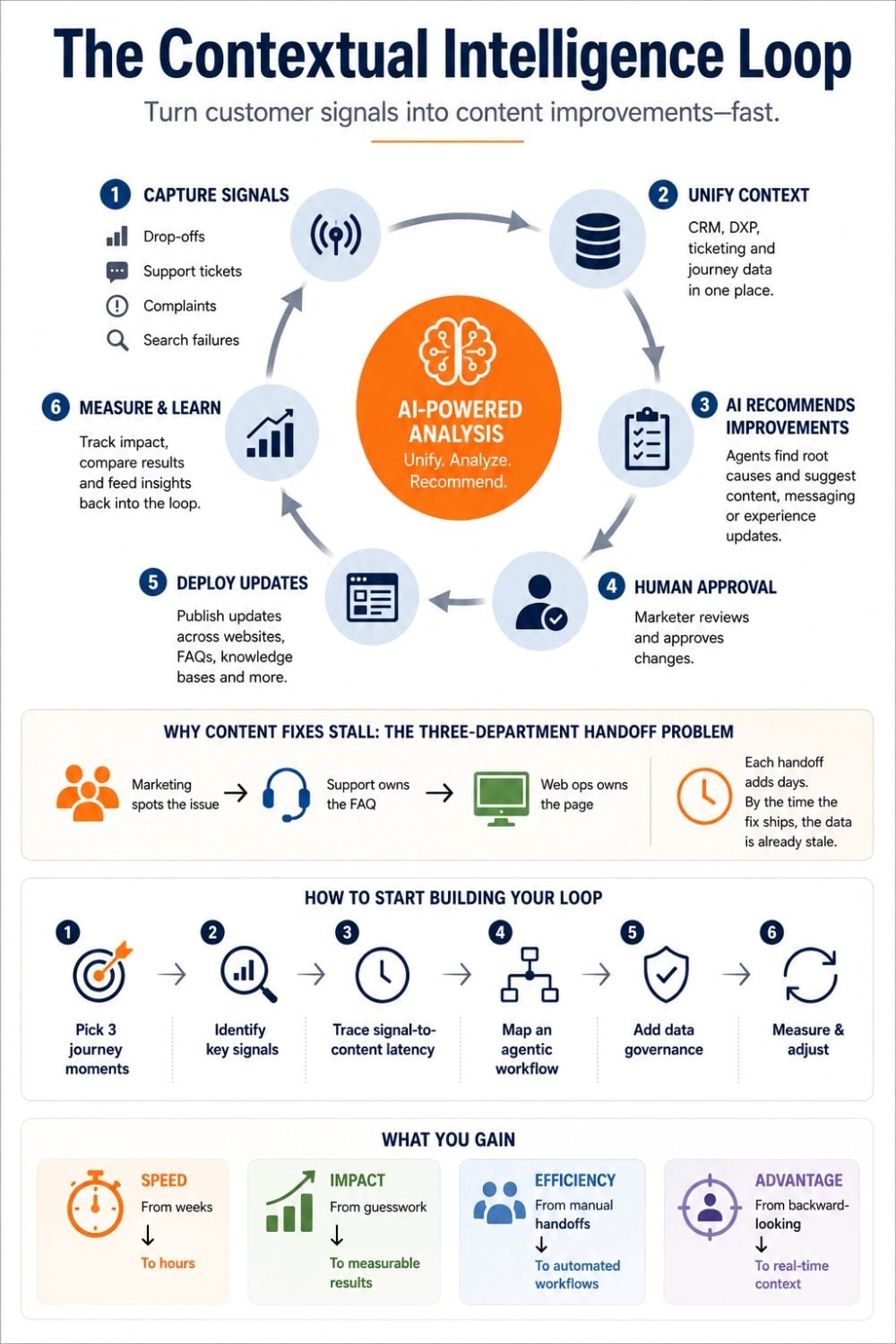
Rather than try to bring the entire customer journey into the loop at once, it's a good idea to start with three journey moments and build from there. For example, in the CPG space, the key moments might be the signup flow, add to cart, or the checkout flow.
Next, identify key signals such as drop-offs, support tickets and complaints. Then trace the path of those signals to see if they impact content, guidance and employee tools. If they do, where is the impact, and how much time elapses between signal detection and those changes? Use that information to define triggers and map an agentic workflow that pulls from the same source of truth for all parties.
Implement the workflow along with data governance. Because employees want to work with AI, it's important to develop policies against the use of unapproved "shadow AI" to ensure consistent, relevant results from the contextual intelligence loop. That's especially important when measuring the results and adjusting triggers and workflows as needed. All AI outputs and content updates must come from the same approved workflows.
Summarizing:
Contextual intelligence loops represent the marketer's dream of fully optimizing customer journeys through data. A few organizations are already working to make that dream a reality, and it's likely they'll have a solution within the next one to two years. When they do, the level of context they bring to customer-journey content is likely to fundamentally shift customer behavior.
The challenge is to start now, using the tools and technology you already have, so you don't get left behind. The first contextual intelligence loop your team builds doesn't have to span the full customer journey. Pick one moment, such as a signup flow, an abandoned cart, or a support escalation. Trace the signals, map the workflow, see what a fully connected loop can do in 90 days, and build from there.
 Learn how you can join our contributor community.

Ben Rothman is Vice President of Customer Experience Solution Lead for Genpact’s Experience team (formerly Rightpoint). leading strategy and delivery for digital products that transform how Fortune 500 brands engage their customers. He focuses on scalable architecture, human-centered design, and the emerging role of AI across healthcare, finance, retail, telecom, CPG and entertainment.