Editorial
Research Report
The 24 Hours That Define Your CX Program

Many leaders find themselves busier than ever. So why are we finding that our strategic momentum has stalled? We invest in technology stacks, AI, resources and agile, et al, yet, our measure of true customer value often remains static.
To execute at the speed and scale the current market demands, we must look beyond departmental optimization and confront the structural friction that turns our internal efforts into customer-facing noise.
Because regardless of whether we "believe" that our model is effective, it's ultimately the customer's decision as to whether it's creating friction or not. The path forward requires a fundamental shift toward Value Stream Delivery, a reorientation of how we view every internal action and whether it truly delivers external customer experience value.
Organizations are typically slow to maneuver or pivot, creating endless internal friction to execute. These legacy frameworks in which we work have a significantly negative impact on the customers we serve, often prioritizing departmental survival over customer success. When we prioritize internal factors over external impact, our lack of progress in delivering customer value stifles our momentum.
Most organizations are structurally designed to frustrate the customer. Sales is hunting for revenue, account management (if you're fortunate to staff the department) is focused on retention and support, well, they're "taking care of the customer."
From the organizational perspective, not one department has a unified view of the customer's true experience. Most leaders mistake this for a "communication problem" between departments.
While that may be true, the deeper, more systemic issue is an "Intelligence Problem." This structural setup kills momentum by fragmenting the truth. The result is a visibility gap that compels leaders to make holistic strategic decisions based on a fractured, incomplete version of the customer experience.
Most customer service departments are managed as cost centers, a perspective that naturally leads to the "Efficiency Trap." We inject technology (AI, automated workflows and self-service portals) with the goal of speeding the customer through a process or deflecting them from human contact altogether.
We tell ourselves we're providing the service they desire, but this focus on "Efficiency Metrics" has a darker systemic result: it prioritizes ending the interaction over advancing the journey. When success is measured by how quickly we can get a customer off the line, we aren't building momentum; we are propping up isolated experiences and not building up the customer.
The final gap in the value stream is the most damning: a latent, underlying fear among leaders that truly understanding customer friction will reveal "messy" problems requiring cross-functional effort. We've all heard the phrase, "Well, I wasn't aware of that," in executive meetings. Often, it's code for: "As long as I don't acknowledge the issue, I don't have to assume responsibility for its resolution."
For example, in a fragmented organization, there is zero incentive to own a "product" flaw if you are measured on "service" volume. This leads to leaders retreating into their departmental four-walls, effectively using ignorance as a psychological safety mechanism. If we don't look too closely, we don't have to fix the arduous structural issues. But this "safety" comes at a high price as it creates a permanent ceiling on organizational momentum.
Related Article: The Best CX Teams Have Ditched the Help Desk for a 'Hope Desk'
Value stream delivery reorients your organization to what really matters: the customer. When you become a truly customer-centric organization, you transcend the inherent friction of silos and the limitations of reactive models. It's the required pivot that transforms service from a defensive cost center into a high-velocity engine for growth.
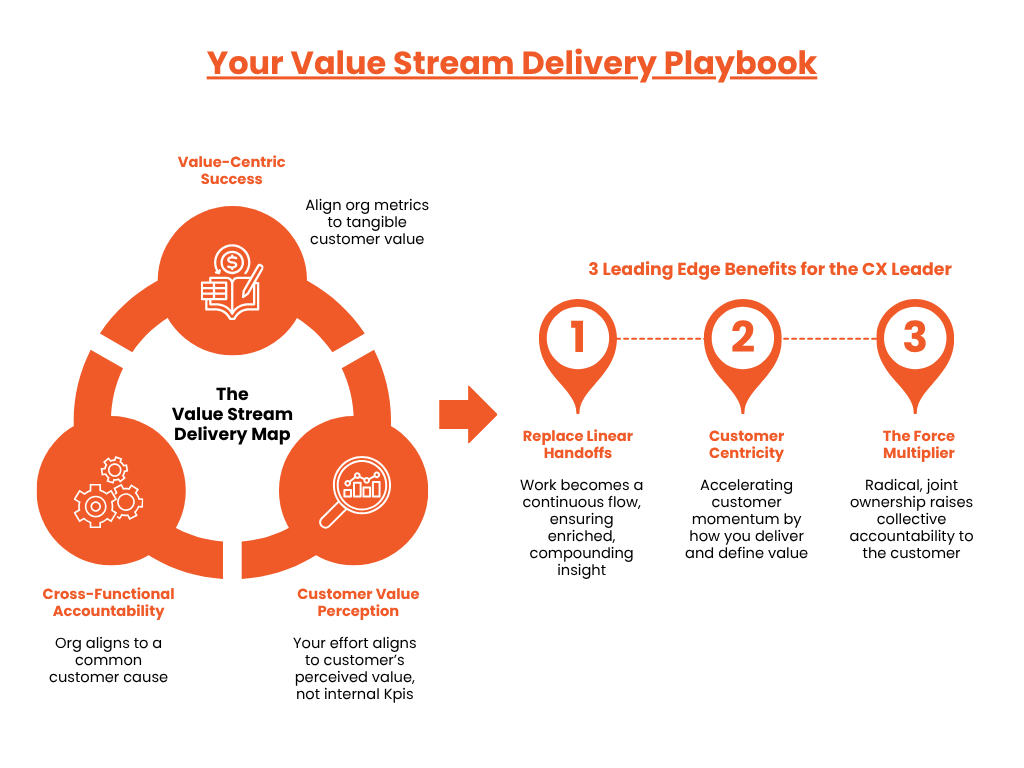
Let's explore the three leading-edge benefits of value stream delivery that align with the very best of what your organization does, strengthening lasting relationships and creating the momentum to achieve what's next.
An organization can excel at solving isolated, linear tasks while simultaneously failing the customer. The first benefit of value stream delivery is the transition from these rigid handoffs to a continuous flow of enriched, compounding insight. This approach ensures the progressive addition of intelligence at every touchpoint through real-time loops.
You are no longer simply moving a customer through a chain; you are moving contextual intelligence through the enterprise. This creates high-definition visibility that enables leaders to identify and resolve friction points with much greater velocity, ensuring that momentum is preserved rather than lost in transition.
Leaders must ask themselves a difficult question: Do our support team's reactive metrics actually benefit the customer, or do they simply serve our internal reporting? Value Stream Delivery breaks the addiction to departmental "efficiency" and elevates the focus to Value Realization, metrics that resonate with the customer's definition of success, such as Time to Value or Outcome Attainment Rate.
This shift reorients the entire operation from a defensive, reactive support posture to a proactive value delivery engine. When your internal KPIs are mirrored in the customer's external progress, you stop merely "handling" customers and start accelerating their momentum.
The most transformative benefit of a value stream delivery model is the shift toward vested, collective accountability. In this model, a friction point in any department, be it product, sales or service, is treated as a direct opportunity to resolve from the customer's perspective. Accountability gaps dissolve when the customer journey is integrated into every operation, turning what used to be departmental "problems" into shared bottlenecks that the entire organization is incentivized to clear.
By giving every team a stake in driving customer momentum, your operating model becomes a force multiplier. This "radical ownership" ensures that execution is always aligned with a single directive: the continuous delivery of value.
Value stream delivery isn't achieved with one decision, but rather through the deliberate re-engineering of how your leadership team interacts with the customer's reality. Move your customer to the center of the conversation, and you'll experience newfound levels of insight leading to organizational momentum.
Let's explore the three strategies that don't relegate customer service to a department, through a customer-centric model that continually drives value and strengthens your customer relationships.
The better operating companies lower the department walls, if not eliminate them entirely. This approach removes the "it's not my department" defense and pivots the mindset to "everyone owns the customer relationship." When united to a common customer cause, each department's bottlenecks, stalling another department's progress, become high-priority projects to resolve. Collaboration and collective execution increase, with the laser-focused momentum to finally solve the customer's problems rather than subjecting the customer to the organizational hierarchy.
Internal alignment is critical and considered foundational. Once aligned, shift your attention from internal processes to your customer's actual perception of value. How? Ask them! This involves mapping your value stream through your customer's lens across your internal operating model. When you do this, you'll begin to identify where in your operation value is delivered and where friction is preventing it from occurring. By aligning your internal operations with the customer's external reality, you reveal exactly where "Value Loops" must be inserted to preserve momentum.
The final strategy is to lean more heavily on "Value Delivery Metrics" that act as your customer-centric delivery model. Identify and pilot measures of success that directly resonate with the customer's definition of value, such as Time to First Insight or Outcome Attainment Rate.
Beyond these internal measures, standard indicators like CSAT and NPS can validate whether your delivery model is resonating externally. When the way in which you score success changes, the organization's behavior and its operating model naturally follow, shifting the model from a reactive cost center to a proactive growth engine. This creates a self-sustaining cycle where the operation is constantly optimized for the customer's momentum.
This table distills the article’s core concepts of Value Stream Delivery, the model that drives organizational momentum at scale.
| Strategy Element | Insight | Why It Matters |
|---|---|---|
| Service is not a Department | Many organizations treat Service as a standalone department’s responsibility. | A department approach is highly reactive and isolated, detached from the organization and underprepared to develop meaningful, lasting customer relationships. |
| The Accountability Problem | Many departments are silos, lacking the accountability and context to work alongside other departments. | In this structure, many leaders are reluctant to lead, creating an accountability gap in the organization as to who really owns the holistic customer relationship. |
| The Customer’s Perception of Value | There exists a significant disconnect between internal “efficiency” metrics and external customer perceived value. | Leaders can fall into an easy trap believing that internal measures of success are performing well, yet causing customer friction that we are either unaware of or unable to resolve. |
| Linear Handoffs vs Value Loops | Most customer interactions are singular and finite, driving no lasting context or value for the customer - and no means for the organization to engage. | Value Loops have a continual focus to not only constantly add value to the relationship, but increasing context from which to multiply value long-term. |
| Value Stream Delivery | The gap between organizations that “manage” and organizations that “execute” is widening. | You drive organizational momentum not with throughput or efficiency, but by increasing your execution to deliver customer value, where Value Delivered = Value Received. |
The gap between organizations that "manage" and organizations that "execute" is widening. The legacy frameworks of the past (think siloed intelligence, reactive metrics, and departmental insulation), are no longer just ineffective; they are immediate and harmful risks to building lasting customer relationships.
Lead boldly and transition to a Value Stream Delivery that reclaims your organizational momentum, outpacing the competition and actively defining meaningful customer relationships that define the market.
 Learn how you can join our contributor community.
Ryan Mayes is a transformation specialist with a distinguished track record of industrializing high-risk operations for Fortune 500 companies and PE-backed growth firms. As the Founder of Business Leaders Field Guide, he serves as an industry-recognized and trusted bridge between boardroom strategy and field execution, architecting the P&L rigor and scalable operating systems required to drive predictable, double-digit growth. Connect with Ryan Mayes: 