Editorial
eBook
Web Marketing Moneyball: How Web Operations Drive Marketing ROI

What's on the mind of marketing analytics professionals that need to state their case to decision makers in their organization?
How to present analysis to management in ways that influence decisions rather than simply inform them.
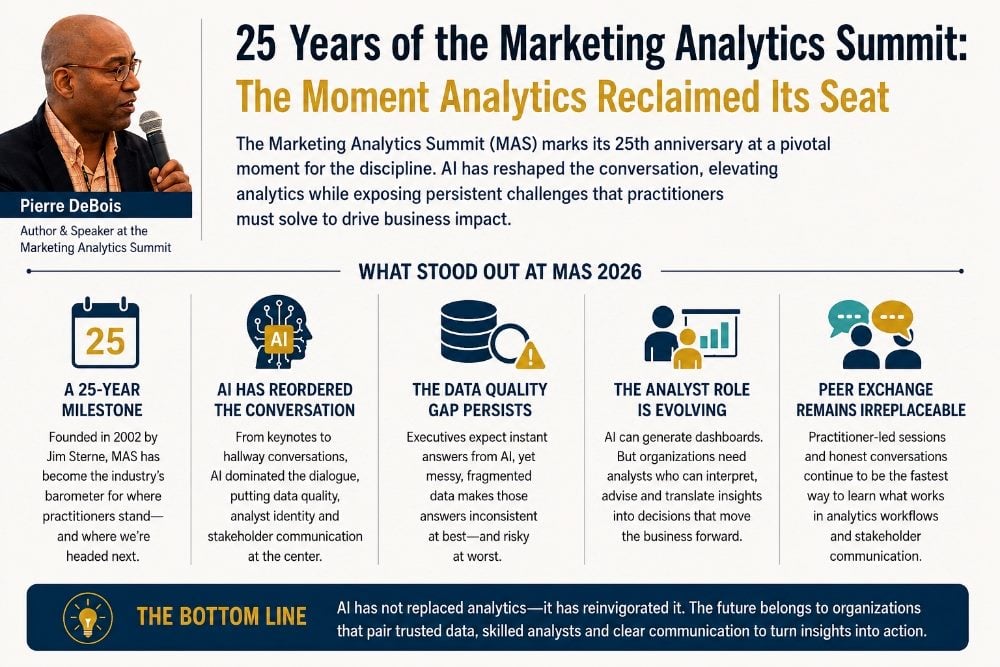
That's one of the main themes that emerged from the Marketing Analytics Summit's 25th year anniversary conference earlier this year in Santa Barbara, Calif. this year. That challenge presented itself during a workshop I hosted on analytics fundamentals.
Here's what else was on the mind of marketing analysts during my trip to the Golden State:
Attendees appreciated the slide showing progress from marketing analytics solutions like Google Analytics to data models produced by R and Python. But the attendees were not struggling with tool selection or technical skill gaps as much as I had assumed when preparing for the workshop. Each person indicated that their struggles lie with the organizational dynamics of reporting.
Their concerns reflect industry discussions on how analytics teams are evaluated. For years, the dominant metric for an analyst's contribution was output: dashboards produced, reports delivered, data requests answered. AI is absorbing much of that output work.
The practitioners who attended the Summit's sessions on stakeholder communication were responding to a version of the same question: if AI can produce the dashboard, what does the analyst provide?
Editor's note: As analytics leaders move from reporting metrics to influencing business decisions, the most valuable capabilities extend beyond dashboard creation. These skills help teams translate customer data into action, validate AI-generated insights and build credibility with stakeholders.
| Capability | What It Looks Like | Why It Matters |
|---|---|---|
| Framing Insights for Decision-Making | Present findings as business decisions to be made rather than metrics to be reviewed. Connect outcomes to recommended next actions. | Management is more likely to act on insights when analysts clearly articulate what should happen next, not simply what happened. |
| Validating AI-Generated Outputs | Review AI-generated analysis for contextual accuracy and identify where technically correct outputs may still be misleading. | Improvado reports that 78% of companies use AI to augment analytics teams rather than replace them, increasing the importance of human judgment and oversight. |
| Building Stakeholder Fluency | Develop a deeper understanding of management priorities, decision processes and organizational dynamics. | Even strong insights can lose traction if analysts fail to connect their work to the decisions leaders are actively trying to make. |
| Connecting Analytics to Customer Behavior | Explain not only what customer data reveals but also where measurement gaps exist and what behaviors remain unseen. | Conversion metrics capture visible actions, but trusted advisors add value by identifying what the data does not show about customer intent. |
Aleya Harris, founder and CEO of Flourish Marketing and a Summit speaker on the second day, framed the advisor mandate in terms that cut through the usual professional development language.
"Your leadership is not about how well you do your job description," Harris told attendees. "It's about how well you bring people together on a shared story and inspire action." For analytics practitioners, that framing redefines what a deliverable actually is: not a dashboard, but a direction.
The shift from output-focused to advisory-focused analytics is a structural repositioning of the analyst role in the organization's decision-making workflow. Analytics practitioners who are navigating this transition most effectively are the ones who have stopped waiting for the organizational structure to change and started changing their own communication approach first. The conference sessions and workshops collectively illustrated that the change is more than a soft skills reset.
Related Article: Top 10 AI Marketing Analytics Tools
Many moments at the Summit focused on communication basics in the light of emerging AI application and AI-enhanced analytic solutions. Speaker Jennifer Kunz hit on a reporting truth in her presentation: decisions are made on what is visible, not necessarily on what is true. Such decisions carry significant operational weight for a business, particularly now that AI tools surface answers quickly. Speed is vital, but it can create the illusion of analytic accuracy — and when the underlying data is poor, that illusion becomes a decision-making liability.
Kunz's emphasis on data quality as the central challenge led a broader theme running through the conference sessions. AI, she noted, has effectively "reclaimed" analytics by making the connection between data and action more visible to everyone in an organization. For years, analytics operated in a corner of the marketing stack. Now, AI has pulled it into executive conversations where it belongs — but where it is also far more exposed. That exposure is not comfortable when the data infrastructure behind AI-generated insights hasn't matured at the same pace as the tools.
The customer experience dimension of this is direct. Marketers building personalization programs, attribution models or customer journey analytics are discovering that AI surfaces the quality of the data. Campaigns built on fragmented identity data or incomplete behavioral signals produce recommendations that erode in value rather than strengthen customer relationships. Gartner has identified metadata management and data quality as top analytics priorities for 2025, noting that identifying areas where data is missing or incomplete is crucial for advancing AI initiatives.
Related Article: The Predictive Analytics Models Marketing Leaders Should Know
Sterne's keynote presented a useful lens for understanding the evolution of analytics. Sterne founded the event when digital measurement was still being defined. His most recent work addresses how AI is rewriting the relationship between analysts and the organizations they serve. The presentation's throughline across 25 years of the Summit revealed a gap between the knowledge analytics practitioners learn compared to what organizations absorb from their work.
That tension has intensified. Gartner's 2025 survey of 402 CMOs found that marketing leaders expect AI-driven automation to grow from 16% of marketing work in 2026 to 36% by 2028. That trajectory compresses the runway for analytics teams to define their value before AI occupies the spaces they currently hold.
Simultaneously, Alteryx's State of the Data Analyst report found that 87% of analysts say their strategic importance has grown in the last year, while 97% say AI tools accelerate their daily tasks — but 76% still rely on manual spreadsheet work for data preparation. The analyst role is expanding and contracting at the same time, depending on which part of the workflow you examine.
For marketers, this market shift has placed the analytics function under a quiet reorganization. Entry-level reporting work is being automated, while the interpretive, advisory, and communication work — the part that has always been harder to scale — is becoming more valuable. Workshops at the Summit on stakeholder communication reflected exactly this pressure, with attendees asking how to manage reporting relationships with management teams that expect both speed and nuance.
The Marketing Analytics Summit's 25th year landed at an intriguing inflection point. AI has blended analytic concerns, creating both opportunity and pressure. The practitioners who attended have already adapted — experimenting with marketing analytics tools, rethinking reporting formats and asking deeper questions about what their analysis actually influences. The opportunity is to continue learning techniques with increased ease, thanks to guidance on AI assistants.
Management should look for two core approaches to leverage those opportunities, which can be organized around data quality and analyst communication.
The presentations at the Summit consistently pointed to data quality as the influence for whether AI produces relevant insights or confident-sounding noise. Before adding AI capabilities to analytics workflows, marketing teams should assess the completeness and consistency of their behavioral, transactional and identity data. Doing so can also reveal how teams are reaching bottlenecks when sharing insights.
A data quality audit doesn't require a platform investment — it requires honest documentation of where data is sourced, how it's cleaned and where the gaps are. Assessing vendor conversations around data quality readiness can be a bonus benefit as well.
Questions worth asking include: What data quality standards are required for this tool to produce reliable outputs? How does the tool handle missing or incomplete data? What validation mechanisms exist for the recommendations it generates? These questions surface the real implementation risk before a contract is signed.
If the practitioner-to-advisor shift is coming — and the Summit made a strong case that it already is — then analytics teams need communication-focused development, not just technical training. Managers should assess how analysts frame findings, whether reports are oriented toward decisions or toward information, and whether stakeholders can act on what they receive. Peer exchange is where communication approaches evolve faster than formal training programs.
Teams can run a low-risk experiment by shifting one regular management report from a data summary structure to a decision-framing structure, then observing whether conversations place more emphasis on tasks related to KPIs and strategic objectives. An experiment costs nothing and provides direct evidence of what stakeholder communication approach works for the organization.
 Learn how you can join our contributor community.
Pierre DeBois is the founder and CEO of Zimana, an analytics services firm that helps organizations achieve improvements in marketing, website development, and business operations. Zimana has provided analysis services using Google Analytics, R Programming, Python, JavaScript and other technologies where data and metrics abide. Connect with Pierre DeBois: 
