Editorial
Research Report
Building the Case for Modern Public Sector Messaging


What creates trust in environments where people can see how organizations actually operate?
Is trust still shaped primarily through messaging and brand perception? Or through responsiveness and execution?
Before online reviews, employee forums and social media communities, organizations controlled much of the story. Advertising campaigns, curated testimonials and favorable surveys shaped perception because customers had limited visibility into how companies operated.
Today, the customer's need for trust has not changed. Customers have always expected organizations to behave ethically and reliably.
What has evolved is how customers evaluate trust. At its core, trust reflects confidence that systems and organizations will respond reliably under changing conditions.
In environments where reviews and employee feedback are visible, organizations are judged by how they operate. Stakeholders increasingly ask for proof that organizations behave consistently with what they claim.
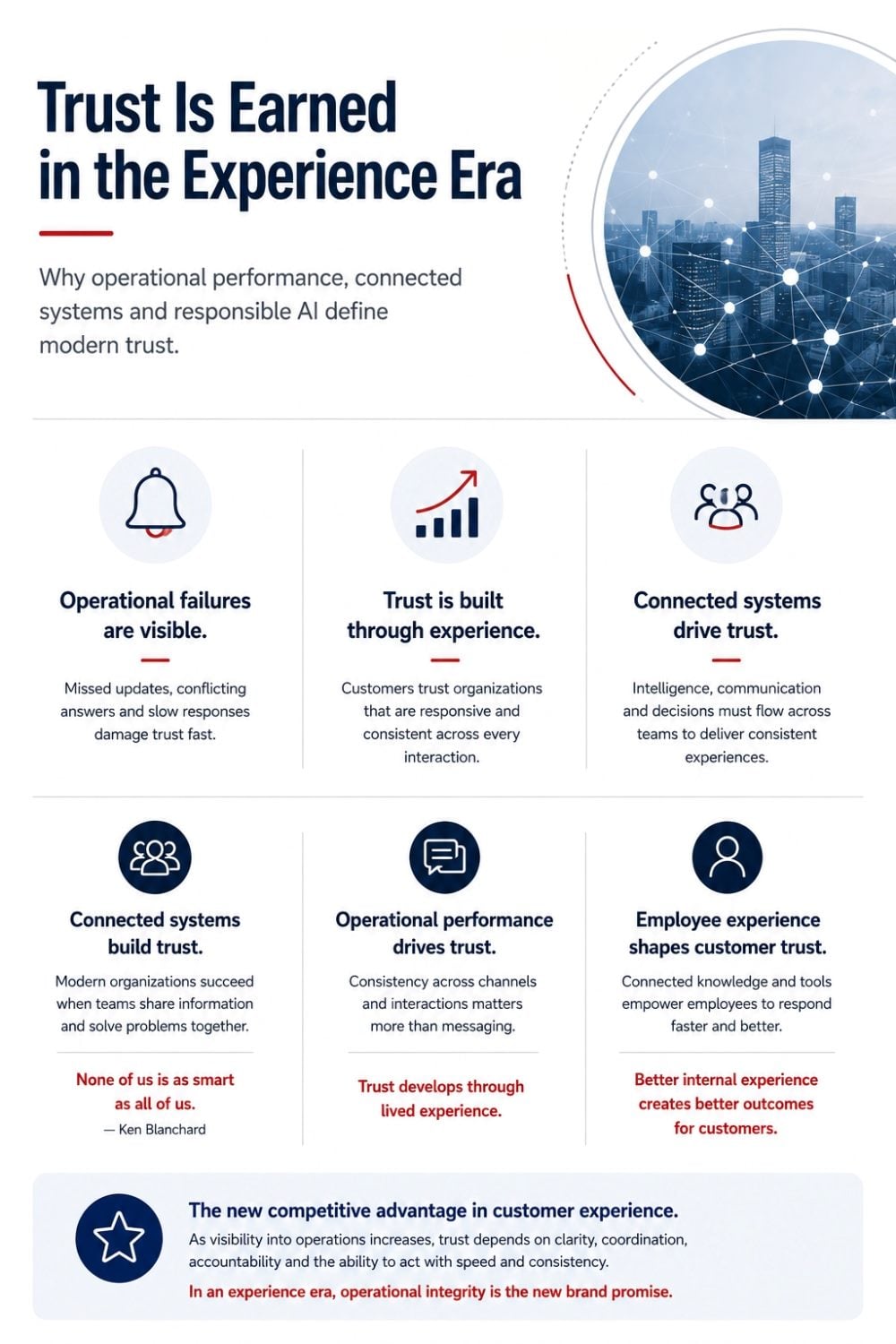
Customers often experience internal problems externally through missed updates, repeated handoffs, conflicting answers and slow responses. Can organizations still separate brand perception from operational reality?
According to the 2024 Edelman Trust Barometer, business remains the most trusted institution globally. As trust expectations continue to shift, organizations face growing expectations around competence, transparency, ethical behavior and operational accountability.
So, what happens when intelligence moves faster than organizations can coordinate action?
Like frontier towns in the Wild West, early organizational systems frequently depended on fragmented intelligence, delayed communication and reactive coordination.
Modern enterprises operate inside highly connected environments where intelligence, communication and decisions move continuously between systems and teams.
Organizations now succeed or fail based on how effectively teams share information and solve problems together. As Ken Blanchard famously observed, "None of us is as smart as all of us."
Related Article: How CMOs Build Brand Trust Across AI Search, Agents and Answer Engines
Today, customers judge organizations based on whether experiences remain consistent across channels and interactions.
A delayed shipment notification, conflicting information or poor internal coordination can damage trust faster than marketing can build it.
Trust now develops through lived experience rather than messaging alone. Customer experience research found that customers increasingly trust organizations that feel responsive and consistent throughout the customer experience. If communication promises continuity, what happens when workflows cannot support it?
Most organizations already possess enormous amounts of intelligence. Yet, employees still wait for approvals, search across disconnected systems and struggle to access the information needed to do their jobs.
A recent analysis on knowledge management found that siloed knowledge slows cross-functional collaboration by up to 30%, leading to redundant work and organizational misalignment. The study also found that organizations using AI-powered insights and connected workflows improved responsiveness and operational efficiency, including a 39% improvement in team speed and efficiency.
Organizations like Toyota have long emphasized frontline communication, collaboration and rapid response to improve quality.
Organizations increasingly compete based on how quickly they can identify problems, align teams and respond.
AI, analytics and predictive analytics capabilities are rapidly expanding across industries. Organizations use connected systems to improve coordination and operational awareness.
Predictive analytics investments continue to accelerate as organizations expand AI-enabled decision-making across customer experience and enterprise workflows. The global predictive analytics market is projected to exceed $116 billion by 2034.
For example, airlines combine predictive maintenance, crew coordination and real-time monitoring to reduce disruptions and improve operational reliability.
Related Article: The Loyalty Equation: Trust + Context + Community
This shift creates a new challenge: how do organizations coordinate decision-making across fast-moving environments?
The predictive trust framework offers one way to visualize how customer signals, communication, accountability and operational behavior shape trust. It synthesizes emerging research on AI governance, customer experience and organizational trust.
| Layer | Key Capabilities | Outcome |
|---|---|---|
| 1. Signal Layer | Customer interactions; Employee feedback; Behavioral signals | Shared visibility across the enterprise |
| 2. Intelligence Layer | AI/ML analytics; Anomaly detection; Risk modeling | Actionable insight into emerging risks and opportunities |
| 3. Coordination Layer | Workflow orchestration; Team synchronization; Cross-functional alignment | The organization responds as a connected system |
| 4. Governance Layer | Accountability; Human oversight; Decision traceability | Responsible execution with transparency and accountability |
| 5. Communication Layer | Customer notifications; Operational updates; Multi-channel coordination | Clear, timely communication builds confidence and reduces friction |
| 6. Trust Layer | Reliability; Responsiveness; Continuity | Coordinated experiences strengthen loyalty, resilience and long-term trust |
As organizations rely on invisible AI-enabled systems, governance and accountability become part of operational trust.
Studies involving logistics experts working alongside AI planning systems found that performance alone was not enough to establish trust over time. Transparency, consistency and human oversight build confidence in AI systems.
Research on digital banking operations similarly found that organizations often struggle to balance responsiveness with compliance. Faster service improved customer experience, but weak coordination and poor operational controls increased reputational and operational risk.
The 2024 Edelman Trust Barometer found that more than two-thirds of respondents who believe innovation is poorly managed also believe society is changing too quickly and not in ways that benefit people like them.
As organizations rely on AI systems across operations and customer service, they also need to explain how those systems are governed.
Leadership teams need to ask different questions, such as:
The next competitive advantage may belong to organizations that can communicate clearly, coordinate quickly and respond consistently across the enterprise.
The next generation of trust may depend less on marketing messages and more on how organizations respond.
Organizations once managed perception primarily through messaging. Today, workflows, communication and operational behavior become part of the brand itself.
Trust develops through visible behavior. In connected environments, customer experience is shaped by responsiveness and consistency across every interaction — and customer lifetime value increasingly reflects how well organizations deliver on that promise.
 Learn how you can join our contributor community.