News Analysis
White Paper
How Enterprise Legal Teams Are Rethinking How Matters Get Managed

There’s a new kind of mismatch showing up in customer experience: not between what customers want and what brands offer, but between what AI could do and what organizations are structurally able to deliver.
Adobe’s 2026 AI and Digital Trends report frames it as an “AI strategy shift” — generative and agentic AI advancing faster than brands can adapt their customer journey operations. In Adobe’s survey research (3,000 executives and CX practitioners, plus 4,000 customers), organizations say the breakthrough experience they’re chasing is highly personalized in real time (80%), seamless across digital and physical touchpoints (72%) and AI-powered while still human and brand-aligned (60%).
That’s the aspiration. The constraint is execution: data fragmentation, uneven alignment between leadership and practitioners and enterprise-wide deployment that’s still rare.
Yes, we've heard that, too: enterprise readiness is where it's at with AI infusions.
Our own research reinforces the same tension: stack maturity is rising, but the operating model still decides whether AI becomes experience improvement or expensive noise. In our State of the CMO report research, 38% of marketing leaders call their digital customer experience technology stack “advanced,” up from 17% in 2023. And 69% say leadership expects quantifiable, measurable results for everything marketing does — up from 59% in 2023.
Meanwhile, our State of the Digital Customer Experience research findings show a sharp confidence jump in platforms and tools, with 51% of organizations saying their digital CX platforms are “working well,” more than doubling from last year.
Adobe’s report lands on a truth CX leaders already feel: the window to make an impression is shrinking. Half of customers say emails, ads and social posts have only 2–5 seconds to capture interest. When the customer’s patience collapses into seconds, the margin for organizational lag disappears. Relevance has to happen now, and it has to be right.
Adobe’s research warns that customers disengage when promotions feel irrelevant or mistimed — and they also disengage when brands simply send too much. The sweet spot is brutal: a meaningful share of customers judge promotional content in under two seconds.
That’s why “personalization” can’t be treated like a marketing feature anymore. It becomes a systems problem: identity, timing, suppression, channel coordination and real-time decisioning. If any one of those breaks, the customer doesn’t experience “AI-powered.” They experience noise.
Related Article: Mastering Personalized Customer Experience for Growth
Adobe reports measurable improvements across key CX performance metrics over the last three years: personalization (70% say it improved), lead generation (64%) and customer retention (59%). Yet only 36% of organizations consider themselves ahead of the curve in digital CX maturity, and 57% say they’re on par with or behind peers.
Translation: generative AI helps, but it doesn’t automatically turn into durable maturity. Adobe finds experimentation is widespread — roughly one-quarter to one-third running limited pilots across workflows — yet organization-wide embedding remains uncommon. That gap is where most AI programs die: pilots live in pockets, while the enterprise never gets the repeatable workflow, governance, and measurement it needs to scale.
Adobe also highlights where brands say they’re investing next: more personalized experiences (56%), improving customer satisfaction/customer loyalty/customer engagement (46%), and automating repetitive tasks (45%). Those priorities make sense — but they depend on foundations that many organizations still haven’t built.
"Industry-wide, most CX leaders still struggle to operationalize AI at scale," CMSWire Contributor of the Year Brian Riback reported in October 2025. "Nearly every enterprise has piloted automation, yet fewer than one in five has successfully embedded AI into daily workflows."
Related Article: Your 'Big Bang' AI Strategy for Customer Experience Is a Momentum Killer
Agentic AI is where Adobe’s report gets spicy: organizations are betting on autonomous systems that can take action across workflows — automate tasks, surface insights, initiate transactions and resolve service issues with limited human intervention. A third of organizations even say they’re prioritizing emerging technologies like agentic AI over more widely adopted ones like generative AI.
But adoption is still early. Adobe reports that across workflows, most organizations have no active use of agentic AI and fewer than a quarter are running limited pilots. Organization-wide adoption is thin: 16% embedded for customer support and 13% for brand discovery and search.
Customers show curiosity — but with hard boundaries. Adobe finds 43% would be willing to interact with a brand’s AI concierge or agent if offered. But many customers are not open to creating personal agents, and organizations consistently overestimate customer comfort with agent-to-agent interactions, sharing personal information, or letting agents make purchasing decisions.
Trust is the tripwire. Adobe reports that unexpected AI involvement can cause disengagement — including customers pulling back when they discover content is AI-generated or when they learn they’re interacting with AI when they expected a person. The most important customer trust factor customers cite is the ability to switch to a human at any time.
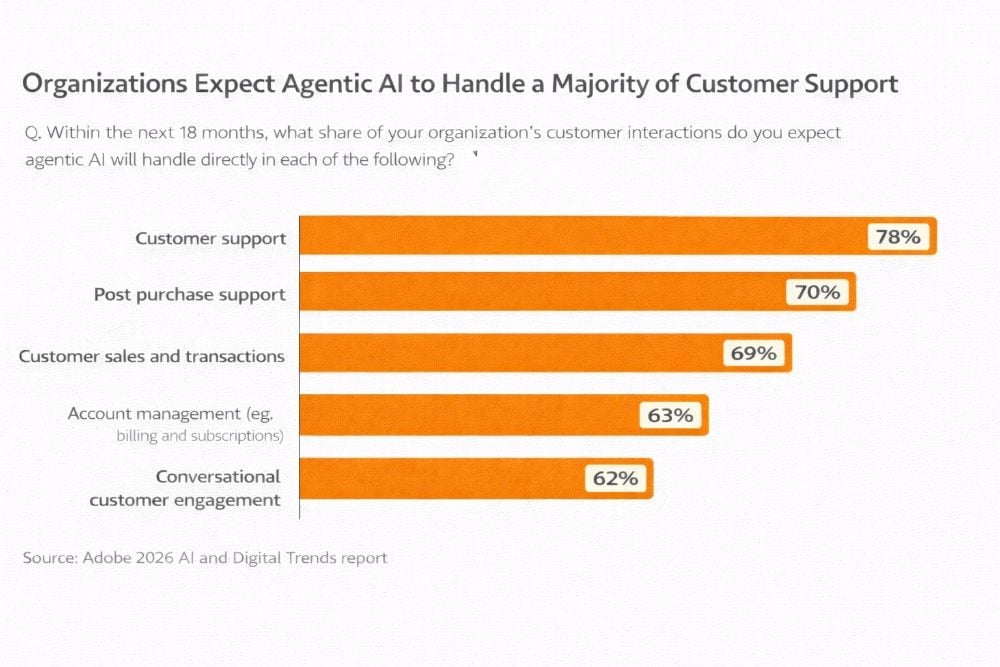
Editor’s note: These statistics from Adobe’s 2026 AI and Digital Trends report highlight where urgency is highest — and what CX leaders should do next.
| Data Point | What It Signals | Action to Take Now |
|---|---|---|
| 50% of customers say emails, ads and social posts have only 2–5 seconds to capture their interest. | Relevance windows are collapsing. Attention is no longer earned over time — it’s decided instantly. | Audit your top 10 outbound journeys. Reduce frequency, tighten targeting and test creative that prioritizes immediate personal relevance over brand messaging. |
| 70% of organizations report improved personalization from generative AI — yet only 36% consider themselves ahead in digital CX maturity. | GenAI delivers tactical wins, but most brands haven’t translated them into durable competitive advantage. | Move from pilots to playbooks. Standardize 3–5 high-impact genAI workflows and tie them to measurable CX and revenue outcomes. |
| Only 31% of organizations have implemented a measurement framework for agentic AI. | Ambition is outpacing accountability. Many brands are scaling without a clear ROI model. | Define success metrics before scaling agentic use cases — including CX, operational and trust indicators — and instrument workflows end to end. |
| 43% of customers would interact with a brand’s AI concierge — but organizations consistently overestimate customer comfort with autonomous AI decisions. | Curiosity exists, but trust boundaries are real. Overreach risks disengagement. | Design AI with disclosure and “human anytime” escalation built into the flow. Treat trust as a feature, not a compliance checkbox. |
| Nearly one-third of organizations report executive and practitioner misalignment on AI strategy; 61% cite executive misunderstanding of AI as the top driver. | Internal friction — not technology — is often the primary bottleneck to scaling AI. | Establish cross-functional AI governance: shared objectives, defined decision rights (RACI), and a unified measurement framework that both executives and practitioners agree on. |
Adobe’s report is blunt: organizations are better prepared for generative AI than agentic AI. Many lack measurement frameworks. Only 44% have implemented a measurement framework for generative AI, and 31% for agentic AI. Nearly half have neither framework in place or aren’t sure one exists.
On infrastructure, Adobe reports most organizations have the technology to support generative AI (including cloud), and many have shared customer data platforms. But agentic AI readiness is lower, and data quality/accessibility remains a major constraint. Less than half say their data quality and accessibility is adequate for AI in general, and fewer say they have a shared customer data platform capable of supporting agentic AI.
Our own research points to the same dividing line: the teams who say their platforms are working well are far more likely to have AI deployed across their digital customer experience toolset than teams who say tools still need work. In other words, AI deployment isn’t a bolt-on. It follows the teams that have already made their environment more interoperable, measurable, and governable.
Adobe also calls out a strategic blind spot: even as organizations admit data unification limits AI progress, far fewer list data quality, unification, and governance as top AI investment priorities. That mismatch is how “AI transformation” becomes a year of pilots and a shelf of decks.
Adobe calls out a persistent split between executives and day-to-day practitioners. Nearly one-third say they’re misaligned on AI strategy, and 47% say alignment is only partial. The top driver: executive misunderstanding of AI (61%).
That misalignment shows up in what each group prioritizes. Executives emphasize revenue growth and customer satisfaction, while practitioners more often focus on operational realities like content creation and activation. Both matter — but when teams don’t share definitions, decision rights, and success metrics, AI programs fragment into disconnected wins.
Adobe also notes that organizations often struggle to demonstrate measurable returns on AI using CX-related metrics, while leadership frequently prioritizes purely financial outcomes. This tension pushes teams toward “easy” metrics (cost savings, productivity) even when the brand’s real risk is customer trust, relevance and retention.
A practical map of what to fix first — based on Adobe’s findings and what our own research suggests separates “tools are working” teams from everyone else.
| Readiness Area | What’s happening | What to do next |
|---|---|---|
| Customer attention | Customers judge promos in seconds; irrelevance and over-messaging trigger fast disengagement. | Build a relevance SLA: frequency controls, suppression rules, and real-time triggers with clear owners. |
| Unified data foundation | Agentic ambition is colliding with fragmented identity, consent, and inconsistent signal quality. | Prioritize identity resolution, consent, and event-stream quality before scaling agents. |
| Workflow integration | Pilots are common; enterprise embedding is rare. | Turn pilots into repeatable playbooks tied to journey moments, escalation paths, and rollback plans. |
| Measurement | Many lack AI measurement frameworks, especially for agentic AI. | Define 3–5 outcome metrics per use case (CX + operational) and instrument the workflow end-to-end. |
| Cross-functional alignment | Executive/practitioner misalignment slows deployment and starves foundations. | Create decision rights (RACI) for AI-in-journey changes: approve, pause, override, rollback. |
| Trust and escalation | Customers want transparency and “human anytime” options. | Make disclosure obvious, escalation instant, and handoffs designed — not treated like exceptions. |
Adobe’s report is ultimately a warning label: the technology is accelerating, but customers still want relevance, clarity and control — and they punish brands that mistake speed for experience quality.
The upside is real. Generative AI is delivering early wins, and agentic AI will unlock new modes of service, discovery, and workflow automation. But the advantage won’t go to the brands with the most pilots. It will go to the brands that fix the boring parts: unified data, measurable outcomes, clear decision rights, and trust-first experience design.
If you want agentic AI to matter, build the operating model like your business depends on it — because now it does.
For us, the rubber meets the road here (directly from the Adobe Digital Trends report):
Nearly one-third of respondents say executives and day-to-day practitioners at their organisation are misaligned on AI strategy and 47% say alignment is only partial at best. The drivers of alignment include clear communication of AI goals (72%), collaborative planning (69%) and strong leadership support (59%). The top challenge causing misalignment is executive misunderstanding of AI (61%) — outranking other factors like resistance to change or technology adoption (52%), insufficient communication about AI’s role (52%) and unclear measurement of AI’s value and ROI (39%).
The findings align with expert commentary that AI success depends less on having the latest models and more on integration, workflow design and data foundations. As one industry leader noted in recent CMSWire coverage, "AI is not a plug-and-play fix for broken journeys—it amplifies whatever foundation it sits on."
These priorities reflect a broader shift CMSWire has tracked in buyer behavior. Organizations are moving toward fewer, better-integrated platforms and governance structures that support cross-functional coordination—lessons learned from AI projects that stalled in "demo mode" rather than delivering measurable value.
The data suggests alignment on AI strategy is both a technical and cultural challenge. Organizations that prioritize communication and leadership engagement are more likely to see business value from AI investments. The winners, according to CMSWire's recent analysis, aren't those with the flashiest demos—they're the ones who connect strategy to execution and hype to results.
Dom Nicastro is editor-in-chief of CMSWire and an award-winning journalist with a passion for technology, customer experience and marketing. With more than 20 years of experience, he has written for various publications, like the Gloucester Daily Times and Boston Magazine. He has a proven track record of delivering high-quality, informative, and engaging content to his readers. Dom works tirelessly to stay up-to-date with the latest trends in the industry to provide readers with accurate, trustworthy information to help them make informed decisions. Connect with Dom Nicastro: 