Feature
On-Demand Webinar
Do More with Less: Modernizing the Cloud Contact Center

By the end of 2025, the digital experience industry had moved past the most basic question it spent the previous two years debating: whether AI belonged in the digital experience stack. That debate was effectively settled. AI wasn’t experimental or peripheral anymore. It had become a structural expectation — embedded into platforms, roadmaps and boardroom conversations alike.
The more consequential story, however, wasn’t that AI showed up. It was how it showed up, where it delivered tangible value and why real-world adoption consistently lagged the volume of announcements, demos and keynote claims. In 2025, digital experience entered an AI reality phase — one defined less by promise and more by proof.
That reality played out along two parallel tracks. On one side, DXP vendors accelerated aggressively, baking AI agents, orchestration layers and copilots directly into their platforms. On the other, practitioners applied the brakes, weighing AI’s potential against operational realities like security, compliance, cost transparency and ownership.
We're not saying there wasn't adoption. There was. We saw the fancy keynotes on stage. And we read the reports, like McKinsey's that says 64% say AI enables their organization. And digital experience software provider Optimizely touted AI adoption throughout its ecosystem in September.
However, we did a lot of listening this year, too: in the customer conference hallways in Vegas at the Adobe Summit, in NYC at Optimizely's Opticon, at Sitecore Symposium in Orlando; in our virtual circles on CMSWire TV's The Digital Experience. The tension between two forces — AI innovation and AI enterprise adoption — shaped nearly every major digital experience conversation of the year.
What did readers care about the last 12 months? The most-read DX stories in 2025 weren’t chasing the next AI breakthrough. They were interrogating structure: who owns integration, how orchestration really works, where composability helps — and where it quietly breaks down under operational weight.
Now, onto what happened in digital experience in 2025.
I really feel CMSWire author David San Filippo's December article really nailed the issue that lands squarely at the heart of where digital experience leaders found themselves in 2025: AI is everywhere in the stack, expectations are sky-high — and outcomes remain stubbornly uneven. It explains why that gap exists and why closing it has far less to do with smarter models than with the unglamorous work of infrastructure, governance and long-term operating discipline.
Here's what San Filippo uncovered:
The hard work of digital experience — and the real opportunity — lies in building the infrastructure, governance and long-term vision that allow intelligence to deliver meaningful customer outcomes.
David's outstanding piece:
Related Article: Why AI Alone Can't Help Your Digital Experience Platform Evolve
Analysts certainly had their say in 2025. Two major analyst reports in digital experience were released this year. Forrester’s 2025 Digital Experience Platform Wave crystallized a theme that had been building all year: agentic AI moved from marketing language into evaluation criteria.
"Agents are now the center of the DXP," Forrester Principal Analyst Joe Cicman wrote Nov. 19. "Not a feature. Not an add-on. The center. ... The story has moved from isolated tech stacks to agentic orchestration that pursues outcomes."
The Wave made clear that simply adding AI features was no longer enough. Vendors were assessed on how effectively AI operated across the platform — coordinating content, personalization, experimentation, analytics and workflow execution. In other words, orchestration mattered more than automation.
Forrester emphasized that leading DXPs were no longer judged by the breadth of capabilities alone, but by how well AI connected those capabilities into goal-seeking systems. Agentic intelligence emerged as connective tissue — enabling platforms to adapt, learn and optimize across customer journeys rather than execute isolated tasks.
Just as notably, the report discussed execution over promise. Vendors that demonstrated operational maturity, customer adoption and real-world use cases were rewarded. Those leaning heavily on future-roadmap narratives faced sharper scrutiny. AI ambition without proof increasingly read as risk, not vision.
At the same time, Forrester struck a sober note for buyers: agentic DXPs raise the bar for organizational readiness. The technology may be advancing quickly, but success still depends on governance, skills and change management — a theme echoed repeatedly by practitioners throughout the year.
Related Article: Adobe Just Turned AEM Into an AI Co-Developer
Gartner’s 2025 Magic Quadrant for Digital Experience Platforms reinforced a parallel signal: AI accelerated platform gravity.
DXPs faced mounting pressure to simplify complexity as stacks grew more interconnected and expectations rose. Gartner highlighted execution, ecosystem maturity and integration realism as key differentiators — signaling that DX leaders increasingly value platforms that reduce operational friction rather than add architectural novelty.
The Magic Quadrant also reflected consolidation in both vendor positioning and buyer behavior. As AI amplified the cost of integration missteps, organizations gravitated toward platforms that could centralize execution while still supporting extensibility. “Best-of-breed” remained viable — but only when orchestration was deliberate and ownership was clear.
One analyst — Irina Guseva, senior director and analyst for Gartner — sees major change coming to the Digital Experience Platform arena.
DXP as we know it will cease to exist in the next couple of years, or even a few months from now, depending on the digital maturity of the end-user organization. This assertion does not constitute yet another iteration of premature obituaries for the DXP ecosystem. It is rather an inflection point that demands a categorical transformation.
- Irina Guseva, senior director and analyst
Gartner
The once commoditized content management foundation takes the front seat again, she added, noting agentic AI is only as good as your content and data; think of the impact AEO and GEO are having on traditional SEO strategies, Guseva told CMSWire.
"Applying the principles of Intelligent Content Coordination organization-wide is the path to success for today and tomorrow’s AI-driven digital customer experiences," Guseva said. "The DXP market has already seen shifts as it started transitioning to composable and headless architectures a few years ago. That required a mind shift in designing enterprise architectures, reskilling and upskilling to support the integration strategy, and multidisciplinary fusion teams to carry this out successfully."
Organizations, Guseva noted, already lack workers with multidisciplinary expertise in APIs, data engineering, front-end development, content strategy, user experience design, etc. Now, they must also manage autonomous agents that make real-time decisions across multiple systems. Now, the quintessential imperative is AI strategy, according to Guseva.
Guseva warned that the combination of maximum flexibility and maximum autonomy could create a “perfect storm,” leading to high-profile failures.
"This represents not just a technology and/or strategy failure," she added, "but a fundamental misalignment between what vendors are building and what end-user organizations can actually implement and govern safely and effectively at scale."
If analyst reports signaled where the DXP market was heading, CMSWire’s own DXP Market Guide helped explain why buyers were hesitating to move faster — even as AI capabilities became undeniably real.
The reporting surfaced a clear tension running through enterprise digital teams in 2025. On one side sat powerful point solutions, each promising best-in-class AI for a specific function: content generation, experimentation, personalization, analytics, search or workflow automation. On the other side were expanding platforms positioning themselves as unified systems of record and execution. Most organizations found themselves navigating somewhere in between.
AI, rather than simplifying that choice, often raised the cost of getting it wrong. Fragmentation that once felt manageable became expensive when AI models needed consistent data access, shared context and reliable orchestration. Teams discovered that stitching together intelligence across disconnected tools introduced latency, governance risk and unpredictable outcomes — precisely the opposite of what AI adoption was meant to deliver.
The Market Guide also highlighted a growing appetite for restraint. Buyers increasingly asked for fewer SKUs, clearer pricing models and governance structures that could scale without ballooning operational overhead. The enthusiasm for flexibility had not disappeared, but it was being tempered by lived experience. Choice without coordination proved difficult to sustain once AI entered the stack.
As a result, DXPs began to be discussed less as content engines and more as coordination layers — systems responsible for connecting data, intelligence and execution across channels. Platforms that could balance embedded intelligence with extensibility resonated most strongly with buyers trying to modernize without destabilizing their organizations.
Editor’s note: This table summarizes how DXP vendors referenced in the 2025 DXP Market Guide approached AI heading into 2025— distinguishing between platform-embedded intelligence, orchestration ambition and more cautious, pragmatic adoption. It also includes one 2025 update.
| Vendor | Latest Product News | AI Positioning | What It Signals for Digital Experience |
|---|---|---|---|
| Acquia | Acquia Launches AI Agents in SaaS CMS for Content Automation | AI agents embedded into SaaS CMS workflows for content automation | Acquia is pushing AI closer to day-to-day content operations, aiming for practical lift inside governed publishing environments. |
| Adobe | Adobe Announces General Availability of AI Agents for Businesses to Transform Customer Experience Orchestration | Deeply embedded AI agents across creative, content, analytics, and experience workflows | Adobe treats AI as infrastructure, reinforcing platform gravity through scale, native integration, and orchestration. |
| Brightspot | Brightspot CMS Fall 2025 Release Available Now | Pragmatic AI enhancements focused on editorial efficiency and publishing workflows | Brightspot prioritizes usability and governance over agentic ambition, reflecting publisher-centric DX realities. |
| Contentful | Contentful Reveals Next Phase of Growth With Modern Digital Experience Vision, Product Innovation and New Strategic Partnerships | Composable content platform with selective AI tooling | Contentful continues emphasizing developer control and modularity, leaning into ecosystem partnerships rather than “one-brain” narratives. |
| Contentstack | Contentstack Agent OS: AI-Powered CMS for Context-Driven Digital Experiences | AI-enhanced headless CMS moving toward agentic orchestration | Contentstack is using AI to compete higher in the stack — positioning context and orchestration as the differentiator, not just headless delivery. |
| CoreMedia | CoreMedia Content Cloud 25.06 Release | AI applied to content operations, commerce alignment, and experience optimization | CoreMedia frames AI as operational advantage tied to enterprise-scale delivery, especially where content and commerce coordination is hard. |
| Crownpeak | Rezolve AI Acquires Crownpeak for $90M to Expand AI Commerce Platform | AI-driven governance, quality management, and compliance tooling | The acquisition speaks to Crownpeak’s role as a governance and quality backbone as AI-driven commerce and content execution converge. |
| HCL Software | HCLSoftware Unveils AI-First Unica Platform for Marketers | AI infused into enterprise marketing and experience tooling with services alignment | HCL leans into enterprise practicality: governed AI adoption, integrated suites, and “make it work in the org you have,” not the one vendors imagine. |
| Ibexa | Ibexa DXP v5.0.4: Smarter Content Experiences With AI-Driven Search and Enhanced Collaboration | Measured AI adoption focused on search relevance and team workflow support | Ibexa spotlights AI where it’s easiest to operationalize: search, discovery and collaboration — less “agents everywhere,” more incremental value. |
| Liferay | Agile Collaboration, Digital Experiences, Liferay DXP, Camunda and Agentic Orchestration | AI positioned around workflow and orchestration in enterprise experience environments | Liferay’s AI story centers on governed workflows and orchestration — a fit for portals/intranets and role-based experiences where structure matters. |
| Magnolia | Magnolia 6.4 Is Here | Composable DXP with pragmatic AI augmentation | Magnolia balances flexibility with restraint, aligning to teams that want composability but are wary of orchestration chaos. |
| Optimizely | Optimizely Enhances Opal With AI Agent Orchestration Tools | Agent orchestration via Opal, positioned as a standalone intelligence layer | Optimizely bets orchestration becomes the control point — the layer that coordinates work across systems, not just inside the DXP. |
| Progress (Sitefinity) | Progress Software Redefines Digital Experiences With First Generative [AI] Capabilities | Incremental AI enhancements tied to CMS and digital marketing workflows | Progress emphasizes stability and evolution — AI as a practical upgrade path for existing customers, not a disruptive reinvention. |
| Sitecore | Sitecore Unveils Sitecore AI and a Vision for Smarter Digital Experience | Platform-wide embedded AI combined with open integration philosophy | Sitecore frames AI as connective tissue across the platform — while insisting customers should be able to plug in whatever “brain” they choose. |
| Squiz | Squiz Launches Enterprise-Grade Conversational Search to Power Faster, More Intuitive Website Experiences | AI applied to search and conversational discovery | Squiz treats AI as a practical customer-facing win: better findability, better self-service, and more measurable impact than back-office “agent dreams.” |
| Uniform | Uniform Eliminates Months-Long Platform Migrations With Industry-First AI That Works on Any Website | AI-enhanced orchestration for composable DX stacks | Uniform positions AI as a coordination accelerator — reducing friction in composable environments without forcing consolidation. |
| Zesty | Zesty.io Is Becoming Content One | AI-forward SaaS CMS positioning centered on speed and simplification | Zesty leans into accessibility and pace — AI as leverage for smaller teams trying to ship modern experiences without heavyweight stacks. |
If 2025 clarified anything, it was that AI strategy had become inseparable from platform strategy. The year’s most consequential vendor moves, the ones we saw in person on the road across the country, weren’t incremental feature releases — they were structural bets on how intelligence should be embedded, governed and scaled across digital experience ecosystems.
Adobe’s direction in 2025 made one thing unmistakably clear: AI agents are no longer an experiment at the edges of the platform. They are central to how work gets done.
Across Creative, Content and Experience workflows, Adobe in Las Vegas March embedded agents directly into the systems teams already use every day. Rather than positioning AI as a separate productivity layer, Adobe treated it as a system-wide capability — one designed to assist, automate and coordinate work across the full lifecycle of digital experiences.
AI was framed as infrastructure. And by integrating agents deeply into established workflows, Adobe reinforced the idea that enterprise AI adoption succeeds fastest when it feels native, not novel.
The message to the market was subtle but firm: ambition matters, but execution at scale matters more.
Sitecore’s big movement in 2025, in Orlando in November, was less about introducing something entirely new and more about reframing how its platform should be understood.
By elevating Sitecore AI as the organizing principle — including repositioning XM Cloud under that banner — Sitecore sent a strategic signal about where it believes value is heading. AI was no longer a feature category. It was the connective tissue binding content, data and experience together.
Just as important was how Sitecore talked about integration. Rather than framing embedded AI as a path to lock-in, executives emphasized flexibility and openness. As one Sitecore leader, Scott Liewehr, global VP, market strategy and growth, put it in an interview with CMSWire in November in Orlando: the goal was not to dictate a single “brain,” but to allow customers to bring the intelligence they trust into the platform and build on top of it.

No vendor leaned harder into the conversation around agentic AI than Optimizely.
With Opal, Optimizely in New York City in September positioned AI not simply as something embedded inside a DXP, but as a potential orchestration layer that could sit above — or even across — platforms. AI agents are the interface, and the system that coordinates them becomes strategically powerful, according to Optimizely.
The timing of that message was impossible to ignore. Announcements were carefully synchronized with competitor events (more on that in a bit), ensuring maximum visibility — and maximum friction. Critics questioned whether Opal represented true differentiation or simply a repackaging of generative services. Supporters countered that orchestration, not raw generation, is where long-term value lives.
Either way, Optimizely forced an uncomfortable but necessary industry conversation: in an AI-first world, does the DXP remain the center of gravity — or does intelligence itself become the platform?
Related Article: The Center of the Digital Experience Stack Is the Customer
These stories captured the moments when AI stopped orbiting the DX stack and moved inside it.
Editor’s note: This table spotlights the year’s biggest reported DXP and DX-stack news moves — leadership changes, AI launches, acquisitions and platform shifts that reshaped how “digital experience” gets built and operated.
| 2025 News Story | What Happened | Why It Mattered for Digital Experience |
|---|---|---|
| Sitecore CEO Change: Dave O’Flanagan Out, Eric Stine In | Sitecore made a leadership change at the top. | DXP vendor strategy in 2025 was inseparable from AI execution — and CEO shifts signaled urgency around product focus, platform direction, and go-to-market clarity. |
| Kontent.ai Launches AI-Powered CMS for Content Automation | Kontent.ai positioned AI as a core CMS capability for content automation. | AI wasn’t just about chatbots anymore — it was being marketed as the operating layer for content production and governance inside modern web stacks. |
| Salesforce Signs Deal to Acquire Qualified | Salesforce moved to acquire Qualified, tying the deal to its Agentforce narrative. | DX was increasingly shaped by adjacent “experience engines” — CRM and marketing platforms pushing agentic positioning that pressure-tested what “DXP” even means. |
| Hightouch Unveils AI-Powered Identity Resolution for CDPs | Hightouch aimed AI at identity resolution and data unification. | Personalization, orchestration, and agentic workflows depend on identity and clean signals — AI moved deeper into the data plumbing that DX stacks rely on. |
| Optimizely Upgrades Opal to Deliver Agentic AI for Marketing Teams | Optimizely advanced Opal’s agentic positioning for marketing work. | The DXP race shifted from “who has AI features” to “who can orchestrate work” — with agentic tooling framed as the new competitive battleground. |
| Adobe Goes All In on AI Agents at This Year’s Summit | Adobe leaned harder into AI agents as a strategic pillar. | Adobe’s moves reinforced the platform reality: “AI inside the suite” became table stakes for enterprise DX — and raised expectations for end-to-end workflow automation. |
| Contentsquare to Acquire Loris AI for Conversation Analytics | Contentsquare pursued conversation analytics via acquisition. | Experience analytics expanded beyond clicks and sessions — “why customers say what they say” became part of the digital experience measurement layer. |
| Figma Make Beta Launches to Turn Designs Into Apps and Prototypes | Figma pushed AI-assisted build workflows closer to production. | DX acceleration wasn’t only a DXP story — it was a build story. AI began collapsing the distance between design intent and working experiences. |
| HubSpot Unveils Data Hub, Breeze Agents and the Loop at Inbound 2025 | HubSpot rolled out data and agent announcements tied to marketing execution. | In 2025, “DX” increasingly included downstream marketing ops and lifecycle motions — and midmarket platforms used agents to claim workflow ownership. |
| Sitecore Stream Gets Smarter With AI Copilots and Agentic Workflows | Sitecore advanced Stream with copilots and agentic workflows. | Stream signaled a shift: DXPs weren’t only “where content lives,” but where work gets orchestrated — briefs, planning, optimization and execution. |
| The Martech Supergraphic Has Grown Up: 15,000+ | The martech landscape grew again, underscoring stack sprawl. | The more tools in the stack, the more orchestration matters — and AI’s promise increasingly hinged on integration, governance and workflow coherence. |
| Figma Make Exits Beta for All Users | Figma broadened access to AI prototyping. | AI-driven velocity moved into the mainstream for digital teams — raising expectations for faster iteration, but also raising the stakes for quality and governance. |
| Optimizely Enhances Opal With AI Agent Orchestration Tools | Optimizely leaned into agent orchestration and tooling depth. | Orchestration became a headline capability — framed as the layer that coordinates systems, tasks, and “last-mile” execution across marketing and DX work. |
| Optimizely Launches GEO-Ready CMS for AI Search Visibility | Optimizely tied CMS readiness to AI search discovery. | “Search visibility” expanded beyond SEO — DX teams began treating generative discovery as a content performance channel with architectural implications. |
| Rezolve AI Acquires Crownpeak for $90M to Expand AI Commerce Platform | Rezolve AI moved to acquire Crownpeak, linking DX and commerce ambitions. | Acquisitions signaled convergence: content, commerce, and AI experience layers increasingly bundled together — and competitive borders blurred. |
| WP Engine Launches AI Toolkit for WordPress Websites | WP Engine brought AI tooling directly to WordPress sites. | AI didn’t stay in “enterprise DXP land.” It moved into the long tail of the web — raising the baseline of what “modern web operations” looks like. |
| Cvent Acquires Goldcast to Automate Event-to-Video Workflows | Cvent pursued automation across event content pipelines. | DX increasingly included content supply chain automation — turning live moments into multi-channel assets faster, with AI as an accelerant. |
| Fullstory Acquires Usetiful to Connect Analytics and Action | Fullstory acquired Usetiful to push analytics into in-product guidance and action. | 2025 reinforced a theme: insight without activation is wasted. Experience analytics vendors moved closer to orchestration and real-time intervention. |
| SearchStax Adds Generative AI to Enhance Website Search | SearchStax embedded GenAI into site search experiences. | Site search became a proving ground for AI value — where relevance, intent, and trust collide in the most visible way possible: customer queries. |
| Algolia Launches Agent Studio for Search-Powered Enterprise AI Agents | Algolia brought “agent studio” concepts into the search layer. | The agent narrative spread beyond DXPs — search and discovery vendors argued they could be the action layer, not just the retrieval layer. |
| Constant Contact Expands Global Reach With Sitecore Send Acquisition | Constant Contact acquired Sitecore Send, reshaping the Sitecore-adjacent ecosystem. | DX stacks don’t end at the web experience. Messaging channels and activation layers stayed central — and ownership shifts changed integration dynamics. |
| Crownpeak Launches FirstSpirit Quality Management Tools for Drupal and WordPress | Crownpeak targeted quality management across popular CMS ecosystems. | As AI increased velocity, quality control became more strategic — governance and validation moved closer to the content workflow itself. |
| Webflow Launches Real-Time Collaboration for Web Teams | Webflow advanced collaboration features for web production. | DX teams kept modernizing how experiences get built — and AI pressure made real-time collaboration and workflow speed feel like competitive necessities. |
| Contentstack Adds Orchestration and Real-Time Analytics to Headless CMS | Contentstack emphasized orchestration and real-time analytics in headless CMS. | Headless players moved up the stack — using orchestration and analytics to compete for “platform” status in an AI-driven experience world. |
Read as a single storyline, the year’s news didn’t just add up to “more AI.” It mapped how quickly digital experience platform (DXP) and other vendors tried to reposition themselves around AI-powered execution — and how often adjacent categories (data platforms, analytics, search, design-to-build tools and marketing suites) pushed into DXP territory.
Editor’s note: Unlike breaking news, these stories focused on how digital experience actually works — the architecture, governance, integration and operational realities shaping success or failure.
| DX Feature Story | Core Question Explored | Why It Resonated in 2025 |
|---|---|---|
| What You Need to Know About Digital Experience Platforms | What actually defines a modern DXP? | As vendors blurred lines between CMS, CDP, analytics and orchestration, DX leaders sought clarity on what truly belongs at the center of the stack. |
| How The Vitamin Shoppe’s Tech Team Built a Composable CX | How does composable architecture work in practice? | The story grounded MACH-style ambition in real operational tradeoffs, showing how composability succeeds only with strong ownership and integration discipline. |
| The Digital Experience Show’s Biggest Moments of 2025 | What themes dominated executive DX conversations? | Executive interviews revealed a pivot away from hype toward execution, governance and measurable impact across digital experience initiatives. |
| Scott Brinker: The Four AI Agents Every Marketing Team Needs to Know | How should teams think about agent roles? | The piece helped move agentic AI from abstraction to functional roles, aligning with growing demand for orchestration over isolated automation. |
| What Sits at the Center of the Digital Experience Stack? | Is there still a “center” in modern DX? | As stacks expanded, the article captured growing debate over whether DXPs, CDPs, AI layers or orchestration engines anchor experience delivery. |
| The Chatbot Era Is Over — and Agentic AI Has Arrived | What replaces scripted conversational AI? | DX teams increasingly recognized that static chatbots failed at scale, while agentic systems promised adaptive, goal-driven interaction. |
| Your New Digital Experience Design Gurus: The U.S. Government | What can public-sector DX teach enterprises? | Government UX mandates reframed accessibility, trust and usability as non-negotiable design principles — not optional enhancements. |
| AI Personalization and the Next Era of Content Strategy: IKEA’s Journey | How does AI reshape content strategy at scale? | The IKEA case study showed how personalization depends as much on governance and structure as on AI capability. |
| Composability Isn’t a Cure-All — It’s a Choice | When does composability help or hurt? | The article reflected growing skepticism toward “composable by default,” emphasizing tradeoffs amplified by AI-driven complexity. |
| Are DXPs the MVPs of Digital Customer Experience? | Do DXPs still deserve center-stage? | As AI expanded across the stack, the piece questioned whether DXPs remain the primary experience engine — or one layer among many. |
Now back to competition in this space. A revealing digital experience competition storyline in 2025 played out early: Optimizely dethroning Adobe as the solo leader in the Gartner Magic Quadrant for DXPs.
That was significant because it ended Adobe's five-year streak as the undisputed leader. Optimizely earned that top spot, rising above Adobe in the quadrant's two categories — ability to execute and completeness of vision. Gartner uses seven assessment and evaluation criteria under "ability to execute" and eight under "completeness of vision" during the evaluation process.
Optimizely rode that victory hard.
Optimizely then in November debuted a Sitecore AI integration announcement — during the week of Sitecore Symposium. Was it simply competitive theater? Or did it expose a deeper fault line in how AI power is expected to operate inside modern DX stacks? Who controls intelligence in the digital experience stack? You? The vendor? A third party?
Some told us in Orlando at Sitecore's event that Optimizely's announcement was gimmicky, something Optimizely and CEO Alex Atzberger publicly denied. He emphasized that Opal was intentionally designed as a standalone agent orchestration layer that could operate across marketing environments — including competitor platforms — rather than being confined inside a single DXP.
"I say good marketing is about timing and message," Atzberger said when asked in November by CMSWire to answer the charge he tried to spoil the Sitecore Symposium party. "We announced Opal as a standalone agent orchestration platform at Opticon in early September. We pursued a different and deliberate strategy than others to not just have AI inside of our solutions but to be a platform. We believe true value from agents comes from orchestrating them across martech solutions. Thus, we have built 100s of tools to connect Opal to other solutions."
Optimizely's commitment to composability is proven through integrating with a competitor, Atzberger said.
"Our job is to let companies know that Opal is a standalone orchestration platform," he added. "Sitecore is well-known in our ecosystem and hence the timing of their Symposium was great. As for product value, we already received multiple leads from Sitecore customers since we made the announcement, so they clearly see value, and the voice of the customer is what matters most."
Atzberger told CMSWire that Sitecore customers can use Opal in two distinct ways. First, they can create agents that orchestrate workflows across marketing functions, such as checking web pages for accessibility, drafting press releases or ideating experiments — without being tied to Sitecore-specific capabilities. Second, they can build agents that take action directly inside Sitecore environments, including analyzing pages and implementing changes in the CMS.
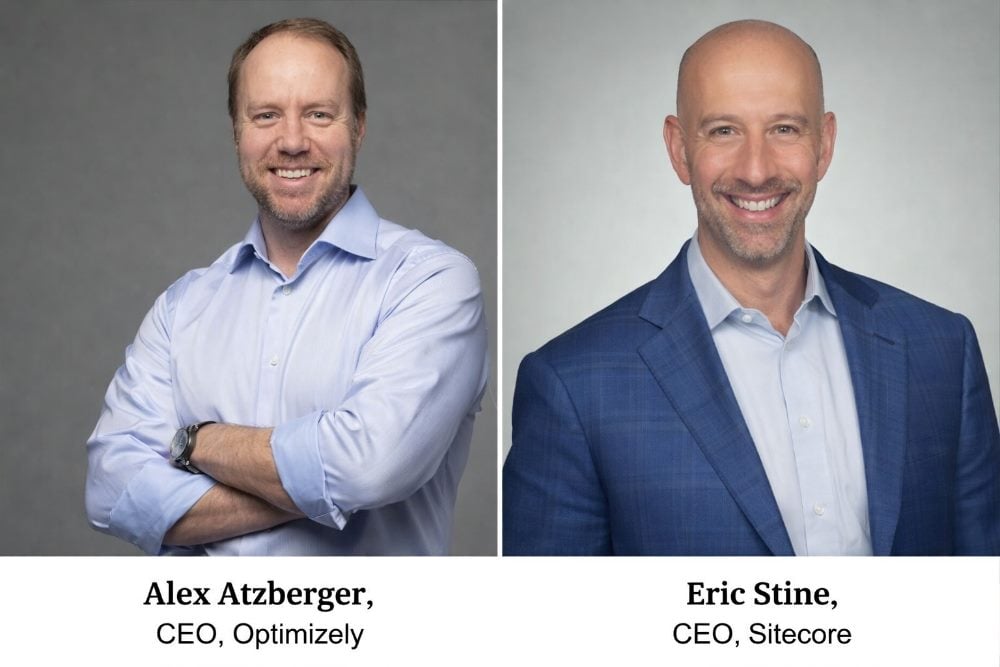
Sitecore’s response to Optimizely's moves during its Symposium, articulated by CEO Eric Stine, struck a philosophical tone. Stine framed Sitecore’s Symposium announcements as a continuation of a long-standing belief about how AI should function inside an enterprise platform.
For Stine, the key distinction wasn’t whether AI is embedded or open — it’s how those two ideas coexist. He emphasized that Sitecore’s strategy is built around deeply embedding AI across the platform while remaining highly flexible in how it integrates with third-party intelligence, whether that’s copilots, agent frameworks or other external AI systems.
“We have been historically consistent in our ability to be almost unlimited in our flexibility for integration,” Stine told CMSWire in Orlando in November.
Stine also downplayed the competitive noise altogether, stressing that Sitecore’s focus remains squarely on how it shows up for customers. In his view, external commentary matters far less than execution, consistency and customer outcomes — a sentiment that resonated with practitioners wary of AI theatrics.
"I truly don't care what anybody says about Sitecore," Stine said, citing how Michelle Obama uses style as a strategy. "The only thing we have control over is how we show up every day, and we will show up as the best version of ourselves because we're focused on our customers."
That philosophy was reinforced by Sitecore's Liewehr, who framed the issue in structural terms rather than competitive ones. As AI strategies mature, Liewehr argued, most organizations will converge on a primary intelligence layer — effectively the “brain” of their organization.
From his perspective, the role of a DXP is not to dictate that choice, but to enable it. “Every organization is going to pick one,” Liewehr said of an AI ecosystem. “And it’s going to become the brain of their organization.” The platform’s responsibility, he added, is to allow customers to bring that intelligence into the DXP and build experiences on top of it. "And so therefore, how is it that us a DXP can go pick and choose the brain that any company is going to use? You want to be able to allow them to use the brain that they bring to the table, and be able to then build on top of that through our through our platform."
Does AI sit above the DXP as an orchestration layer that can swap platforms underneath it? Or does it live inside the DXP, where content, data and governance are already tightly connected?
Once the initial noise around Optimizely’s Sitecore integration announcement settled, a quieter conversation took hold among analysts, consultants and practitioners watching the DXP market closely.
Across these perspectives shared with CMSWire, a shared theme emerged: the announcement mattered less for what it technically enabled today and more for what it signaled about control, context and power in an AI-driven DXP landscape.
Tony Byrne, founder and CEO of Real Story Group, viewed the move with a healthy dose of skepticism, framing it less as a transformational integration and more as strategic provocation.
"It seems like they’re just messing with Sitecore," Byrne said in November. "Opal is a fancy name for a GenAI service that I imagine could be made to run against any number of repositories. Other vendors could likely do same."
The implication of Byrne’s take is subtle but important: if agentic AI layers become interchangeable services rather than deeply contextual engines, the long-term advantage may still reside with platforms that own experience context — not just orchestration.
David San Filippo, senior vice president of digital experience for Altudo (and, yes, the author of the aforementioned piece on DX infrastructure), has hands-on experience working across both ecosystems, and his take highlighted the operational realities behind the headlines. He acknowledged Optimizely’s aggressive posture toward Sitecore, noting that this competitive dynamic has been visible for years — but he also emphasized that marketing theater doesn’t automatically translate into customer migration.
San Filippo pointed out that while Optimizely has sharpened its narrative around agent orchestration, questions remain around usage limits, pricing clarity and real-world deployment at scale. Those uncertainties matter for partners and customers alike, particularly when long-standing relationships are involved.
On the Sitecore side, he observed that adoption of Sitecore Stream and AI-driven capabilities is happening most visibly in content enrichment and planning workflows, rather than wholesale workflow replacement. For many organizations, changing entrenched content operations requires parity — not novelty.
Crucially, San Filippo emphasized that enterprise AI strategies rarely center on the DXP itself. Instead, organizations increasingly anchor AI decisions around hyperscaler platforms such as Azure, Google Cloud or AWS, then evaluate how DXPs integrate into that broader intelligence strategy. In that context, the question isn’t which platform “wins,” but which fits cleanly into an organization’s AI operating model.
Jill Grozalsky Roberson, senior vice president of marketing and partnerships at Velir, framed the moment as part of a broader architectural shift rather than a one-off competitive clash. She noted that Sitecore’s recent moves signal a return toward greater consolidation — not as a rejection of composability, but as a response to customer demand for cohesion as AI accelerates complexity.
At the same time, she viewed Optimizely’s decision to position Opal as a standalone product as an expansion play, opening access to organizations regardless of their underlying CMS or DXP. In her view, this wasn’t strictly about Sitecore customers — it was about broadening Optimizely’s relevance across the entire DXP landscape.
Roberson also expressed how different this moment feels compared to previous composable cycles. While Sitecore’s earlier acquisitions helped spark composability conversations, the current AI-driven strategies introduce a fundamentally new dynamic: intelligence itself is becoming a competitive surface.
The ultimate proof there? XM Cloud is now SitecoreAI:
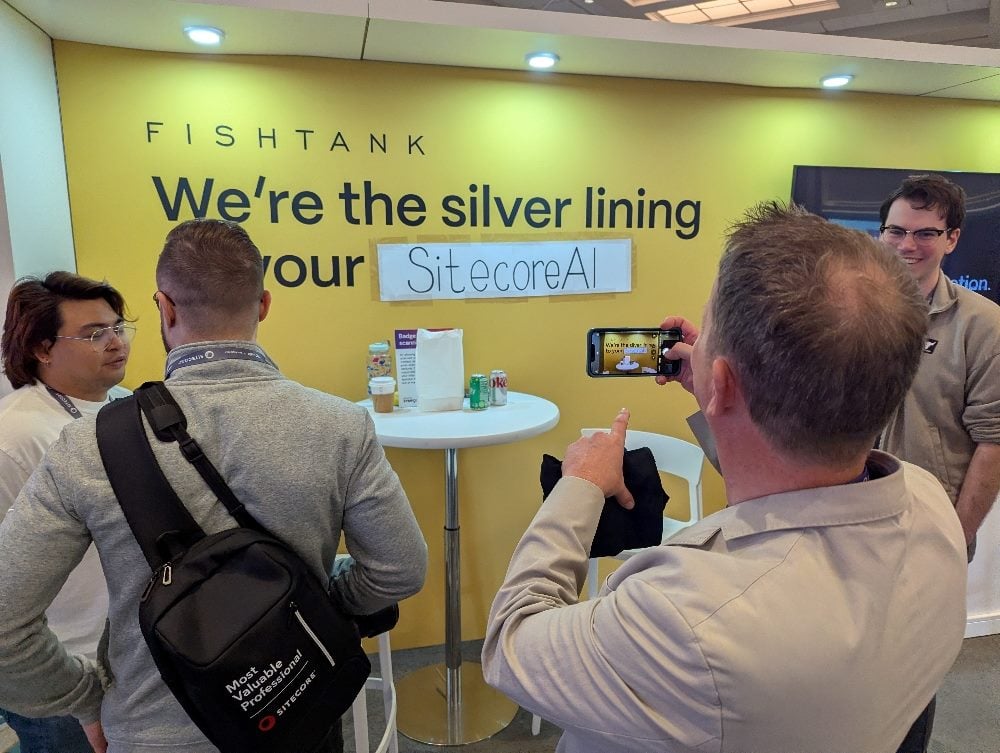
Johnny Mullaney, co-founder of First Three Things, interpreted the Optimizely announcement as both playful and strategic. Yes, the timing was deliberate — announcing an integration during Sitecore Symposium was a clear jab. But beneath the surface, Mullaney saw a calculated attempt to position Optimizely Opal as the primary AI interface for marketers.
He emphasized that the real question isn’t whether Opal can connect to Sitecore, but how much contextual depth it can access when operating outside Optimizely’s native ecosystem. Inside Optimizely, Opal benefits from rich signals across CMS, experimentation, analytics and CDP data. Outside that ecosystem, the value of orchestration depends on how deeply context travels with it.
Mullaney also highlighted a longer-term implication: if marketers begin interacting with AI primarily through Opal — regardless of the underlying CMS or DXP — Optimizely gains influence over the experience layer itself. With AI, he argued, the interface becomes the product. Owning that interface could ultimately shape which platforms sit beneath it.
Related Article: SitecoreAI and the Shift From Search to Discovery in Digital Experience
2025 DX saw other friction. One of the most revealing debates CMSWire covered in the digital experience space in 2025 wasn’t about AI agents or personalization models — it was about architecture itself. Specifically: whether MACH (Microservices, API-First, Cloud-Native, Headless) still represents the best path forward for modern digital stacks, or whether its promise has been overtaken by complexity, cost and execution fatigue.
The debate ignited publicly when VTEX co-CEO Mariano Gomide de Faria challenged MACH as a movement, arguing that pure best-of-breed composability has too often resulted in integration chaos, operational overload and unclear ROI. His critique struck a nerve, not because it was universally agreed with, but because it surfaced frustrations many DX leaders quietly share.
In response, MACH Alliance leaders and practitioners pushed back — not by defending MACH as dogma, but by reframing it as a discipline. The consensus that emerged wasn’t “MACH vs. monolith,” but something more pragmatic: composability is not binary. It’s a spectrum, and success depends less on architectural purity and more on governance, orchestration and organizational readiness.
That tension — between flexibility and friction, freedom and accountability — became a defining theme of digital experience in 2025. MACH principles are now largely table stakes. The harder work lies in deciding how far to take them, where they add value and when simplicity matters more than modularity.
To capture the essence of that conversation beyond social posts and conference stages, CMSWire brought the MACH Alliance directly into the discussion on The Digital Experience Show. In a video interview, MACH Alliance advisor and longtime industry analyst Mark Demeny cut through the noise with a grounded reminder: composability isn’t a cure-all — it’s a choice.
Demeny emphasized that MACH works best when organizations start small, modernize incrementally and resist the temptation to over-engineer for flexibility they don’t actually need. In other words, the real risk in 2025 wasn’t choosing the wrong architecture — it was misunderstanding the tradeoffs that come with it:
All of that strategy, competition and positioning ultimately lives or dies in the hands of the practitioners responsible for making digital experience work.
Vendor and industry alliance debates aside, the bottom line here? Digital experience execution comes down to the practitioners. And we spoke to more than a few in 2025.
Editor’s note: I spent 2025 on the road, and in my home office, from vendor conferences to in-depth CMSWire TV interviews, capturing unfiltered perspectives from digital experience leaders navigating AI, composability, governance and scale in real-world environments. Here's a snapshot of what they told me:
| Practitioner | Title | Brand / Organization | DX Reality Check | Biggest Challenge | What’s Actually Working | Defining Insight |
|---|---|---|---|---|---|---|
| Rachna Gupta | Senior Product Owner | Kimberly-Clark | AI adoption only works when it scales across hundreds of properties without eroding trust. | Maintaining consumer-first experiences across a massive, distributed digital footprint. | Pairing internal AI initiatives with analytics to better understand intent and behavior. | Keeping consumers — not tools — at the center of AI decision-making. |
| Sandra Hodgson | Chief Communications Officer | American Board of Obstetrics and Gynecology | DX modernization must respect credibility, accuracy and regulatory responsibility. | Balancing AI efficiency with governance, compliance and brand trust. | Using AI to assist internal workflows while preserving human oversight. | AI adds value only when human judgment remains in control. |
| Anand Kushwaha | Senior Engineer | AAA Club Alliance | AI is powerful — but only when developers control context and expectations. | Avoiding misleading or low-quality outputs caused by poor prompting and unclear inputs. | Selective experimentation with AI tools alongside traditional engineering discipline. | Context determines whether AI accelerates progress or creates noise. |
| Fouzia Sultana Malim | Director, CX Offerings Lead | Virtusa | AI value comes from execution at scale, not novelty or buzzwords. | Delivering speed and innovation without sacrificing governance or trust. | Embedding AI into workflows to reduce time to market and operational friction. | Business impact matters more than AI theatrics. |
| Yann Boisclair-Roy | Solutions Architect | Altitude-Sports | Composable delivers flexibility, but only when teams truly own the integration layer. | Managing connector complexity and avoiding long-term dependency on vendor-built integrations. | Rebuilding and owning integrations internally to improve control, debugging and scalability. | MACH works when organizations understand the “Lego bricks,” not just how fast they snap together. |
| Danson Huang | Global VP of Digital Commerce | Diageo | Composable architecture must balance brand agility with enterprise governance. | Scaling flexibility across hundreds of brands without fragmenting systems or budgets. | A hybrid model combining composable front ends with centralized enterprise platforms. | Composable success at scale depends on reuse, orchestration and disciplined governance. |
| Sophia Zlatin | Manager of Marketing Technology | James Hardie | Composable martech must evolve alongside responsible, privacy-aware AI adoption. | Reducing tech debt while evaluating AI in environments with real data and privacy risk. | Modular martech design paired with clear guardrails and strong IT–marketing alignment. | Composable isn’t about building more — it’s about building only what you can sustain. |
| Uman Chan | Senior Director of Digital Technology | The Vitamin Shoppe | Composable architecture is a long-term strategy, not a one-time replatforming. | Managing architectural complexity while delivering continuous business value. | A phased, value-driven composable rollout with strong vendor isolation. | Composable isn’t about speed alone — it’s about resilience and choice. |
| Van Vuong | Director of Digital Platforms | Baylor Scott & White Health | Customer-facing AI delivers the most immediate value in highly regulated environments. | Balancing experimentation with medical, legal and security guardrails. | AI-driven chat experiences that handle intent recognition, scheduling and billing without forcing users into legacy workflows. | AI succeeds in healthcare when it reduces friction — not when it chases novelty. |
| Jeff Harling | Head of Global Digital Customer Experience | Zoom | Digital CX succeeds when customers can choose their path — and agents are empowered. | Balancing AI automation with knowledge accuracy and agent experience. | Strong knowledge management powering AI-assisted self-service and support. | AI works best when it improves both customer and agent experiences. |
Look across the year through the lens of digital customer experience via our CMSWire State of Digital Customer Experience 2025 report, the story sharpens further. AI capabilities expanded rapidly, but maturity didn’t scale at the same pace. The distance between what platforms can do and what organizations are prepared to deploy remains significant — and entirely rational.
Digital experience teams are moving from experimentation to responsibility, from pilots to platforms, from possibility to proof. AI is already influencing CX outcomes — reducing friction, improving discovery, accelerating internal workflows — but only where governance, data and operating models are ready to support it.
The lesson from 2025 is that digital experience entered a new phase — one where intelligence is assumed, but execution determines value. Progress, in this moment, isn’t defined by how much AI exists in the stack. It’s defined by how deliberately organizations choose to use it.
That’s where digital experience stands now: firmly in the work of making intelligence practical.
Dom Nicastro is editor-in-chief of CMSWire and an award-winning journalist with a passion for technology, customer experience and marketing. With more than 20 years of experience, he has written for various publications, like the Gloucester Daily Times and Boston Magazine. He has a proven track record of delivering high-quality, informative, and engaging content to his readers. Dom works tirelessly to stay up-to-date with the latest trends in the industry to provide readers with accurate, trustworthy information to help them make informed decisions. Connect with Dom Nicastro: 