Feature
Research Report
The 2026 State of CX Outsourcing

The Digital Experience Platform (DXP) market has reached a point of broad capability parity. Nearly every serious vendor now offers content management, customer data, personalization, automation and commerce integration.
What separates leaders from laggards is no longer the presence of features, but how intelligently those capabilities are orchestrated to drive measurable business outcomes.
This is the thinking from The Forrester Wave™: Digital Experience Platforms, Q4 2025 report, released Nov. 19, 2025. Will this set the agenda in the world of DXPs for 2026? Check back with us in 11 months, like we did with the 2025 state of digital experience.
For now, here's what's projected to be on the DXP roadmap as we surge through the opening quarter of 2026:
Forrester and Gartner point to a category transition: from feature accumulation to orchestration, with content and governance becoming the gating factors.
| Market Shift | What It Means for DXP Teams | What to Pressure-Test |
|---|---|---|
| Capability parity becomes the norm | Vendors look similar on paper; outcomes matter more than feature lists | Proof of measurable impact tied to workflows (not isolated pilots) |
| Orchestration becomes the differentiator | DXPs are evaluated by how well they coordinate systems, teams and decisions | Integration patterns, telemetry, cross-channel consistency, operability |
| Agentic AI moves into experience delivery | AI agents begin coordinating “the seams” across tools and workflows | Human-in-the-loop controls, guardrails, auditability, failure modes |
| Content and data reassert centrality | AI quality and discoverability depend on governed content and reliable data | Content modeling, data hygiene, knowledge sources, governance ownership |
Forrester describes the emergence of “agentic DXPs” — platforms that embed AI agents capable of operating across content, data and workflows to continuously optimize digital experiences. Rather than acting as passive toolkits, these systems function as goal-seeking environments that learn, adapt and assist teams in real time.
The report frames this as a shift away from static composability toward platforms that actively coordinate how components work together. In this model, AI agents operate under human direction, accelerating experimentation, personalization and optimization without requiring teams to manually stitch together every interaction.
If AI agents are going to orchestrate workflows, teams need clear roles, controls and telemetry — not just new features.
| DXP Work Area | Traditional Approach | Agentic DXP Approach | Owner to Assign |
|---|---|---|---|
| Content operations | Publish pages and assets; optimize periodically | Coordinate structured content for continuous reuse and AI-driven delivery | Content ops lead + governance |
| Personalization and testing | Manual segmentation, A/B tests, campaign-based iteration | Agents propose, run and optimize experiments under policy controls | CX optimization lead |
| Integration and data flows | Point integrations, project-by-project connectors | Standardized integration patterns that agents can safely leverage | Enterprise architecture |
| Governance and risk | Policies exist, enforcement varies | Guardrails, audit trails and decision transparency become mandatory | Security + legal + data governance |
Despite rapid innovation, Forrester finds that adoption — not technology — has become the primary constraint. Enterprise references cited sprawling, poorly understood operations and legacy workflows that make it difficult to deploy agentic capabilities effectively. In many cases, AI is layered onto processes that were never redesigned for automation or intelligence.
As a result, success with modern DXPs depends as much on organizational readiness, governance and operating model change as on platform selection. The report finds that agentic systems demand new ways of working, not just new features.
Forrester also raises expectations for DXP vendors themselves. Leaders are increasingly judged on whether they can demonstrate agentic capabilities in their own digital experiences — effectively becoming their own “customer zero.” Beyond product demos, vendors are expected to guide customers through phased modernization efforts that span people, process and technology.
Taken together, Forrester’s analysis suggests that the DXP market in 2026 is less about assembling the right stack and more about mastering orchestration at scale — a theme that reshapes how leadership, innovation and value creation are assessed across the category.
"If your digital experience platform is still a collection of parts, don’t just add more features," Joe Cicman, principal analyst at Forrester, blogged on the DXP Wave. "Shift the center. Let agents orchestrate the seams — and free your teams to reengineer how work gets done. Start with mindset. Track with telemetry. Map the workflows. Govern the change."
Related Article: Inside the AI Makeover of Digital Experience Platforms
Editor’s note: DXPs are shifting from feature-heavy suites to orchestration-first systems, with agentic AI raising both upside and risk. These quick answers level-set what’s changing — and what to validate before you commit.
Organizations should look beyond feature checklists and focus on operational proof. Key areas to assess include orchestration across systems, integration patterns, governance and controls, telemetry and measurement, and the vendor’s ability to support real-world operating models rather than isolated demos.
An agentic DXP embeds AI agents that operate across content, data and workflows to assist with optimization and decision-making. Rather than acting as passive tools, these agents help coordinate work across systems under human direction, accelerating experimentation, personalization and experience delivery.
A DXP in 2026 is less about a bundled set of features and more about how effectively a platform orchestrates content, data, workflows and AI across channels. Most vendors now offer similar core capabilities; differentiation comes from how well those capabilities are coordinated to deliver measurable business outcomes.
The biggest risk is not technological failure in isolation, but organizational misalignment. Highly autonomous AI combined with highly flexible architectures can outpace an organization’s ability to implement, govern and operate safely at scale, leading to stalled programs or unintended outcomes.
As AI-driven discovery and automation expand, the quality, structure and governance of content and data become the limiting factors for success. Agentic AI can only perform as well as the content and data it can reliably access, making disciplined content coordination and data hygiene critical.
In a November 2025 interview with CMSWire, Gartner senior director analyst Irina Guseva offered a blunt assessment of where the digital experience platform market is headed — and why many organizations may not be ready for what comes next.
Rather than declaring the end of DXPs as a category, Guseva described a moment of forced transformation driven by AI, autonomy and organizational limits.
“DXP as we know it will cease to exist in the next couple of years (or even a few months from now, depending on the digital maturity of the end-user organization),” Guseva said. “This assertion does not constitute yet another iteration of premature obituaries for the DXP ecosystem. It is rather an inflection point that demands a categorical transformation.”
One of Guseva’s core arguments is that as AI becomes more embedded in digital experience delivery, long-standing fundamentals are regaining urgency. In particular, content management — often treated as commoditized infrastructure — is moving back to the center of the conversation.
“The once commoditized content management foundation takes the front seat again,” Guseva said. “Your Agentic AI is only as good as your content and data – think of the impact AEO and GEO are having on traditional SEO strategies, as an example.”
She emphasized that organizations must think beyond tooling and focus on how content and data are coordinated across the enterprise to support AI-driven experiences.
“Applying the principles of Intelligent Content Coordination organizationwide is the path to success for today and tomorrow’s AI-driven digital customer experiences,” Guseva said.
Guseva noted that the DXP market’s earlier transition toward composable and headless architectures already forced significant changes inside organizations, from architecture design to team structures and skills development.
That shift required new approaches to integration, reskilling and collaboration — challenges many enterprises are still working through.
“That required a mind shift in designing enterprise architectures, reskilling and upskilling to support the integration strategy, and multidisciplinary fusion teams to carry this out successfully,” Guseva said.
She added that organizations already face a shortage of workers with cross-functional expertise spanning APIs, data engineering, front-end development, content strategy and user experience design — a gap that becomes even more consequential as AI agents enter the equation.
“Now, they must also manage autonomous agents that make real-time decisions across multiple systems,” Guseva said.
Looking ahead, Guseva framed AI strategy — not platform selection — as the defining imperative for DXPs. She warned that the combination of highly autonomous AI systems and highly flexible composable architectures could expose a dangerous mismatch between vendor ambition and enterprise capability.
“In the coming years, we might see a sobering reality with a wave of high-profile DXP + Agentic AI failures at many organizations, causing enterprise-wide and market-wide crisis,” Guseva said.
She described this as a “perfect storm” driven by technologies promising maximum flexibility and maximum autonomy at the same time — without sufficient attention to governance, safety and operational feasibility.
“This represents not just a technology and/or strategy failure but a fundamental misalignment between what vendors are building and what end-user organizations can actually implement and govern safely and effectively at scale,” Guseva said.
Use this as a practical screen before expanding automation and autonomy across your DXP stack.
| Readiness Area | Minimum Standard | Red Flags | Fastest Fix |
|---|---|---|---|
| Content and knowledge foundation | Structured content models, governed sources, clear ownership | Content sprawl, inconsistent taxonomy, unclear “source of truth” | Standardize models and editorial governance |
| Data hygiene and identity | Reliable data pipelines, defined entities, monitored quality | Duplicate customer records, brittle pipelines, unclear semantics | Define canonical data + quality monitoring |
| Workflow visibility | Mapped workflows and measurable handoffs across teams | Tribal process knowledge, inconsistent steps, unclear approvals | Map top workflows end-to-end before automating |
| Governance and controls | Policies enforced with auditability and role-based permissions | “We’ll govern later,” no audit trail, unclear escalation paths | Human-in-the-loop + logging as default |
| Skills and operating model | Fusion teams with API, content, UX and data capability | Single-threaded teams, vendor dependency, no cross-functional capacity | Start with one fusion team + repeatable playbook |
As we move ahead toward the year ahead in 2026, it's worth reflecting back on how 2025 started: The world of digital experience platforms saw a significant shift — at least in one analyst report.
Adobe's five-year streak as the undisputed leader in the Gartner Magic Quadrant for Digital Experience Platforms (sign-in required) is over. Optimizely has earned that top spot, rising above Adobe in the quadrant's two categories — ability to execute and completeness of vision. Gartner uses seven assessment and evaluation criteria under "ability to execute" and eight under "completeness of vision" during the evaluation process.
The two digital customer experience software providers are still close in the quadrant in each category, but Optimizely, a testing and optimization software company that entered the DXP and content management software world in 2020 when Episerver acquired Optimizely, is now the leader in each category.
It's a clean sweep for what could be considered a DXP upstart that's only 5 years old in this software category. Whereas Adobe, primarily known globally for its digital media business, entered the digital experience space in 2010 with its acquisition of CMS provider Day Software.
It's a major leap for Optimizely, no doubt. Last year, it got dinged by Gartner researchers for its "overfocus" on content marketing and optimization and experimentation capabilities. It was, at the time, "diluting" its DXP product strategy.
One year later, Optimizely got high marks for its platform breadth and modularity, pricing and packaging and global momentum and growth. Adobe's brand awareness, innovation and partner support got Gartner's praise but price, a complex product portfolio and "steep" technical skillset learning curve earned spots in Gartner's "cautions" for the San Jose, Calif.-based provider.
Acquia was also named a leader. Other vendors assessed include: Contentstack, Sitecore, Magnolia, HCLSoftware, OpenText, Liferay, Progress, Kentico, CoreMedia, Builder.io, Contentful, Squiz and Pimcore. The newbies include Builder.io, Contentful, Contentstack, Pimcore and Uniform Systems.
Alex Atzberger, CEO of New York City-based Optimizely, told CMSWire in an exclusive interview in early 2025 that his company's DXP leaders ascension is a "seminal moment."
"I really think it's the breadth and composability of the solution really coming together at this point," Atzberger said. "Because it was October 2023 when we launched Optimizely One and the vision of actually one DXP. I think we are the purest definition of what a DXP actually should be. Because there are so many questions always about what's even in the DXP, and how do you define it. I think we have probably done the best job in the industry to say what's actually part of the DXP, and making each of the elements by themselves very, very good, but then also bringing them together in such a way that companies who are all in actually benefit from it."
Atzberger said Optimizely brings content management, content marketing and personalization together in a cohesive way. The company's dedicated significant support to integrating these solutions, ensuring that data models work seamlessly across the platform. Developers and administrators gain access to all their deployments in a unified environment, with a single console to manage subscriptions and tools.
Optimizely's still got a ways to go proving market maturity for its SaaS CMS, according to Gartner researchers, who noted Optimizely's core SaaS CMS/DXC products were less than a year old when reviewed for the 2025 Gartner MQ for DXPs. Gartner also noted Optimizely's marketing focus makes other buyers less targeted, and its customer base favors B2C, which could rule out other use cases over time.
However, the company's CEO is confident in Optimizely DXP vision, data models and integrations backed by artificial intelligence.
"All the data, all of the Optimizely One solutions feed the AI," Atzberger said. "So it's not, oh, we have a separate tool here, a separate tool here, but the AIs don't talk to each other, the LLMs, the data doesn't talk to each other. That common data model is the key. So the data model and the orchestration of the workflow are the two things that are going to be so, so important in the future. And that's where I think our position is important, and it's also important for customers to embrace that strategy."
Related Article: AI at the Crossroads: Creativity, Ethics and Integration Challenges
When feature sets blur, evaluation needs to center on orchestration, operability and governance — not demos.
| Evaluation Area | What “Good” Looks Like | Questions to Ask |
|---|---|---|
| Orchestration across tools | Workflow coordination across CMS, DAM, data, experimentation and delivery | Where does orchestration live, and what is actually automated vs. manual? |
| Agent governance and controls | Role-based permissions, policy enforcement, auditable decisions | How do we inspect, override and audit agent-driven changes? |
| Content intelligence and reuse | Strong content modeling, structured delivery, reuse across channels | How does the platform support atomic content and reuse at scale? |
| Telemetry and measurement | Observable workflows, measurable outcomes, operational dashboards | What telemetry do we get by default, and how does it tie to outcomes? |
| Integration burden | Standard connectors plus clear patterns for custom integration | What will take the most effort in year one: integration, migration or ops? |
That was the big news to start 2025. But big vendor news isn't the whole story.
Examining the DXP world as a whole, businesses in 2025 prioritized cloud-based, interoperable and user-friendly solutions that seamlessly integrate multiple technologies to deliver cohesive digital experiences, according to Gartner researchers.
The market has seen a strong preference for SaaS and managed platform-as-a-service (PaaS) offerings. Companies are moving away from the burdens of self-hosting and manual software updates, opting instead for cloud-based solutions that offer easier maintenance, scalability and customization without the operational overhead.
"SaaS (much more than PaaS) is being sought for due to its benefits around modernization, elasticity and consumption-based pricing," Guseva told CMSWire in early 2025. "TCO is hard to properly calculate when moving from, say, self-hosted IaaS to SaaS, but usually the benefits are clearly evident, once you do the math — at least from the internal spending perspective; licensing can be a very different story."
DXPs are becoming more modular, with vendors breaking down monolithic platforms into independent, flexible components. At the same time, headless CMS providers are expanding their capabilities, integrating with broader ecosystems and their own packaged business capabilities to stay competitive.
For organizations selecting a DXP, it is critical to assess their own level of digital maturity and future aspirations before going straight to shortlisting, according to Guseva.
A problem for many organizations? The human element, whether its availability of certified resources with the right skillsets, and processes, whether it is governance, training, use adoption or content strategy, "fall through the cracks with hopes that technology on it own will solve all issues."
"You need to be internally ready to be composable," Guseva said. "Composable not only refers to the technology and architectures, but also to composable business and composable thinking."
Businesses are prioritizing seamless integration across various tools and platforms. By leveraging orchestration tools, they can automate workflows and create a unified experience for users, even when working across multiple technologies, according to Guseva. Enhanced UI-level integrations ensure that nontechnical users can operate within a cohesive interface while maintaining a modular backend.
These trends highlight a broader shift toward agile, interoperable DXPs that balance flexibility with ease of use, helping organizations deliver connected and personalized customer experiences.
"In a multi-experience world, many organizations struggle to seamlessly manage digital CX across multiple digital channels, which results in a disjointed experience," Guseva said. "The driver for Experience Architectures is underpinned by the need for new skillsets in using modern approaches and frameworks for front-end development, such as front-end JavaScript-based frameworks (React, Angular, etc.), micro-frontends, LCAPs, GraphQL."
Another area of need, she added, is to implement content modeling and employ generative AI to shift from web-focused, page-based monolithic content to atomic and reusable content.
"Another important element alongside content strategy is data strategy and data hygiene, as 'orchestration' requires a single source of each data type can be reused across multiple experiences/UIs/channels," Guseva said. "This avoids having such data duplicated between tools that are used by different departments, leading to silos of engagement with customers."
Digital experience platform vendors accelerated innovation in 2025, with AI integration and composable architectures becoming standard offerings as companies compete to deliver measurable business outcomes.
Optimizely expanded its platform's modularity and introduced Opal, an AI partner that powers campaign ideation, segmentation, content optimization, personalization and agentic orchestration. The company also broadened its global reach through platform enhancements. It enhanced that tool in September 2025 with agent orchestration tools.
Adobe pushed boundaries with AEM Site Optimizer for performance improvements and Agent Orchestrator, which coordinates AI agents across Adobe's suite to improve customer journeys. In March 2025 at its Adobe Summit, Adobe went all in on AI agents.
Sitecore invested heavily in AI orchestration capabilities, component generation via prompts and agentic workflows for content and asset management. It made a big splash in November, changing XM Cloud to SitecoreAI.
Meanwhile, Contentful boosted its personalization and audience behavior analysis capabilities through its acquisition of Ninetailed.
DXP vendors are emphasizing composable and headless architectures, providing more out-of-the-box connectors, cloud-native SaaS options and low-code environments. This approach enables customers to build best-of-breed digital experience stacks tailored to their specific needs.
The sector saw increased M&A activity, with vendors like CoreMedia expanding capabilities through acquisitions. Companies are focusing on interoperability, usability and integration to position the DXP as the central hub for customer experience, data and content management.
While AI integration has become table stakes, with generative AI driving content creation, translation, optimization and personalization, vendors face pressure to demonstrate real business impact beyond initial capabilities.
Related Article: Optimizely Enhances Opal With AI Agent Orchestration Tools
The shift is not about smarter models — it’s about how intelligence is coordinated, governed and operationalized.
| Dimension | 2025: AI Enters the DX Stack | 2026: AI Orchestrates the DX Stack |
|---|---|---|
| Primary role of AI | Embedded features inside CMS, personalization, testing and search tools | Coordinating layer that connects content, data and workflows end to end |
| Scope of impact | Local optimization within individual platforms | System-wide optimization across channels and touchpoints |
| Operating model | AI assists users inside existing processes | AI agents propose, execute and optimize workflows under human control |
| Content dependency | Generates and rewrites content on demand | Relies on structured, governed content as a system of record |
| Data requirements | Consumes available signals opportunistically | Depends on clean, shared data models and observable pipelines |
| Primary constraint | Model accuracy and feature maturity | Governance, readiness and cross-functional coordination |
| Failure mode | Underwhelming productivity gains | Uncontrolled autonomy, inconsistent experiences, operational risk |
It's always good to level-set. It's sure fun to analyze and report on moving dots from an analyst firm's quadrant.
But why is digital customer experience important, and how does a DXP provide a supporting role in digital experience delivery? Delivering high quality customer experiences across digital channels has become a top priority for businesses.
From websites and mobile apps to kiosks, automobiles, social media and beyond, every touchpoint along the customer journey is an opportunity to engage, delight and retain customers.

This has given rise to the concept of "digital experience" — the sum total of interactions and engagements a customer has with a brand through its digital channels.
To effectively manage and optimize these experiences, businesses often turn their attention toward a digital experience platform. The DXPs have emerged as essential foundations for organizations looking to modernize their digital presence and increase operational agility.
A digital experience platform, also referred to as a digital customer experience platform and sometimes as just a CMS, is defined as an integrated set of core technologies whose purpose is to support the creation, management, delivery and optimization of tailored digital customer experiences.
At CMSWire, we often look at four facets of a platform:
Historically speaking, what we now know as a digital experience platform evolved in roughly three phases:
With the above said, the more things change, the more they stay the same.
Any experienced enterprise architect or systems integrator can tell you that while the marketers have evolved their nomenclature, many an RFP today still calls these systems "content management systems," and when teams are chatting internally, you can bet they call the system a CMS.
Additionally, while vendors love to tout the fancy features and the lofty goal of one-to-one personalization, most of DXP platform owners will smile and confirm that what they mostly do is manage content types, content relationships, content reusability, content versions and reliable content delivery.
It may shock the DXP idealists and earnest evangelists to learn how little of the published content is actually authored inside the typical digital experience platform. Many a content team prefers to work in Google Docs or an equivalent platform, then transfer the content into the DXP.
And oh, the horror ... a lot of authors still love their old fashioned MS Word docs, where tools are familiar and sessions never timeout.
As inconvenient as these facts are for those creating fabulous authoring environments and generative AI smarts, this is all unlikely to change any time soon.
According to the CMSWire DXP Market Guide, a digital experience platform is best understood not as a single monolithic system, but as a coordinated set of core capabilities designed to create, manage, deliver and optimize digital experiences across channels and customer journeys.
While vendor packaging and market terminology continue to evolve, CMSWire research consistently finds that successful DXPs share a common foundation rooted in content operations, extensibility and orchestration — not just surface-level features.
At the center of every DXP is content: how it is modeled, governed, reused and delivered. CMSWire identifies the following capabilities as foundational:
These functions support the reality that most organizations use DXPs primarily to manage structured, reusable content at scale — even as new AI-driven capabilities emerge.
Beyond content management, CMSWire defines DXPs as systems that support experience creation, experimentation and continuous improvement:
These capabilities enable business and marketing teams to adapt experiences without deep engineering involvement, while still operating within governed frameworks.
Modern DXPs are defined as much by how they integrate as by what they include. CMSWire emphasizes platform flexibility as a critical selection and success factor:
These capabilities allow organizations to evolve their experience stacks over time, integrate best-of-breed tools and avoid hard platform lock-in.
CMSWire research also highlights the importance of connecting DXPs to the broader enterprise ecosystem:
Together, these integrations enable DXPs to act as experience hubs — coordinating content, data and engagement across touchpoints rather than operating in isolation.
CMSWire’s DXP Market Guide reinforces a consistent reality: while vendors continue to expand feature sets and introduce AI-driven enhancements, the long-term value of a DXP depends on strong content foundations, extensible architecture and the ability to orchestrate experiences across systems.
As the market moves toward more autonomous and AI-assisted experiences, these core components remain the system of record upon which newer capabilities depend.
Related Article: Advancing Your Digital Experience Testing & Optimization Maturity
Today, customer expectations are higher than ever — it's no cake walk trying to keep up with public expectations while managing internal roadmaps, diverse stakeholders, demands from the CXOs and new paradigms presented by artificial intelligence and generative AI innovations.
Customers demand seamless and personalized experiences across multiple touchpoints, and businesses must meet these expectations to stay competitive. This is where digital experience software comes in.
Key reasons why companies need a DXP include:
A DXP provides a centralized content management system that allows businesses to create, manage and distribute content across various digital channels from a single platform. This enables consistent branding, messaging and user experiences, while also ensuring efficient content creation and updates.
Digital experience platform capabilities empower businesses to deliver personalized experiences (like the email below) to their customers based on their preferences, behaviors and demographics. This level of personalization enhances customer engagement, loyalty and conversions, as it tailors content and offers to individual customer needs and interests.
With customers interacting with businesses through multiple channels such as websites, mobile apps, social media, email and more, it's crucial for companies to provide a seamless and consistent experience across all touchpoints. A DXP enables businesses to create and manage content for multiple channels, ensuring a seamless and unified experience for customers.
A digital experience platform provides a wide range of tools and features to boost customer engagement, such as personalized content, interactive interfaces, social media integration and more. This helps businesses create compelling and interactive experiences that capture and retain customer attention, driving increased engagement and loyalty.
A digital experience analytics platform offers robust analytics and reporting capabilities that allow businesses to measure and analyze the effectiveness of their digital experiences. Customer data management capabilities allow companies to gain insights into customer behavior, preferences and trends, enabling them to optimize their digital strategies and continuously improve their customer experiences.
A DXP provides a scalable and flexible platform that can grow and evolve with a business's needs. It allows companies to add new functionalities, integrate with third-party tools and adapt to changing market trends and customer demands, ensuring long-term success in the digital space.
Mature enterprise architects have by this time likely developed significant nomenclature calluses. Yet the term "decoupled" may ring some bells.
In the early days there were some number of "headless CMS" platforms that offered a separate, decoupled, head.
This decoupled head may have taken the form of anything from a client software library that spoke to the backend to a full delivery tier that operated separately from the content management and authoring environment. For those familiar with Sitecore, the concept of content management servers and content delivery servers may come to mind, but there were quite a few examples in the early 2000's.
What separates the modern definition of headless CMS from the legacy decouple concept is that modern headless CMS do not tend to provide a "head". Instead, the head or delivery tier tends to be custom software. The DXP or CMS vendor generally has no formal opinion on what the head should be or how it's implemented.
Today's heads are typically custom React, Vue.js or similar software applications. But, you know, sky's the limit in the headless world, kids.
Digital experience platforms, we'll say, are rather useful. When thoughtfully designed and well implemented they offer numerous benefits to their owners, empowering them to create content and experiences in a consistent manner via centralized work management system that is accessible to a broad range of business users.
Some stand out benefits include:
Related Article: What's Your DXP Path? Composable or Monolith?
To choose the best DXP, start by defining your business needs. Identify your business goals, digital strategy and customer experience objectives. Consider factors such as your target audience, desired features and functionalities, scalability and budget. Understanding your needs and requirements will help you evaluate different DXPs and make an informed decision.
Next, assess the available DXPs in the market. Research and compare different DXPs based on their features, functionalities, ease of use, scalability and pricing. Look for DXPs that align with your needs and offer a comprehensive solution for creating and managing digital experiences. Consider the vendor's reputation, customer reviews and case studies to gauge their track record and customer satisfaction.
Also consider the implementation and support aspects of the DXP. Evaluate the ease of implementation, training and support options offered by the vendor, and the availability of documentation and resources. Consider the vendor's expertise, experience and customer support services to ensure a smooth implementation and ongoing support for your DXP.
Popular digital experience platform examples featured in CMSWire's 2025 DXP Market Guide include:
Related Article: 8 Things to Know About Composable DXP
So what are the actual outcomes when implementing and managing DXPs? Guseva in 2019 put together a myth vs. reality comparison when asked to dispel certain myths around DXPs:
| DXP Is (Reality) | DXP Is Not (Myths) |
|---|---|
| Central technological foundation to be built upon and to support the entire, continuous customer life cycle across all digital channels | Not just a mashing together of new or existing technologies. Not just a bucket of products. |
| Multichannel delivery via APIs of digital interactions across all touchpoints, including IoT, AR/VR, digital assistants and kiosks | Not just a website channel. Or a responsive/mobile web. Or mobile app |
| A unified and integrated platform on which an employee experience (among other experiences) can be deployed | Not a stand-alone intranet package |
| It’s a platform where business and IT with various skills and responsibilities work together toward the common goal of customer experience improvement. | Not an IT system, not a marketing system. It is, however, a way to manage experiences and that management is far from just a task for the IT organization |
| DXP is built for change and can be easily changed as a response to changes in demand | Not a monolithic system that doesn’t undergo constant evolution, optimization and refinement |
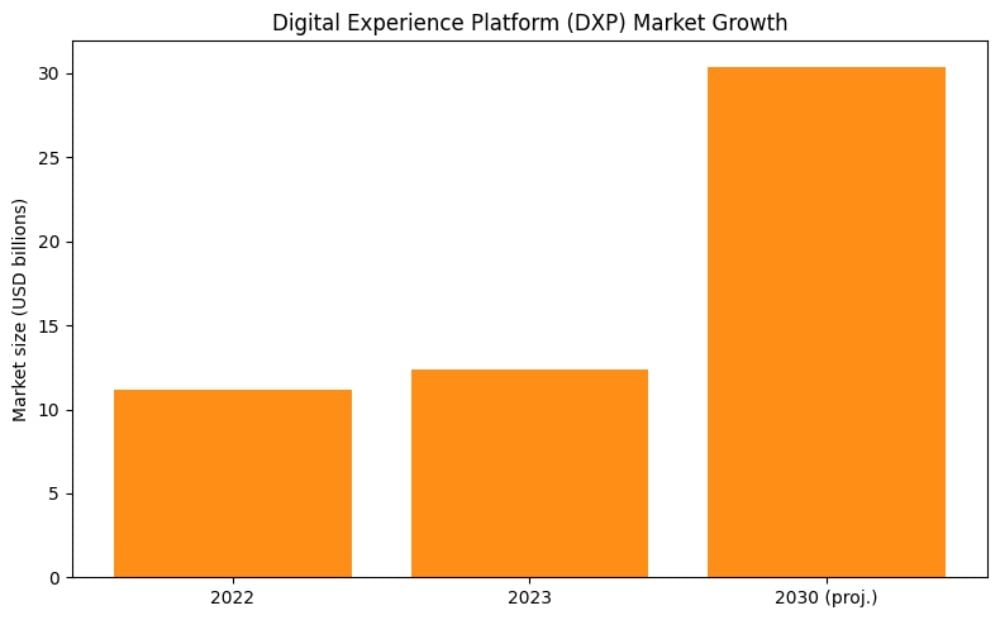
Global spending on digital experience platforms continues to climb as organizations move beyond basic CMS and personalization capabilities toward orchestration, integration and AI-driven experience delivery, according to Grand View Research.
Related Article: The Benefits — and Challenges — of Composable Digital Experience Platforms
By 2026, at least 70% of organizations will be mandated to acquire composable DXP technology, as opposed to monolithic DXP suites, compared to 50% in 2023, according to Gartner. By 2027, 40% of organizations will fail to deliver impactful digital CX due to a lack of AI-driven intelligent content coordination and content operations strategy, according to Gartner.
Digital experience platforms don’t come cheap. Gartner found that 85% of effort and cost in a DXP program will be spent on integrations with internal and external systems, including the DXP’s own, built-in capabilities.
A digital experience platform can be a powerful tool for businesses to create and manage engaging digital experiences for their customers. By providing a unified and seamless experience across various digital touchpoints, DXPs enable businesses to deliver personalized, relevant and consistent experiences that drive customer engagement, loyalty and business growth.
When selecting a DXP for your business, it's important to carefully assess your business needs, research and compare available options and consider implementation and support aspects to make an informed decision. With the right DXP in place, your business can leverage the power of digital experiences to achieve business success.
Dom Nicastro is editor-in-chief of CMSWire and an award-winning journalist with a passion for technology, customer experience and marketing. With more than 20 years of experience, he has written for various publications, like the Gloucester Daily Times and Boston Magazine. He has a proven track record of delivering high-quality, informative, and engaging content to his readers. Dom works tirelessly to stay up-to-date with the latest trends in the industry to provide readers with accurate, trustworthy information to help them make informed decisions. Connect with Dom Nicastro: 