Editorial
Guide
Post-Acquisition Guide: How to Bring Two Digital Experiences Together


For two years the AI content debate has circled one question: can Google actually tell? A newly published Google research paper suggests the answer is yes, just not in the way most marketers expected.
The paper, covered by Roger Montti at Search Engine Journal and shared widely by Glenn Gabe on X, describes the Scalable Cluster Termination System. Google built it to fight AI-generated video spam on its platforms, but the methods it describes (text embeddings, template detection, publishing-behavior analysis) apply just as cleanly to web content.
Gabe's read: Google will not let companies spam their way into AI search, and marketers should expect stronger automated systems plus manual actions.
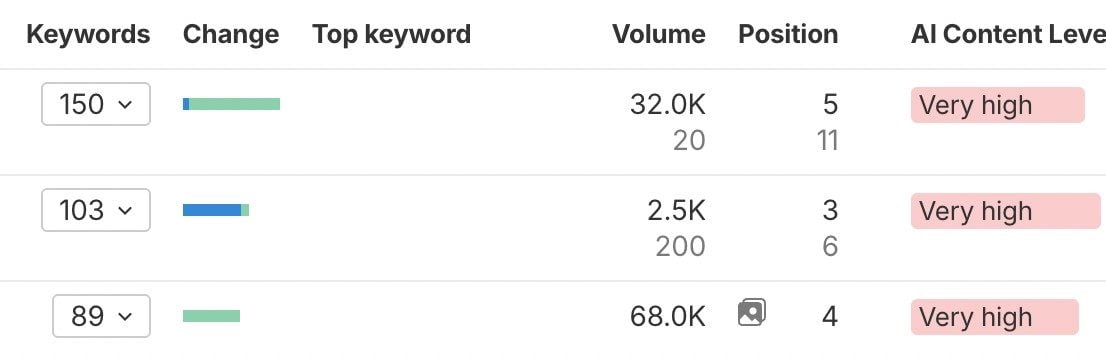
The timing matters because the traffic data is already moving. Over the past month I've watched websites with heavy concentrations of AI-generated content, the kind Ahrefs now flags as "Very high" on its AI Content Level metric, begin sliding in Google organic search. This also lines up with the rollout of Google’s latest June 2026 spam update that recently finished rolling out. Correlation is not causation. But when declines cluster around a specific site profile right as Google publishes both an algorithm update and research on detecting that exact profile, it deserves attention.
Traditional quality filters evaluate one piece of content at a time. Is this page thin? Does it satisfy intent? Google's researchers acknowledge that generative AI broke that model. Spammers can now produce endless variations of what the paper calls functionally identical content: every page technically unique, every page effectively the same. At volume, that flood is built to swamp content-level filters.
S-CTS works from a wider angle. It looks for the organizational structure of a spam operation, meaning the mass reuse of a semantic narrative template across many accounts, combined with infrastructure signals suggesting those accounts share an operator. The system groups related accounts into what the researchers call Generation Clusters, networks statistically likely to be running the same script, API or automation stack.
Two components do the work. A content classifier scans for repetitive, templated narratives and for high-frequency publishing behavior that no human schedule produces. An infrastructure component ties accounts back to a common source. When enough accounts in a cluster show the same AI-generated templates, Google removes the whole cluster at once rather than penalizing individual pages.
Now swap "accounts" for "domains" and "videos" for "articles." A network of sites publishing 30 templated posts a day from the same prompt stack fits this detection model exactly.
Related Article: Google's AI Search Playbook Is Here. Spoiler: SEO Still Matters
S-CTS groups accounts that share templated content and infrastructure signals into Generation Clusters, then removes the entire cluster at once instead of penalizing individual pages.
For SEO practitioners, the most useful detail sits in the methodology: Sentence-BERT.
The researchers cite SBERT, a model that converts sentences into embeddings comparable by cosine similarity, to support the paper's core assumption that automated AI text leaves a distinct mathematical footprint. When thousands of pages come from the same prompts and the same tools, they land close together in embedding space no matter how different they look to a human reader.
SBERT has existed since 2019, and Montti points out the SEO industry has rarely discussed it as a spam-detection mechanism. Its appearance in a Google paper about catching synthetic spam suggests it may have been put to that use only recently.
One more detail worth knowing: speed of adaptation. The paper describes using Low-Rank Adaptation (LoRA) and Automatic Prompt Optimization (APO) to retune classifiers when spammers move to new generative models. That means days of adjustment instead of months of retraining. When the next model ships and spam operations migrate, Google can follow almost immediately.
Sentence-BERT converts text into embeddings, and pages generated from the same prompts and tools cluster together in embedding space even when their wording looks unique to a human reader.
The loudest reaction to this research has also been the least accurate one, so the distinction is worth stating plainly.
Google's official guidance from 2023 still stands: content gets rewarded for quality and helpfulness regardless of how it was produced. Automation has been part of publishing for decades, from sports scores to weather forecasts.
What Google targets falls under its spam policies, specifically scaled content abuse: producing large volumes of pages mainly to manipulate rankings rather than help people.
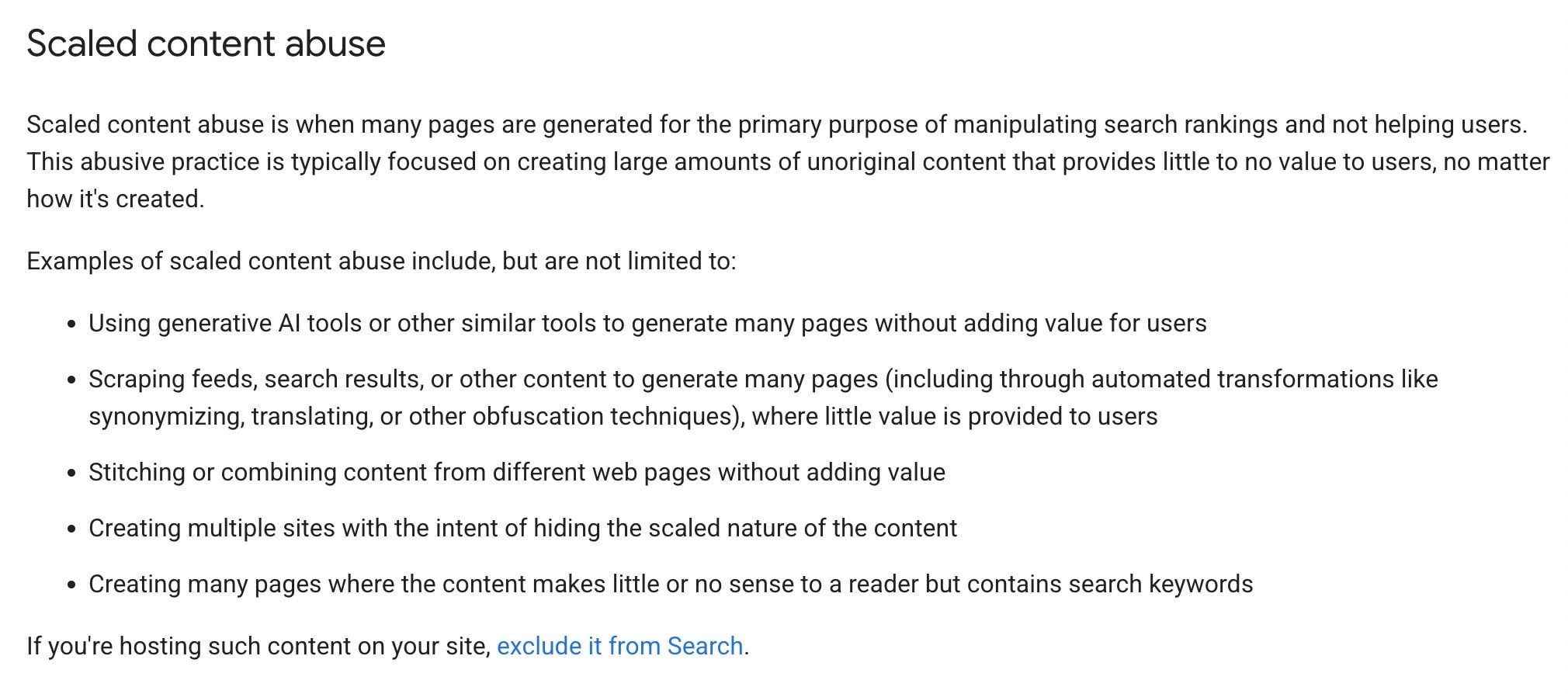
The March 2024 core update already wiped out networks of AI-heavy sites under that policy. This research shows the enforcement machinery getting sharper.
The practical line is velocity and intent. A brand publishing four edited, AI-assisted articles a week that answer real customer questions looks nothing like a site pushing 30 posts a day from one prompt template. The second pattern is a fingerprint, and fingerprints are what cluster-level detection finds.
When a skeptic in Gabe's replies asked whether these systems would sweep up all AI-generated content, his answer was direct: Google uses multiple signals, AI usage alone does not equal spam and anyone scaling thin content with AI should consider themselves warned.
No. Google's 2023 guidance rewards content for quality regardless of production method; enforcement targets scaled content abuse, meaning high-volume, low-value pages built mainly to manipulate rankings.
The following table highlights the most important lessons, actions and strategic considerations emerging from these five recommended content moves.
| Key Area | What Happened | Why It Matters | Recommended Action |
|---|---|---|---|
| Human Writing | Human writing still reads better, and readers can feel the difference. | Avoiding AI for scaling content entirely would be silly, but the human voice can't be replaced. | Put your credible, named authors on the pieces that build actual thought leadership for the brand, and let AI support the workflow instead of replacing the voice. |
| AI Voicing | Prompt adjuncts exist that remove telltale LLM patterns: the stock openers, the symmetrical hedging, the em-dash habit. | Templated phrasing is exactly what embedding-based detection clusters on. | Strip the AI voicing out of drafts. (Mine currently runs 13 pages and keeps growing.) |
| Genuine Usefulness | AI drafts pad by default — does the piece answer the question succinctly, or drag on to hit a word count? | This takes real editing discipline. | Ask whether each piece is genuinely useful, and add a key-takeaways section and table of contents to help both the editor and the reader who scans. |
| Point of View | An article with no edge or stance is a summary of what every other article already says, which in embedding terms is functionally identical content. | A real point of view is the one thing generative templates cannot fake at scale. | Have an opinion. Invest in your brand's voice. |
| Human-First Publishing | At least one of every four pieces should be made explicitly for users rather than search engines. | Satisfied users are the one signal no detection system will ever penalize. | Publish for humans, then run conversion rate optimization on that content: match the intent behind the query, answer it and give the reader a clear next action so they don't pogo-stick back to the results page and land on a competitor. |
Prioritizing human-led writing, stripping templated AI phrasing, cutting padding, adding real point of view and publishing at least some content for readers rather than rankings all reduce the templated-content fingerprint S-CTS looks for.
The risk calculus for AI-heavy SEO & AEO has changed shape. The question used to be whether a single page looked low quality. The question now includes whether your templates, publishing cadence, infrastructure and content similarities make your operation resemble a coordinated spam network. That is a much harder problem to solve with a plugin or a prompt, and based on the traffic declines of the past month, Google may already be grading the exam.
My own strategy stays the same: build a strong brand on a strong domain, publish content that serves real search intent and treat AI as a tool rather than an identity. The sites getting removed at the cluster level made themselves look like machines. Do not be one of them.
 Learn how you can join our contributor community.

Bradley Keys is an accomplished digital marketing expert with over a decade of experience in the industry. As the founder of All Star Digital, a boutique digital marketing firm specializing in search optimization, he has demonstrated a keen ability to drive impactful results for a diverse range of clients.