Editorial

Case Study
Why So Many Digital Modernization Efforts Stall

Editor’s note: This is Part 2 of a two-part series on evaluating digital experience platforms. In Part 1, we explored how DXP selection increasingly centers on operating models rather than feature checklists, introducing KPI domains such as authoring velocity, content operations and front-end delivery. Part 2 continues the framework by examining the operational realities that determine long-term success — including infrastructure ownership, deployment efficiency, ecosystem depth, community strength and AI operational readiness — before reframing total cost of ownership through the lens of how platforms shape enterprise execution over time.
As a reminder....
In practice, we see five KPI domains consistently determine long-term success:
We covered 1 and 2 in the first part of our series. Now onto 3-5:
As digital platforms mature, the operational lens shifts from how experiences are built to how they are sustained.
Platform Operational Efficiency measures how much effort, coordination and engineering capacity are required to run the system over time. Infrastructure ownership, upgrade cycles, environment management and release predictability all shape whether teams focus on innovation or maintenance.
Evaluating this domain requires more than asking whether a platform is “cloud-based” or “SaaS.” It requires examining how the deployment model affects long-term operational burden, internal staffing needs and roadmap capacity.
Two KPI lenses are particularly useful here: Infrastructure Ownership & SaaS Maturity and Release & Deployment Efficiency.
Infrastructure Ownership & SaaS Maturity measure how much operational responsibility your organization retains after go-live.
Traditional on-premise and early PaaS implementations required significant infrastructure coordination. Even after moving to the cloud, teams were responsible for managing scaling policies, failover strategies and disaster recovery across multiple regions. Warm and cold DR configurations increased both cost and operational complexity. Platform architectures often included numerous interconnected services that required monitoring, patching and version alignment.
Sitecore’s historical on-prem and PaaS deployments illustrate this complexity. Implementations frequently included multiple services, and as scalability demands increased, Kubernetes support became common. While Kubernetes provided technical flexibility and resilience, it also introduced operational overhead. Cluster management, container orchestration and upgrade coordination required specialized DevOps expertise.
Upgrades compounded the burden. Sitecore historically released new versions annually, but many customers adopted them every few years due to the project effort required. Those upgrades often meant provisioning new infrastructure and executing full migration cycles. Even platforms with lighter upgrade paths experienced disruptive transitions. Optimizely’s move from .NET Framework to .NET Core required meaningful replatforming work for many customers.
SaaS delivery models aim to reduce this operational tax. In a mature SaaS model, infrastructure scaling, patching and version management shift to the vendor. Sitecore’s SaaS-based SitecoreAI offering represents this architectural pivot, removing traditional upgrade projects and consolidating infrastructure ownership into a managed service. Continuous updates replace periodic replatforming initiatives.
However, SaaS maturity must be evaluated holistically.
Related Article: Why Modern Digital Experience Platform Selection Starts With KPIs, Not Features
In headless architectures, the CMS is only part of the system. The front-end application, often built in Node.js and deployed separately, introduces its own operational surface area. Investing in a SaaS CMS reduces backend infrastructure burden, but if the front-end layer requires self-managed scaling, server provisioning or custom DevOps pipelines, operational complexity reappears. Modern front-end hosting platforms such as Vercel and Netlify help mitigate this, but the key point remains: operational efficiency must be assessed across the entire delivery stack, not the CMS alone.
Evaluating this KPI requires measuring actual operational load:
The central question is not whether a platform is labeled SaaS. It is how much infrastructure ownership, upgrade responsibility and operational risk remain with your team once the system is fully deployed, including the front end.
Related Article: Headless CMS: Definition, Core Concepts & 13 Headless Platform Examples in 2026
Enterprise teams evaluating DXPs should examine operational indicators that reveal how much infrastructure responsibility and deployment complexity remain after implementation.
| Operational Area | What to Evaluate | Key Questions to Ask |
|---|---|---|
| Infrastructure ownership | How much infrastructure management remains internal after deployment. | Who manages scaling, failover, disaster recovery and environment provisioning? |
| Upgrade burden | Frequency and complexity of platform upgrades. | Do upgrades require replatforming projects, migration windows or infrastructure rebuilds? |
| DevOps staffing needs | Engineering capacity required to maintain the platform. | How many engineers are dedicated to infrastructure maintenance rather than feature development? |
| Deployment complexity | Coordination required to release code to production. | Do deployments require multi-service orchestration, downtime windows or cross-team coordination? |
| Release cadence | How frequently changes can safely reach production. | Can teams deploy multiple times per day, or are releases limited to scheduled windows? |
| Rollback and recovery | Speed and reliability of issue recovery. | How quickly can deployments be rolled back if an incident occurs? |
| Front-end operational load | Infrastructure required to run the front-end delivery layer. | Does the front end require separate scaling policies, DevOps pipelines or hosting infrastructure? |
Release & Deployment Efficiency measures how quickly and predictably changes move from code commit to production.
In traditional monolithic architectures, deployments were operational events. Updating the platform often meant coordinating changes across multiple servers and services, sometimes across multiple regions. Blue-green deployment strategies and Kubernetes orchestration reduced downtime risk, but releases still required planning windows, environment synchronization and rollback coordination. It was common for releases to take hours, sometimes days, and to be scheduled well in advance. That cadence naturally slowed iteration.
Headless architectures change that dynamic.
When the front end is decoupled from the CMS, a front-end change does not require recycling the entire backend platform. Teams can deploy independently. Modern serverless hosting platforms such as Vercel and Netlify further simplify this by distributing deployments automatically across a global CDN. Infrastructure provisioning, scaling and rollback are abstracted away, making releases largely declarative rather than operational.
This does not eliminate discipline. CI/CD pipelines, testing strategies and environment controls still matter. But the operational overhead per release is materially reduced compared to coordinated, multi-service deployments in monolithic environments.
Evaluating this KPI requires looking at measurable release indicators:
Release frequency and lead time for changes are particularly revealing metrics. Organizations that can deploy multiple times per day without downtime operate very differently from those limited to weekly or monthly release windows. The number of deployment-related incidents or emergency patches also signals operational maturity.
Nearly every vendor now emphasizes reduced operational burden. The practical distinction lies in how much coordination is required to execute a release and how much engineering capacity is consumed maintaining deployment pipelines rather than delivering new features.
Release efficiency is not simply a DevOps concern. It directly affects roadmap velocity. If deployments are complex and infrequent, experimentation slows and backlog pressure increases. If releases are routine, low-risk and infrastructure-light, innovation compounds.
The KPI lens reframes the evaluation from “Does it support CI/CD?” to “How quickly and safely can our teams ship change under the deployment model we will actually run?”
As digital programs mature, the operational lens shifts from core platform functionality to the ecosystem that surrounds it.
Platform Ecosystem & Composable Capabilities measure how easily adjacent capabilities can be activated and how sustainably they can be supported over time. Personalization, search, experimentation, analytics, data unification and automation rarely remain optional for long. The pace at which these capabilities move from idea to production often determines long-term momentum.
Evaluating this domain requires more than asking whether integrations are technically possible. It requires examining how cohesive the surrounding ecosystem is, how well data flows across systems and how much coordination is required to activate new capabilities.
Two KPI lenses are particularly useful here: Ecosystem Depth & Activation Speed and Community Strength & Support Signals.
Adopting a Digital Experience Platform (DXP) ecosystem is similar to moving to a new country with its own language and systems. You can still operate in other environments, but fluency inside the local ecosystem reduces friction. While composable architecture allows integration with virtually any tool, the path of least resistance often lies within the platform’s native ecosystem.
Over the past several years, this has been reinforced by consolidation across the market:
These were not simply portfolio expansions. Vendors invested in aligning identity models, permissions, workflows and data structures so their products function more cohesively together.
Other platforms have taken a different path. Contentful has emphasized openness and deep partnerships, making it easier to activate third-party integrations through pre-built connectors and structured APIs. This model can reduce initial activation friction, particularly when best-of-breed tools are central to the strategy. However, openness does not eliminate operational responsibility. Integration logic, data mapping and ongoing support still become part of the operating model.
Low-code integration platforms have further accelerated this trend. Sitecore, for example, white-labeled Workato to simplify connections across thousands of systems. Similar approaches exist elsewhere in the market. These tools can dramatically reduce initial build effort, but they introduce their own cost structures and governance considerations, particularly at high data volumes. Activation speed may improve, yet long-term scalability and operating cost must be evaluated carefully.
Related Article: Why AI Alone Can't Help Your Digital Experience Platform Evolve
Ecosystem Depth & Activation Speed should therefore be measured using tangible operational indicators:
Time-to-value, integration maintenance effort and data reconciliation overhead are measurable signals of ecosystem cohesion. When identity models and governance frameworks are aligned natively, adjacent capabilities can be activated incrementally with less engineering coordination. When tools are loosely coupled, integration effort increases and ongoing oversight becomes a permanent operational cost.
Composable architecture makes integration possible. Ecosystem depth determines how sustainable it is. The KPI lens reframes evaluation from “Does it integrate?” to “How quickly can we activate adjacent capabilities, and what long-term operational responsibility will those integrations create?”
Community Strength & Support Signals measure how well a platform supports your organization after the contract is signed.
Adopting a platform can either feel welcoming or isolating. If support interactions are slow, opaque or difficult to navigate, frustration compounds quickly. Ticket response times, escalation clarity and access to knowledgeable solution engineers all influence long-term satisfaction. Vendors offer different tiers of support, often with varying SLAs, training entitlements and support services. It is important to understand the level of responsiveness and advisory access included in your agreement. Programs such as Sitecore’s 360 service, which bundle proactive reviews and enablement alongside support, illustrate how vendors attempt to formalize that experience.
Community strength extends beyond formal support. Some platforms cultivate environments that feel like extended professional networks. Sitecore’s global MVP community and regional user groups create regular touchpoints for practitioners to share lessons and best practices. Optimizely maintains an active World community blog and ecosystem of contributors. Large events such as Sitecore Symposium, Opticon and Adobe Summit bring together customers, partners and product teams in ways that accelerate shared learning. Acquia hosts its own events, while the broader Drupal open-source community contributes a vast library of modules and hosts conferences such as DrupalCon, reinforcing a collaborative development culture.
Related Article: What to Expect at Sitecore Symposium
Training accessibility also influences this KPI. Some vendors invest heavily in structured certification paths and curated enablement programs. Others benefit from large enough ecosystems that independent courses appear on platforms like Udemy or Pluralsight. The availability of third-party education reduces hiring friction and lowers onboarding risk.
Evaluating this KPI requires looking at measurable signals rather than brand perception. Organizations should examine average support response and resolution times under the contract tier being considered, availability of proactive advisory services, frequency and geographic reach of user groups, size of certified developer communities and the number of active third-party contributors. Hiring velocity and salary premiums for platform-specific talent also provide insight into ecosystem depth.
Community and support strength directly affect operational resilience. A vibrant ecosystem shortens problem resolution cycles, reduces dependence on vendor escalation and lowers hiring risk. A thin ecosystem increases reliance on formal support channels and specialized partners.
The KPI lens reframes the evaluation from “Does the vendor have a community?” to “How much operational confidence will we have when challenges arise, and how quickly can we access the expertise needed to solve them?”
As digital platforms evolve, the operational lens shifts from how experiences are built and delivered to how intelligently they are optimized and automated.
AI Operational Readiness measures how effectively a platform enables AI-driven workflows today and how well it positions the organization for rapid AI advancement tomorrow. Content generation, personalization, workflow automation and agentic orchestration are no longer experimental features. They are becoming structural components of the operating model.
Evaluating this domain requires more than asking whether a platform includes AI features. It requires examining how deeply AI is embedded into authoring, governance and data models, how safely it can act within enterprise constraints and how easily it integrates with broader AI ecosystems.
Two KPI lenses are particularly useful here: Embedded AI & Workflow Integration and Agentic & Ecosystem Alignment.
Embedded AI & Workflow Integration measure how deeply artificial intelligence is woven into daily operations rather than treated as a surface-level productivity add-on.
Today, nearly every major platform supports generative AI inside text fields. Drafting assistance, summarization, metadata suggestions and tone adjustments are becoming table stakes. We are also seeing AI applied beyond text. Adobe Experience Manager’s integration with Firefly, for example, enables image generation directly within the authoring interface, extending AI assistance into visual asset creation. These capabilities can reduce production time and accelerate campaign launches.
However, presence alone does not define operational readiness.
The more meaningful distinction lies in governance and contextual alignment. Some platforms allow organizations to define brand guidelines that shape AI output.
Embedded AI maturity should be evaluated through measurable impact:
Surface-level AI improves drafting speed. Embedded AI integration influences structural efficiency. When AI is connected to brand guardrails, structured content models and workflow controls, it becomes part of the operating model. When it exists as a convenience feature, its impact remains limited to individual productivity gains.
The KPI lens reframes the evaluation from “Does it offer generative AI?” to “How measurably does AI improve throughput, consistency and governance within our operating model?”
Organizations evaluating AI capabilities in digital experience platforms should measure how deeply AI integrates into workflows, governance and enterprise systems rather than focusing only on feature availability.
| AI Capability Area | What to Measure | Evaluation Questions |
|---|---|---|
| Workflow integration | Extent to which AI is embedded in daily authoring and operational processes. | What percentage of content creation or campaign production uses AI assistance? |
| Governance controls | Ability to enforce brand, regulatory and workflow guardrails. | Can organizations define brand guidelines, approval workflows and auditing for AI outputs? |
| Model flexibility | Ability to swap or integrate different large language models. | Can the organization bring its own model or adjust knowledge sources as strategy evolves? |
| Enterprise integration | Depth of AI interaction with CMS, DAM, personalization and experimentation systems. | Can agents safely interact with structured content models and enterprise data? |
| Automation impact | Reduction in manual workflow steps through AI orchestration. | How many repetitive operational tasks can be safely automated? |
| Agent governance | Visibility and control over agent-driven actions. | Are permissions, audit trails and monitoring available for agent activity? |
| Cost predictability | Stability of AI consumption pricing. | Are token-based usage costs predictable at enterprise scale? |
The next phase of AI inside DXPs is agentic orchestration. Instead of assisting with a single draft or suggestion, agents can coordinate multi-step workflows, create or modify structured content, launch experiments, update personalization rules or interact with external systems. This shift requires more than exposing REST APIs. It requires structured access to content types, permissions, governance models and event data so agents can operate safely inside enterprise guardrails.
Vendors are moving quickly in this direction. Sitecore and Optimizely have both introduced agentic tooling that allows organizations to define agents within their ecosystems. Consumption models vary. Some platforms charge based on token usage, which can introduce cost variability that is difficult to forecast at scale. Others currently abstract that complexity, though pricing strategies continue to evolve.
Model Context Protocol (MCP) is emerging as another important integration layer:
These approaches signal a broader shift: DXPs are no longer just content repositories; they are becoming structured endpoints for enterprise AI ecosystems.
Evaluating this KPI requires measuring orchestration depth and integration sustainability:
Agentic readiness also depends on data coherence. If content types, identity models and governance rules are inconsistent across systems, agents cannot operate reliably. Integration may be technically possible but operationally fragile.
This domain is evolving rapidly, which makes measurement more important, not less. Enterprises should track automation adoption rates, reduction in manual workflow steps, agent-driven task completion accuracy and cost-per-automated-task over time. These metrics reveal whether agentic capability is delivering operational leverage or introducing new oversight burdens.
The KPI lens reframes evaluation from “Does the platform have agents?” to “How safely, predictably and cost-effectively can agents operate across our enterprise stack?”
Future proofing in this domain is not about predicting the next feature release. It is about ensuring the platform’s architecture supports structured, governed and extensible AI integration as agentic strategies mature.
Traditional total cost of ownership models focus on what is easiest to quantify. License fees, implementation services, hosting, infrastructure and support contracts form the visible layer of analysis. These inputs matter. They shape budgets and procurement decisions. But they do not capture the full cost of a platform.
The long-term economics of a DXP are driven less by subscription pricing and more by operating behavior.
Every KPI discussed in this framework compounds over time. Authoring velocity influences how many developers support marketing. Front-end velocity determines how frequently new experiences can be released. Infrastructure ownership shapes staffing models and upgrade cycles. Ecosystem depth affects how quickly adjacent capabilities reach production. AI readiness influences whether automation reduces workload or becomes another oversight layer.
These effects rarely appear in an RFP scoring sheet. They surface in day-to-day work.
Related Article: Turning DXPs Into Intelligence Engines — Not Just Interfaces
If routine content changes require engineering support, labor costs increase even if licensing costs are moderate. If upgrades require periodic replatforming efforts, roadmap capacity is diverted from innovation. If activating personalization or search demands heavy integration work, time-to-value stretches and internal alignment becomes more complex. If headless reduces backend overhead but shifts operational burden to a self-managed front-end stack, the total system cost simply moves rather than disappears. If AI features exist but are shallow or disconnected from governance, expected productivity gains remain unrealized.
None of these are line items in a contract. They are multipliers inside the organization.
This is why feature comparisons are insufficient. Two platforms may both support personalization, headless delivery or AI assistance. The question is not whether the feature exists. The question is how that feature fits into your operating model:
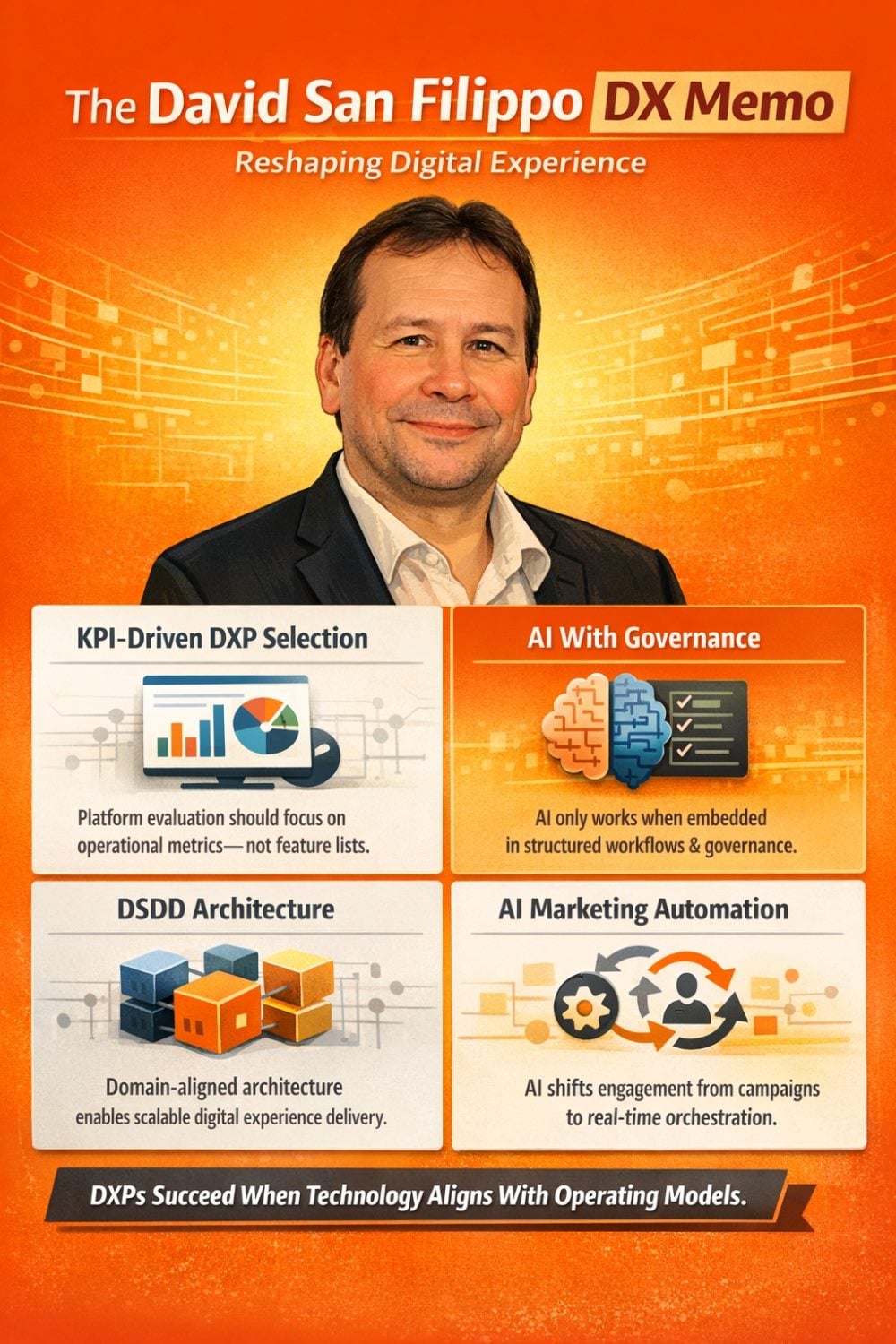
Over the past year, David San Filippo has explored how digital experience platforms are evolving — from KPI-driven evaluation frameworks to AI integration and scalable architectural models.
| Article | Core Insight |
|---|---|
| Why Modern Digital Experience Platform Selection Starts With KPIs, Not Features | DXP evaluation should focus on measurable operational KPIs — such as authoring velocity, deployment efficiency and ecosystem maturity — rather than feature checklists. |
| Why AI Alone Can’t Help Your Digital Experience Platform Evolve | AI capabilities only deliver value when embedded within strong operating models, governance frameworks and structured content architectures. |
| Why DSDD Is the Future of Scalable Digital Experience | The DSDD framework (Domain-Specific Design and Delivery) enables enterprises to scale digital experiences by aligning platform architecture with organizational domains. |
| How AI-Driven Marketing Automation Transforms Customer Engagement | AI-driven marketing automation shifts customer engagement from campaign management toward real-time orchestration powered by data, machine learning and adaptive workflows. |
A platform that aligns naturally with how your teams work may carry a higher subscription cost yet lower long-term operational drag. A platform that appears less expensive may require structural adjustments in staffing, workflow discipline or DevOps maturity that outweigh the licensing delta.
Evaluating TCO through a KPI lens forces a different conversation. Instead of asking which platform checks the most boxes, organizations ask how each option will shape their next five to seven years of execution. Which one reduces friction in the areas that matter most? Which one compounds efficiency rather than coordination overhead?
Evaluating a digital experience platform requires more than comparing features. These questions help practitioners assess how a platform will affect operational efficiency, ecosystem scalability and AI readiness over time.
| Evaluation Area | Key Questions to Ask | Why It Matters |
|---|---|---|
| Infrastructure ownership | How many engineers are dedicated to infrastructure management? | High infrastructure ownership shifts platform cost from licensing to engineering labor. |
| Environment stability | How often are environment rebuilds required? | Frequent rebuilds signal operational fragility and reduced development velocity. |
| Upgrade burden | How much roadmap capacity is consumed by version transitions? | Complex upgrades divert teams away from innovation toward maintenance work. |
| Scaling responsibility | Does scaling require internal intervention? | Manual scaling increases operational risk and slows response during traffic spikes. |
| Disaster recovery | How is disaster recovery handled? | Recovery architecture determines both platform resilience and operational overhead. |
| Front-end operations | In headless deployments, how is the front-end application operationalized and scaled? | Operational complexity can shift from the CMS to the delivery layer in headless architectures. |
| Release velocity | How long does it take to move a front-end change from approved code to production? | Short release cycles accelerate experimentation and customer experience improvements. |
| Deployment coordination | How often are releases scheduled in advance due to infrastructure coordination? | Frequent coordination slows innovation and increases engineering overhead. |
| Recovery speed | What is the rollback time in the event of an issue? | Fast rollback capabilities reduce risk during frequent deployments. |
| Operational coupling | How frequently do deployments require cross-team synchronization between CMS, infrastructure and front-end engineers? | High coordination overhead signals architectural coupling that slows delivery. |
| Ecosystem activation | How long does it take to activate a new adjacent capability, such as personalization or experimentation? | Activation speed determines how quickly new capabilities generate business value. |
| Integration effort | How many integration sprints are required to align identity, event and profile data? | Integration complexity compounds operational cost across the ecosystem. |
| Governance consistency | Are permissions and governance frameworks unified across systems, or must they be replicated? | Unified governance reduces compliance risk and operational friction. |
| Automation readiness | What percentage of repetitive workflows can be automated safely? | Automation determines whether AI reduces workload or creates additional oversight. |
| AI integration depth | What percentage of content production leverages AI assistance? | Adoption metrics reveal whether AI is embedded into operations or used sporadically. |
| Agent governance | How granular are permissions and audit trails for agent-driven actions? | AI governance determines whether automation can operate safely at enterprise scale. |
| Cost predictability | How predictable are agent consumption costs under projected usage volumes? | Unpredictable token-based pricing can introduce hidden operational costs. |
The most expensive platform is not necessarily the one with the highest fee. It is the one that slows your organization down.
In a market already reshaped by SaaS transitions, headless architectures and rapid AI advancement, enterprises have a rare opportunity to choose deliberately. The right evaluation framework does not start with features. It starts with operating reality.
The real TCO question is not what the platform will cost on paper. It is how efficiently your organization will be able to operate, innovate and evolve once it is embedded in your daily work.
 Learn how you can join our contributor community.
David San Filippo is the Senior Vice President of Digital Content and Experience at Altudo. He is focused on helping clients get more value out of their digital experience platform investments. Connect with David San Filippo: 
