Feature
Research Report
The 2026 State of CX Outsourcing

In 2026, the question is no longer whether businesses should unify their customer data; it's how. As marketing stacks grow more complex and privacy expectations tighten, the customer data platform (CDP) has evolved from a niche tool into a central element of modern customer experience.
Designed to bring together data from across digital and offline touchpoints, CDPs create persistent, unified customer profiles that power real-time personalization, analytics and activation.
But as the market expands and legacy tools rebrand themselves as CDPs, understanding what a true CDP is, and how it differs from CRM and DMP systems, matters more than ever.
Editor’s note: CDPs sit at the center of first-party data strategy — but the category’s growth (and rebranding) makes it critical to separate true identity resolution and activation from stitched-together profiles and legacy overlap.
AI makes unified data more actionable — enabling predictive analytics, churn modeling, automated segmentation and next-best-action recommendations. But it also raises risk: weak data quality, poor identity resolution or inconsistent consent handling can amplify errors and undermine trust, making governance and transparency non-negotiable.A CRM is designed for managing customer relationships and sales/service workflows — tracking contacts, pipelines, cases and interaction histories. A CDP focuses on unifying first-party behavioral and transactional data across channels into identity-resolved profiles that can be activated across downstream systems, not just managed as records.A DMP was built primarily for advertising, using large volumes of anonymous, cookie-based third-party data to create segments for ad targeting. A CDP centers on first-party data, persistent profiles and identity resolution — and is designed to support cross-channel engagement across marketing, sales and service, not only media activation.A true CDP has three foundations: (1) marketer control (usable day-to-day without constant engineering work), (2) a persistent unified customer database (with identity resolution and historical retention), and (3) accessibility/activation (making unified data available to other systems to operationalize it across the enterprise).A CDP ingests data from digital and offline touchpoints, cleans and de-duplicates records, resolves identities and maintains persistent profiles. Once unified, teams can segment audiences, identify behavioral patterns and activate relevant messages or experiences in near real time across channels.A CDP is software that collects, unifies and organizes first-party customer data from multiple sources into a persistent, centralized database. It resolves identities across channels to create unified customer profiles that can be used for segmentation, analytics and activation across marketing, sales and service systems.Start with readiness and operational ownership, not features alone. Prioritize integration depth (connectors plus APIs/real-time pipelines), identity resolution strength, consent and compliance controls, usability for marketers, scalability and the ability to activate unified profiles across the systems that run marketing, sales and service.
A customer data platform is software that collects, unifies and organizes first-party customer data from multiple sources into a persistent, centralized database. It resolves identities across channels, creating a single, unified customer profile that can be used for real-time analytics, segmentation and activation across marketing, sales, and service systems.
CDPs are omnichannel, gathering data from websites, mobile apps, CRM systems, point-of-sale platforms, email tools, and other online and offline touchpoints. By stitching that data together at the individual level, a CDP enables businesses to move from fragmented interactions to coordinated, personalized engagement.
The CDP's consolidation of data involves cleansing, de-duplicating and organizing customer records that would otherwise remain siloed across different tools, teams and departments.
Once the data is unified, CDP software applies analytics and machine learning (ML) to uncover behavioral patterns, segment audiences, and uncover actionable insights. The result is a persistent, comprehensive profile of each customer that marketers (and cross-functional teams) can use to deliver more relevant campaigns, personalize experiences in real time, and improve return on investment.
By turning fragmented data into a clear picture of customer behavior, a CDP enables businesses to make smarter decisions and build deeper customer relationships.
The CDP market continues to expand as businesses invest in first-party data infrastructure to support personalization, privacy compliance, and omnichannel engagement. Markets & Markets estimates the category will grow from roughly $9.7 billion in 2025 to more than $37 billion by 2030. At the same time, the market is fragmenting. Warehouse-native, or "composable," CDPs that build on existing cloud data platforms are gaining traction alongside traditional standalone systems, reflecting a broader shift in how brands approach data unification and ownership.
When evaluating customer data technologies, three platforms are often discussed together: CDPs, customer relationship management systems (CRMs), and data management platforms (DMPs). While all three handle customer information, they are built for fundamentally different purposes.
While CDPs, CRMs and DMPs all handle customer-related data, they are built for different strategic purposes. This comparison highlights how each platform approaches identity, activation, and long-term customer engagement.
| Platform | Primary Purpose | Data Type | Identity Resolution | Real-Time Activation | Primary Users |
|---|---|---|---|---|---|
| CDP | Unify first-party data into persistent customer profiles | First-party behavioral, transactional, and engagement data | Yes — cross-channel identity stitching | Yes — across marketing, sales, and service systems | Marketing, data, sales, and CX teams |
| CRM | Manage customer relationships and sales pipelines | Structured contact and interaction records | Limited — typically account or contact based | Operational workflows rather than marketing activation | Sales and service teams |
| DMP | Audience segmentation for advertising | Anonymous third-party and cookie-based data | Minimal — largely anonymous identifiers | Ad platform activation only | Advertising and media teams |
A CRM is designed to manage direct customer relationships. Sales and service teams use it to track interactions, manage pipelines, log support cases, and maintain account histories. It excels at operational record-keeping and relationship management but typically relies on structured, manually entered data.
A DMP was built primarily for advertising. It aggregates large volumes of anonymous, cookie-based third-party data to create audience segments for programmatic ad targeting. However, as third-party cookies phase out and privacy regulations tighten, DMPs have become less central to long-term customer strategy.
A CDP, by contrast, focuses on unifying first-party data across channels into a persistent, identity-resolved customer profile. It ingests behavioral, transactional, and engagement data from websites, apps, email systems, point-of-sale platforms, and more. The result is a real-time, comprehensive view of each customer that can be activated across marketing, sales, and service systems.
So which is best? It depends on your objective. If you need to manage pipelines and customer touchpoints, a CRM remains essential. If you are executing large-scale paid media campaigns based on anonymous audiences, a DMP may still play a role. But if your goal is to create a connected, cross-channel customer experience grounded in first-party data, a CDP is purpose-built for that task.
Beth Pfefferle, CMO at Redpoint Global, told CMSWire, "The most important element to look for is centralized control and real-time access to customer data across all channels, and not just stitched-together profiles. An authentic CDP gathers data from every touchpoint, resolves identities to create a consistent, unified customer profile, and activates that profile across both digital and off-line systems."
Related Article: Is the CDP Still the Queen? Exploring the Future of Customer Data
Not every platform labeled a "CDP" meets the term's definition. As the category has grown, some legacy systems have been repositioned as customer data platforms without fully delivering the capabilities the term implies. According to the CDP Institute, a true CDP must include three foundational elements:
A CDP is packaged software that marketers can manage directly, without requiring continuous custom development or deep IT intervention. While IT and data teams play a critical governance role, day-to-day segmentation, audience building, and activation should not depend on engineering backlogs.
At its core, a CDP maintains a centralized, durable database that ingests data from multiple sources and links it to individual customer profiles. That database must retain historical data, resolve identities across channels, and continuously update profiles as new interactions occur. Without persistence and identity resolution, it is not a true CDP.
A CDP does not exist in isolation. It must make unified customer data available to other systems, including marketing automation platforms, CRM systems, analytics tools, and ad networks. The value lies not just in storing data, but in operationalizing it across the enterprise.
Together, these elements distinguish CDPs from CRMs, data warehouses, and marketing clouds that may store data but do not unify, persist, and activate it in a marketer-controlled environment.
Modern CDPs extend beyond these foundations by embedding AI and machine language into the platform itself. Rather than acting solely as a storage layer, leading platforms now support predictive analytics, automated segmentation, churn modeling, and next-best-action recommendations, reflecting a broader shift from data consolidation to intelligent orchestra
Beyond the core definition, a CDP must deliver practical capabilities that marketers can use daily. According to Gartner and other industry analysts, several functional features separate enterprise-ready CDPs from data repositories.
A modern CDP does more than store data. It ingests signals, resolves identity, builds intelligence, and activates insights across channels in a continuous feedback loop.
| Lifecycle Stage | What Happens | Business Impact |
|---|---|---|
| Data Ingestion | Collects first-party data from web, mobile, CRM, POS, and other systems | Creates a unified input layer for customer intelligence |
| Identity Resolution | Matches interactions across devices and channels to a single customer profile | Eliminates duplication and fragmentation |
| Profile Unification | Maintains persistent, historical customer records | Enables longitudinal behavioral analysis |
| Segmentation & Analytics | Applies rules, scoring, and machine learning models | Identifies high-value segments and churn risks |
| Activation | Pushes audiences and attributes into marketing, sales, and service systems | Drives personalized, cross-channel engagement |
| Measurement & Feedback | Captures performance data and feeds results back into the profile | Continuously improves targeting and ROI |
Expanded definitions include:
In 2026, leading CDPs increasingly integrate AI-driven capabilities directly into these features. Automated audience creation, real-time personalization triggers, and machine learning–based recommendations are becoming standard expectations rather than differentiators.
CDPs consolidate various data types, each bringing unique insights about the customer. The types of data that make up a customer data platform include:
By skillfully integrating these data tiers, CDPs provide businesses with a multi-dimensional, comprehensive view of their customers, enabling data-driven decision-making.
The growing role of AI is reshaping how these data tiers are interpreted and activated. Machine learning models rely heavily on first-party behavioral signals to drive personalization, predictive scoring, and next-best-action recommendations. As third-party cookies decline and privacy regulations tighten, first-party and consented second-party data have become even more critical inputs for AI-driven engagement. At the same time, AI systems can amplify errors, biases, or inconsistencies in poorly governed data.
That reality reinforces why data quality, identity resolution, and consent management are no longer backend concerns—they directly influence the accuracy and trustworthiness of AI-powered decisions built on top of the CDP.
Editor’s note: Definitions informed in part by CMSWire’s CDP Market Guide and ongoing editorial coverage of the evolving customer data platform landscape.
| Term | Definition | Why It Matters |
|---|---|---|
| Customer Data Platform (CDP) | Software that unifies first-party customer data from multiple sources into persistent, identity-resolved profiles that can be activated across systems. | Forms the foundation for real-time personalization, analytics and cross-channel orchestration. |
| Identity Resolution | The process of matching customer interactions across devices, channels and systems to a single individual or account profile. | Eliminates duplication and enables a consistent view of the customer. |
| First-Party Data | Data collected directly from customers through owned channels such as websites, apps, POS systems and CRM platforms. | Becomes increasingly critical as third-party cookies decline and privacy regulations tighten. |
| Composable (Warehouse-Native) CDP | A CDP architecture that operates on top of an existing cloud data warehouse rather than maintaining a separate database. | Gives organizations greater control over data ownership, governance and scalability. |
| Persistent Profile | A continuously updated customer record that retains historical behavioral, transactional and engagement data. | Supports longitudinal analysis, predictive modeling and lifecycle engagement. |
| Real-Time Activation | The ability to push audience segments or customer attributes into marketing, sales and service systems instantly or near instantly. | Enables contextual engagement based on live behavioral signals. |
| Segmentation | The practice of grouping customers based on shared behaviors, attributes or predicted outcomes. | Drives targeted campaigns, retention strategies and cross-sell opportunities. |
| Consent Management | Tracking and enforcing customer data permissions across channels and systems. | Ensures regulatory compliance and protects brand trust. |
| Next-Best Action (NBA) | AI-driven recommendation logic that determines the most relevant message, offer or experience for a customer. | Transforms unified data into proactive engagement decisions. |
| Data Ingestion | The process of collecting structured and unstructured data from multiple internal and external sources into the CDP. | Creates the unified input layer required for accurate identity resolution and analytics. |
From creating a unified customer view to enhancing personalization and ensuring easy integration, CDPs epitomize the core advantages of using a sophisticated customer platform. Let's take a deeper look at some of the benefits a CDP can bring to modern businesses.
CDPs shine in their ability to aggregate diverse data from multiple touchpoints, from web interactions to in-store purchases. This results in a comprehensive, 360-degree profile of each customer. With this profile in hand, businesses can delve deeper into the nuances of individual customer behaviors, ensuring more tailored interactions and enhancing the customer journey.
With the amount of data they handle, CDPs allow businesses to develop personalized marketing campaigns that deeply resonate with their audience. But it's not just about what they show; it's also about what they don't show. Customer data platforms can suppress ads or materials that may be irrelevant to a user, ensuring each interaction is meaningful and unobtrusive.
CDP integration with existing marketing tools, such as CRM systems, marketing automation platforms and data warehouses, prevents siloes and ensures data moves fluidly across the business ecosystem. This interconnected setup enables businesses to react in real-time to customer actions from clicked links to abandoned carts, and refine strategies on the go.
Centralizing data management minimizes risks of duplication and inaccuracies. But, more critically, in an age where data privacy concerns loom large, CDPs offer robust data protection features. They ensure that businesses not only stay compliant with evolving data protection regulations (like the General Data Protection Regulation, or GDPR) but also prioritize customer privacy, safeguarding sensitive information and reinforcing brand trust.
Because CDPs centralize and standardize customer data, marketing, sales, and service teams can work from the same source of truth. This reduces dependency on manual data pulls or IT backlogs and shortens the time between insight and execution. Campaigns can be launched faster, audience segments can be refined in real time, and cross-functional teams can align around shared customer intelligence rather than conflicting reports.
When businesses sharpen their marketing strategies with unified, high-quality data, the result is more efficient ad spend and stronger conversion performance. CDPs help brands identify high-value customers, suppress low-intent audiences, and trigger timely engagement based on real behavioral signals. Increasingly, AI-driven scoring and predictive analytics within CDPs further improve campaign precision, allowing brands to allocate budget toward segments most likely to convert or retain. The result is measurable efficiency gains across acquisition, retention, and cross-sell efforts.
Related Article: Inside the CDP Illusion: When Data Dreams Meet Mid-Market Reality
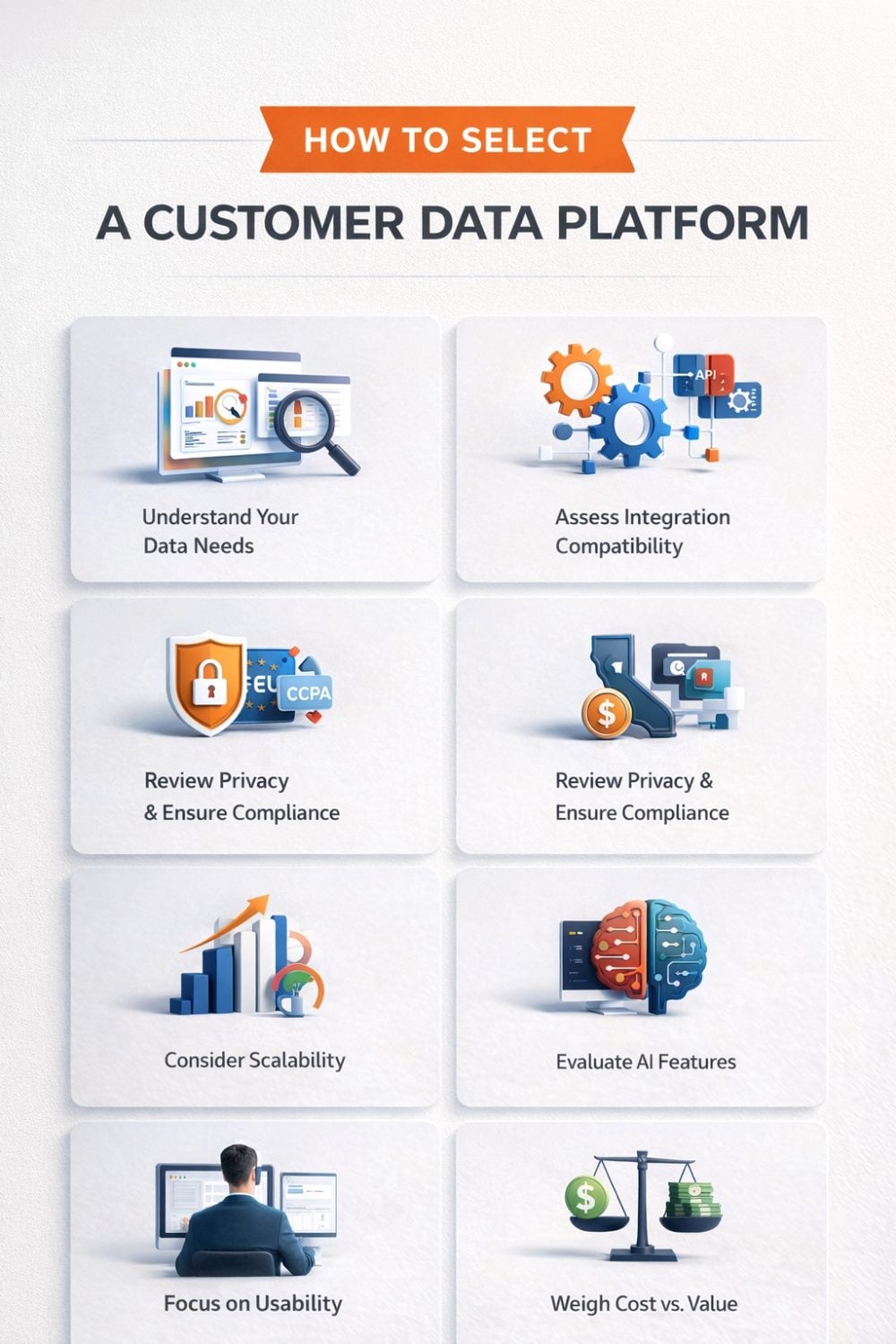
Choosing the right customer data platform requires clarity about organizational readiness as much as technical requirements. The most successful CDP deployments align data strategy, governance and operational ownership before platform selection begins.
| Evaluation Area | What to Assess | Why It Matters |
|---|---|---|
| 1. Understand Your Data Needs | Define primary data requirements. Are you merging online and offline data? Do you need real-time analytics or predictive modeling? Is your priority analytics, activation or orchestration? | Clarifying scope narrows suitable platforms. Some CDPs specialize in data unification, others emphasize real-time engagement and journey execution. |
| 2. Integration Capabilities | Ensure clean integration with marketing tools, CRM systems and data warehouses. Evaluate prebuilt connectors, API flexibility and event streaming capabilities. | A CDP is only as effective as the data it receives. Without connected ecommerce, CRM, marketing and loyalty systems, journeys become disjointed. |
| 3. Data Privacy & Compliance | Confirm support for GDPR, CCPA and regional regulations. Assess consent versioning, data residency requirements and automated suppression logic. | Compliance must be baked into the foundation. Transparent consent enforcement enables meaningful personalization while protecting brand trust. |
| 4. AI-Driven Features | Evaluate predictive analytics, automated segmentation, churn modeling and next-best-action recommendations. | Modern CDPs move beyond storage into intelligence engines that power real-time personalization and behavioral prediction. |
| 5. Scalability | Assess identity resolution volume, cross-region deployment and evolving governance support. | The platform must grow with increasing data complexity without requiring full reimplementation. |
| 6. User Experience & Autonomy | Evaluate interface usability and marketer self-service capabilities. | Marketer autonomy often determines whether the CDP becomes shelfware or strategic infrastructure. |
| 7. Support & Training | Review onboarding resources, implementation support and ongoing enablement. | Strong support accelerates adoption and reduces early-stage friction. |
| 8. Cost vs. Value | Examine licensing, operational overhead, integration maintenance and internal resourcing needs. | True CDP success is measured by agility — the ability to launch complex cross-channel programs without waiting on IT or third parties. |
In this episode of The Digital Experience, we unpacked the evolving role of customer data platforms — from integration challenges and identity resolution to AI-driven orchestration and real-time activation. The conversation explores what separates true CDPs from rebranded legacy systems, why integration remains the biggest barrier to value, and how AI is shifting CDPs from data consolidation engines to intelligence layers that power next-best-action, predictive modeling and cross-channel coordination.
The discussion ultimately centers on operational ownership: what it really takes for unified customer data to move from promise to measurable business impact.
Examining key capabilities of some of the players in the customer data platform space.
| Vendor | Key Capabilities |
|---|---|
| Acquia | Unified customer profiles, marketing automation, open DXP integration |
| ActionIQ | Enterprise CDP, identity resolution, audience management |
| Adobe | Real-time CDP, AI-driven personalization, experience cloud integration |
| Amperity | Identity stitching, data unification, analytics for retail/consumer |
| Antisomi | Consent-first marketing, CDP for privacy-focused campaigns |
| Bloomreach | CDP plus search and merchandising for commerce |
| BlueConic | Profile unification, lifecycle marketing, consent management |
| Blueshift | AI recommendations, cross-channel activation, segmentation |
| FirstHive | Self-learning CDP, edge identity graphs, marketing automation |
| Fospha Marketing | Attribution-focused CDP, ecommerce analytics |
| Hightouch | Reverse ETL, composable CDP, warehouse-native architecture |
| Informatica | Enterprise data management, CDP integration via Salesforce |
| Leadspace | B2B CDP, account-based marketing, data enrichment |
| Lytics | Behavioral scoring, personalization, cloud-native CDP |
| mParticle | Data pipelines, consent management, event tracking |
| n3 Hub | Healthcare and pharma-focused CDP with secure data handling |
| Ometria | Retail-focused CDP, AI customer intelligence |
| Onecount | Publisher-focused CDP, real-time targeting |
| Opentext | Data orchestration and CDP within enterprise information management |
| Oracle | Fusion CX, real-time personalization, enterprise CDP |
| PwC | CDP consulting and implementation services, not a standalone platform |
| Qualtrics | Experience ID and XM Directory with CDP-like functionality |
| Rudderstack | Warehouse-first, developer-friendly composable CDP |
| Salesforce | Unified customer profiles, journey orchestration, Einstein AI |
| SAP | Customer data cloud, consent management, CX suite integration |
| SAS | Advanced analytics, real-time decisioning, identity resolution |
| Sitecore | Content and commerce CDP integration, personalization |
| Spotler | SMB marketing automation, email and CRM integrations |
| Tealium | Tag management, customer data hub, consent management |
| Teavaro | Identity solutions and privacy-centric CDP |
| Treasure Data | Enterprise CDP, IoT and offline data integration |
| Twilio | Segment CDP, data pipelines, real-time event streaming |
| Velocidi | Customer journey analytics and data unification for ecommerce |
| Zeotap | Consent-based identity resolution, telco-originated data |
| Zeta Global | Marketing cloud with built-in CDP, predictive analytics |
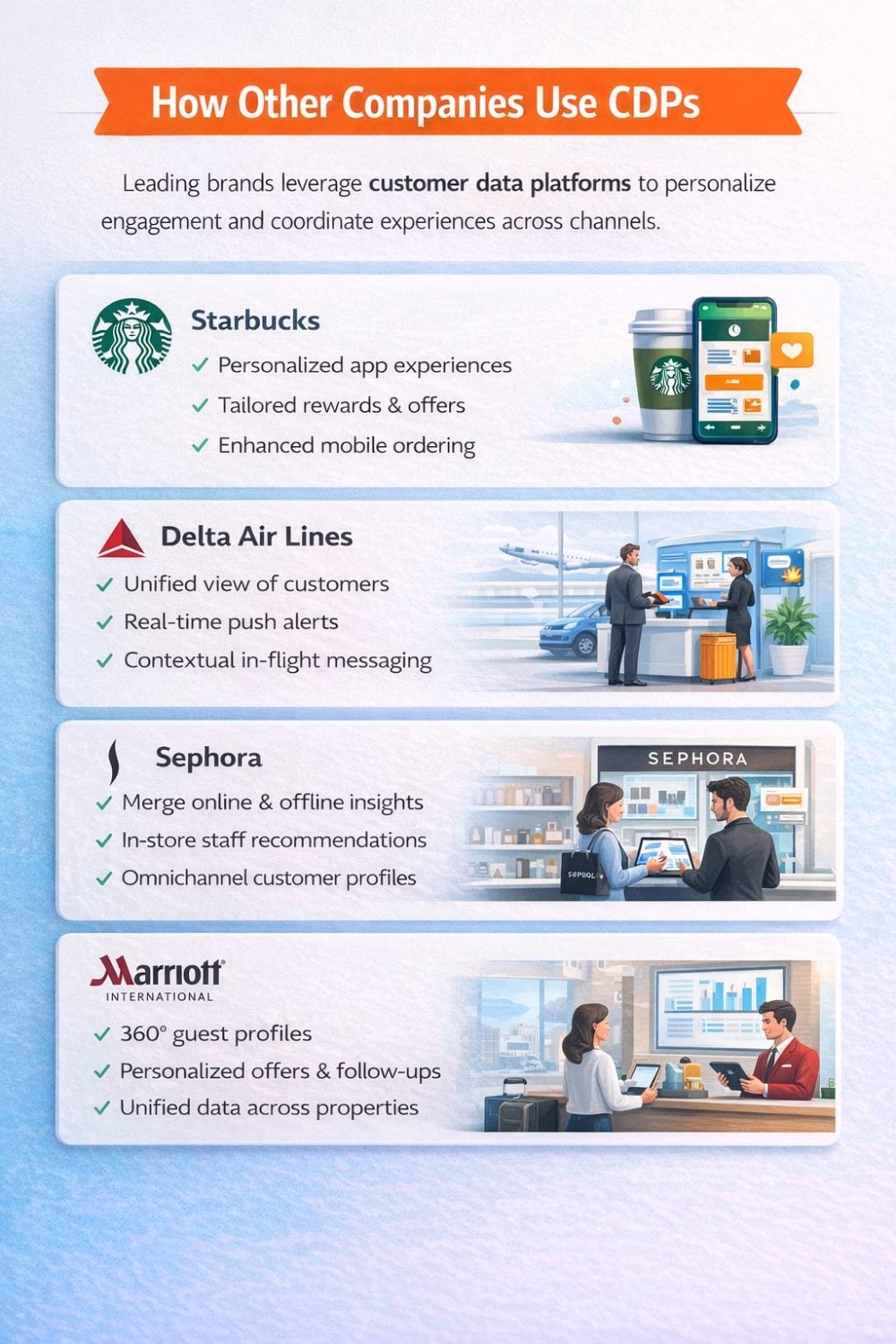
Industry leaders often adopt customer data platforms as part of their strategies to optimize customer engagement. Let's take a look at how some companies are using these data systems:
Beyond travel and hospitality, CDPs are increasingly serving as shared infrastructure across the enterprise. In financial services, healthcare, telecommunications, and retail banking, unified customer profiles help businesses coordinate messaging across marketing, service, and digital product teams. Instead of relying on archaic batch segmentation or disconnected campaign tools, businesses can respond to behavioral signals in near real time, aligning outreach with customer context rather than channel silos.
The most immediate impact of a CDP still appears in improved marketing performance, but its value now extends well beyond basic campaign optimization. Recent CDP industry statistics indicate that the CDP market is continuing to expand and differentiate, with increasing adoption of real-time activation, composable architectures, and AI-enhanced capabilities that support contextual engagement across channels.
CDPs centralize customer data in a way that allows different systems to reference the same underlying identity. That shared foundation can reduce fragmentation across channels, improve audience consistency, and make it easier to evaluate performance against a stable customer record rather than disconnected datasets. It also gives sales and service teams access to the same core profile, helping align outreach and support around a unified view of the customer.
Sales teams benefit as well. When account activity, digital engagement, and transactional history are consolidated into a persistent profile, teams can identify cross-sell and up-sell opportunities with greater accuracy. In B2B environments, CDPs increasingly support account-based strategies by connecting multiple contacts within a single buying group.
Service organizations also gain a clearer view of customer health. CDP analytics can uncover early indicators of churn, changes in engagement patterns, or declining satisfaction signals drawn from digital and transactional data. With that visibility, support teams can intervene proactively rather than reactively, reinforcing loyalty before friction turns into churn.
Scott Clark is a seasoned journalist based in Columbus, Ohio, who has made a name for himself covering the ever-evolving landscape of customer experience, marketing and technology. He has over 20 years of experience covering Information Technology and 27 years as a web developer. His coverage ranges across customer experience, AI, social media marketing, voice of customer, diversity & inclusion and more. Scott is a strong advocate for customer experience and corporate responsibility, bringing together statistics, facts, and insights from leading thought leaders to provide informative and thought-provoking articles. Connect with Scott Clark: 