Feature
Research Report
The 2026 State of CX Outsourcing

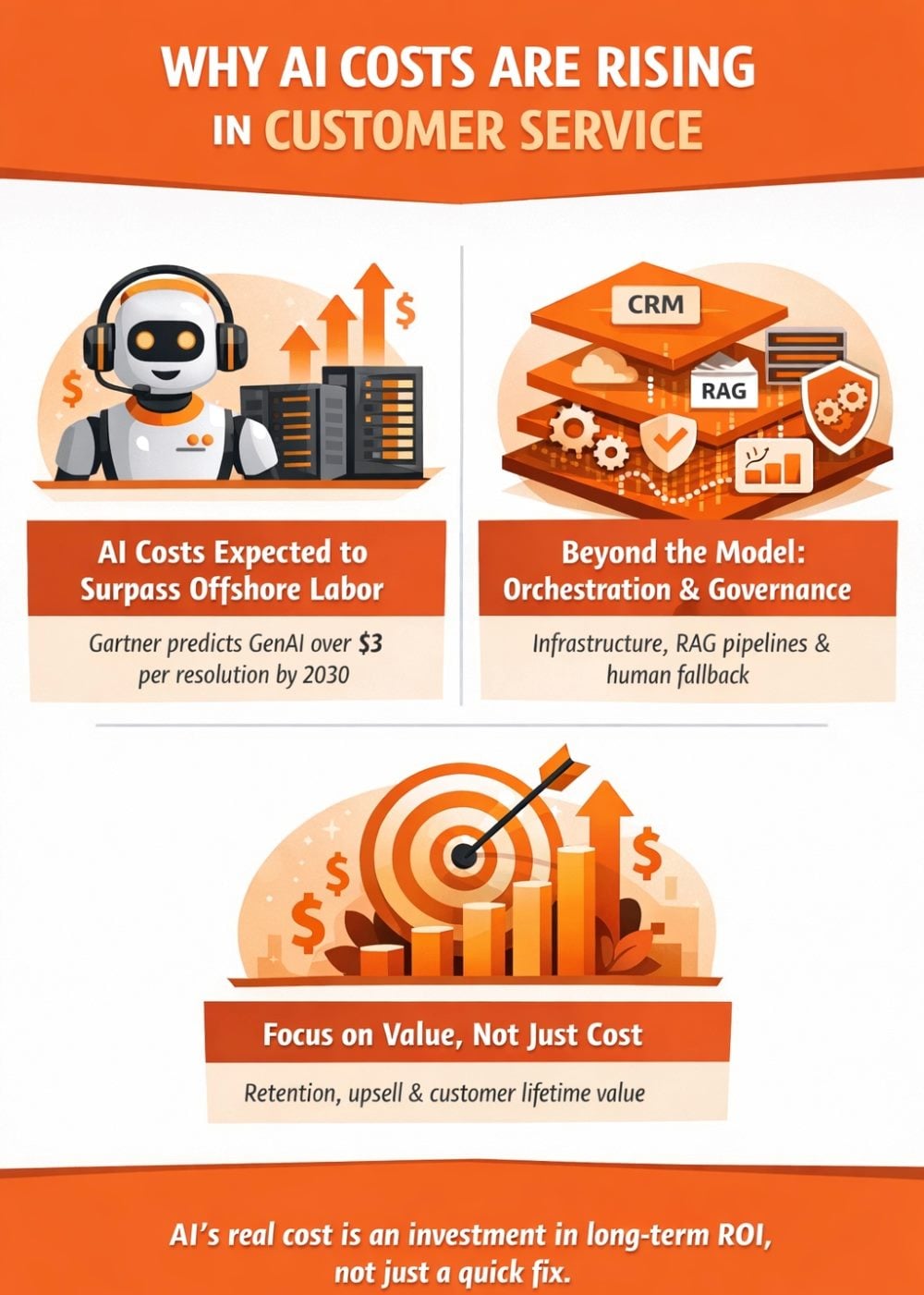
Gartner recently forecast that by 2030, the cost per resolution for generative AI (GenAI) in customer service will exceed $3, surpassing the average cost of many B2C offshore human agents.
Simplified: AI agents will cost more than human agents.
Wait, aren't we in the era of automation means efficiency gains and cost savings?
However, this comes as rising data center costs, a shift from subsidized pricing to profitability for AI vendors and increasingly complex AI use cases drive up total cost of ownership.
According to Gartner's Customer Service & Support practice, customer service leaders should temper expectations that AI inherently reduces support costs. Instead, the firm suggests that full automation is likely to be prohibitively expensive for most enterprises, and that brands will need to balance AI investment with human engagement strategies that improve customer experience and long-term value rather than cut costs.
For the past several years, the business case for generative AI in customer service has rested on a simple premise: automation lowers cost. AI agents resolve tickets without salaries, benefits or geographic constraints. Offshore teams are reduced. Cost per resolution declines. Margins improve.
That assumption has shaped investment decisions across contact centers and service operations. Enterprises have used AI-powered chatbots, copilots and routing systems with the expectation that automation would ultimately undercut human labor, especially in lower-cost offshore markets.
But the Gartner prediction challenges that narrative. According to the firm, by 2030 the cost per resolution for GenAI in customer service will exceed that of offshore human agents.
If AI does not deliver sustained cost savings, the central question shifts. What, exactly, is generative AI in customer service meant to optimize? Efficiency? Quality? Scale? Or something else entirely? That tension sits at the heart of the next phase of AI adoption in service environments.
Related Article: What Is Contact Center as a Service (CCaaS)?
Gartner's forecast is not a broad claim that AI "fails" at cost reduction. It is a specific projection about cost per resolution in customer service environments, and that distinction matters.
According to Gartner, the average cost per resolution for generative AI in customer service will exceed $3 by 2030, surpassing the cost of many offshore business-to-consumer human agents. That projection reflects not only model usage costs, but the broader infrastructure required to deploy AI at scale. Several factors contribute to this outlook:
As generative AI moves from pilots to enterprise-scale deployment, infrastructure, pricing normalization and model complexity are reshaping the true cost profile of production systems.
| Cost Driver | What’s Changing | Why It Increases Cost |
|---|---|---|
| Infrastructure expenses | Enterprise-grade deployments require secure hosting environments, integration with Customer Relationship Management (CRM) platforms and knowledge systems, monitoring tools, governance controls and ongoing maintenance. | AI becomes part of a distributed, high-availability architecture rather than a simple chatbot layered onto a website, increasing operational and maintenance overhead. |
| Vendor pricing normalization | Early competitive pricing and promotional access to large language models (LLMs) may not persist indefinitely as the market matures. | Pricing structures for API usage, orchestration layers and advanced reasoning models are likely to stabilize at levels reflecting long-term compute and support costs, exposing real economics at scale. |
| Rising model complexity | Enterprises are moving beyond scripted automation toward multi-step reasoning, retrieval-augmented generation (RAG) and personalized responses. | Higher-quality interactions require larger context windows, retrieval systems and more advanced models, increasing computational demand and cost per interaction. |
Gidi Adlersberg, Voca CIC business line manager at AudioCodes, told CMSWire, "The factors behind this prediction are real. Rising data center costs, AI vendors pivoting from subsidized growth pricing to profitability, and increasingly complex use cases that consume more tokens and require more expensive talent are all contributing to higher GenAI costs."
Adlersberg explained that on top of that, regulatory pressure is building. "Gartner predicts that by 2028, assisted service volume will rise 30% as regulations guarantee customers the right to speak with a human agent, which will force organizations to maintain or even grow their human workforce."
Importantly, Gartner's projection does not imply that all AI-driven resolutions will exceed human cost today, nor that hybrid environments are inherently uneconomical. The forecast primarily addresses fully automated, generative AI–driven resolutions at scale. In hybrid models, where AI augments human agents rather than replaces them, cost structures may look different, particularly if AI reduces handle time or improves first-contact resolution rates.
The prediction reframes the debate. If generative AI in service is not guaranteed to be cheaper than offshore labor, its value proposition must extend beyond labor arbitrage.
Related Article: The CX Reckoning of 2025: Why Agent Experience Decided What Worked
The projected increase in cost per resolution is not simply a function of model pricing. Generative AI in customer service carries layered operational expenses that extend well beyond API calls.
At the infrastructure level, GPU and inference costs remain significant. LLMs require high-performance compute environments to operate at enterprise scale. Even as hardware improves, demand for inference capacity (the ability of the infrastructure to process model predictions, responses or classifications at scale) continues to rise, particularly for systems handling complex reasoning, long context windows or multimodal inputs.
Ongoing model refinement also contributes to cost. Enterprises rarely deploy foundation models "as is." They invest in fine-tuning, RAG pipelines, prompt optimization and domain-specific tuning to improve accuracy and reduce hallucinations. Each iteration requires engineering time, testing and additional compute.
There are also orchestration layers to consider. Production-grade AI deployments often include routing systems, prompt management frameworks, knowledge retrieval layers and guardrail mechanisms that determine how and when the model responds. These components add architectural complexity and operational overhead.
As enterprises deploy AI into real customer environments, interactions become multi-turn, context-rich and less predictable than early chatbot pilots suggested. That complexity directly influences token usage and compute consumption.
Paul DeMott, chief technology officer at Helium SEO, told CMSWire, "Customer issues are complex and demand a multi-turn discussion with a large context window, which increases the cost of tokens in comparison to simple queries. The projection includes the cost of concealed engineering, quality supervision and management of AI failures needing human intervention as well."
Additionally, monitoring and AI governance increase total cost. Enterprises must track performance, bias, compliance and model drift. Logging, auditing, red-teaming and human review processes are essential in regulated industries or high-risk customer experience interactions. These safeguards are not optional; they are part of responsible deployment.
Finally, escalation and fallback systems remain necessary. Even highly capable AI agents cannot resolve every issue. Seamless handoff to human agents, contextual data transfer and support for edge cases all require integration work and ongoing maintenance.
Taken together, these elements reveal a broader reality: generative AI in customer service is not a single technology expense. It is an operational infrastructure investment. As deployments mature and move beyond experimental pilots, the full cost structure becomes more visible.
Related Article: The Great Customer Service AI Rehiring Is Coming
Gartner's projection hinges on a comparison point: offshore human agents. But cost per resolution is not a fixed or universal number. It varies by geography, training level, interaction type and service complexity.
Generative AI deployments in customer service introduce layered infrastructure, governance and operational costs that extend well beyond model usage fees.
| Cost Driver | What It Involves | Why It Increases Total Cost |
|---|---|---|
| Infrastructure and compute | Cloud hosting, GPUs, inference environments and high-performance architecture required for enterprise-scale deployments | Large language models demand significant compute power, especially for complex reasoning, long context windows and multimodal interactions |
| Model refinement and tuning | Fine-tuning, retrieval-augmented generation (RAG), prompt optimization and domain-specific customization | Continuous engineering, testing and iteration increase both labor and compute expenses |
| Orchestration layers | Routing systems, prompt management frameworks, knowledge retrieval layers and guardrail mechanisms | Adds architectural complexity, monitoring requirements and ongoing maintenance overhead |
| Vendor pricing normalization | Shift from early subsidized pricing to mature API and model usage pricing structures | Stabilized pricing reflects long-term compute, support and profitability demands |
| Governance and compliance | Logging, auditing, red-teaming, bias monitoring and regulatory compliance controls | Responsible deployment requires oversight processes that expand operational cost |
| Escalation and fallback systems | Human handoff workflows, contextual data transfer and edge-case handling | Hybrid service models require integration and coordination across AI and human teams |
In many business-to-consumer environments, offshore cost per resolution can fall below $3 when measured purely on labor expense. However, that figure often excludes management overhead, training programs, quality assurance teams and turnover costs. It may also reflect the handling of standardized or lower-complexity interactions rather than nuanced, multi-step problem resolution.
Quality complicates the equation further. Customer satisfaction scores, first-contact resolution rates and escalation frequency all influence the true cost of service. A lower-cost interaction that results in repeat contact or churn carries hidden downstream expense. In contrast, a higher upfront resolution cost that improves loyalty or reduces repeat volume may deliver stronger long-term economics.
While Gartner's projection introduces cost discipline, it does not eliminate use cases where automation delivers a clear margin improvement. Structured, repeatable workflows remain a strong candidate for AI-led resolution.
Matt Nalley, director of sales operations at outsourcing service provider Magellan Solutions USA, told CMSWire, "The reality is the massive volume of simple, repeatable resolutions isn't going anywhere. And those interactions will almost always be cheaper for AI to handle than a person."
Nalley argued that AI economics depend heavily on call type. High-volume, low-variance workflows often favor automation, while complex and emotionally sensitive cases still justify human involvement. In his view, orchestration, not blanket replacement, determines ROI.
There is also the question of task equivalency. Offshore agents frequently handle structured workflows, billing inquiries or routine account changes. Generative AI systems, by contrast, are often deployed for conversational self-service across a broader range of inquiries. If the nature of the work differs, cost comparisons become less precise.
In other words, the benchmark matters. Comparing AI-driven resolutions to offshore agents assumes that both are performing equivalent tasks at equivalent quality thresholds. In practice, the workloads, expectations and escalation paths may substantially differ.
The real question is not simply which option is cheaper in isolation, but whether they are solving the same problems under the same performance standards.
Cost per resolution is a clean metric. It is easy to calculate, easy to benchmark and easy to compare across service models. But it measures efficiency, not impact.
Cost per resolution measures efficiency. Value per resolution measures broader business impact. Gartner's forecast encourages leaders to examine whether service performance should be judged solely by expense or by outcomes such as retention and revenue growth.
| Dimension | Cost Per Resolution Focus | Value Per Resolution Focus |
|---|---|---|
| Primary Metric | Cost per ticket | Customer lifetime value and retention |
| Optimization Goal | Labor reduction and efficiency | Experience quality and revenue impact |
| Time Horizon | Short-term operational savings | Long-term growth and loyalty |
| Risk Profile | Underinvesting in complex service needs | Higher upfront investment |
| Strategic Orientation | Operational efficiency | CX-driven revenue performance |
If generative AI increases cost per resolution while improving outcomes elsewhere, the equation changes. A slightly more expensive interaction that reduces churn, increases upsell conversion or improves customer satisfaction may deliver greater long-term value than a cheaper resolution that solves only the immediate issue.
As Adlersberg and others have suggested, cost per resolution is a narrow lens through which to evaluate the ROI of GenAI in customer experience. A broader lens considers revenue impact, retention and customer lifetime value.
"If we adopt a more holistic view, the picture changes significantly. For example, if AI helps you resolve an issue faster and more effectively, and that improved experience leads to better upselling or cross-selling right after the interaction, that value needs to be factored into the equation," Adlersberg explained. "When you aggregate the full economic impact, including increased customer lifetime value, higher repurchase rates, and stronger brand loyalty, the ROI story for GenAI in CX remains strong."
Customer service does not exist in isolation. It influences customer retention, expansion revenue and brand perception. If AI-driven systems can anticipate needs, personalize responses and resolve issues more consistently, they may strengthen customer relationships in ways that traditional labor arbitrage models cannot.
There is also the productivity effect on human agents. If AI shortens handle time for complex cases, improves first-contact resolution or reduces repeat inquiries, it can shift the economics of the entire service operation. Even if AI-led resolutions cost more on a per-interaction basis, hybrid models may reduce total cost of ownership across the service function.
Rather than viewing AI solely as a headcount reduction tool, enterprises may need to rethink service economics more broadly.
Chris Arnold, VP of contact center strategy at ASAPP, told CMSWire, "AI shifts the economics of service from labor arbitrage to capability expansion." Arnold suggested that businesses that are focused only on short-term labor savings risk missing AI's larger impact. He said the more durable value lies in expanding service capabilities, improving experience and increasing output per full-time employee rather than eliminating roles outright.
The bigger question, then, is whether businesses should optimize for the lowest possible cost per ticket or for the highest lifetime value per customer. A narrow focus on resolution cost risks undervaluing the strategic role of service in revenue growth.
"The organizations that will win are those that reposition AI as a productivity multiplier and economic lever for the service function," noted Arnold.
In practice, most enterprises are not choosing between fully automated AI and fully human offshore teams. They are building hybrid service models that blend automation and human judgment.
AI increasingly handles front-line triage: answering routine questions, retrieving account information, processing simple transactions and routing more complex issues to the appropriate channel. When the inquiry exceeds defined thresholds, the interaction escalates to a human agent, ideally with full conversational context preserved.
At the same time, AI copilots are becoming standard inside contact centers. These systems assist human agents by summarizing prior interactions, suggesting responses, retrieving knowledge base articles and identifying compliance risks in real time. In this model, AI does not replace agents. It amplifies them.
Agentic AI models can also drive costs upward when deployed without discipline.
Michael Moran, chief technology and information officer at NQX, told CMSWire, "Highly agentic AI is where costs skyrocket. However, if we think of AI as an assistant to a human agent, that's where we're seeing real efficiencies and cost savings."
Hybrid architecture complicates cost comparisons. If AI resolves a portion of low-complexity interactions and reduces average handle time for escalated cases, the total cost of the service function may decline even if AI-led resolutions carry a higher individual price tag. Conversely, poorly implemented automation that increases escalations or repeat contacts can erode savings quickly.
Moran said that successful adopters anchor AI to clearly defined use cases and KPIs, build human safety nets into workflows and treat AI as agent assistance rather than a fully autonomous system. In practice, he noted, supplementation often produces more sustainable returns than full automation.
The economic question shifts from "Is AI cheaper than offshore labor?" to "How does AI alter the overall cost structure and performance profile of the service operation?"
In most enterprises, the answer will depend on how effectively AI and human roles are integrated rather than how aggressively one replaces the other.
For contact center leaders, Gartner's forecast is less a rejection of generative AI and more a recalibration of expectations. AI should not be deployed solely as a labor replacement strategy, but as an operational capability that influences quality, scalability and customer lifetime value. The critical task is to evaluate AI within the full service ecosystem—infrastructure, governance, hybrid workflows and performance outcomes—rather than through cost per resolution alone. Leaders who focus on integration, measurement and long-term value creation will be better positioned than those chasing short-term cost advantages.
Scott Clark is a seasoned journalist based in Columbus, Ohio, who has made a name for himself covering the ever-evolving landscape of customer experience, marketing and technology. He has over 20 years of experience covering Information Technology and 27 years as a web developer. His coverage ranges across customer experience, AI, social media marketing, voice of customer, diversity & inclusion and more. Scott is a strong advocate for customer experience and corporate responsibility, bringing together statistics, facts, and insights from leading thought leaders to provide informative and thought-provoking articles. Connect with Scott Clark: 