Feature
Research Report
The 2026 State of CX Outsourcing

For much of the past decade, customer data platforms (CDPs) were positioned as the foundation of the modern customer experience, promising a unified, 360-degree view of the customer through the centralization of data across the business.
While CDPs addressed critical needs around identity resolution and activation, they were never meant to shoulder the full burden of customer intelligence. As AI becomes more embedded and real-time decisioning moves closer to live interactions, businesses are shifting focus away from where data resides and toward how insights are assembled, applied and governed.
This shift reflects a broader move from standalone CDPs to customer intelligence systems built on orchestration and context rather than consolidation alone.
Editor’s note: These FAQs address common questions CX, marketing and data leaders ask as customer intelligence shifts from centralized CDP models to more composable, decision-time systems.
Customer data platforms emerged at a moment when customer data was deeply fragmented and siloed across various enterprise departments, such as marketing, sales, IT, service and analytics systems. Businesses struggled to reconcile identities, connect behaviors across channels and activate data consistently. CDPs were designed to address that fragmentation by ingesting data from multiple sources, resolving identities into unified profiles and making those profiles available for segmentation and activation.
By stitching together customer records and events, CDPs gave teams a way to move beyond siloed reporting and campaign execution. Marketers could target audiences more precisely, CX teams could personalize journeys and analytics teams could work from a more coherent dataset. For many brands, this represented a meaningful step forward from disconnected tools and incomplete views of the customer.
Centralization made sense in that context. Bringing data together into a single platform simplified governance, reduced duplication and made activation easier to manage. At a time when real-time decisioning was limited and batch-driven workflows were the norm, a centralized system of record offered clarity and control. CDPs became the logical hub of the CX stack because they solved pressing problems with the tools and architectures available at the time.
As customer experience expectations evolved, the limitations of a CDP-centric approach became more visible. While centralized platforms worked well for unifying data and supporting batch-driven segmentation, they were less suited to environments where decisions needed to happen in real time. Latency introduced by data ingestion, processing and activation pipelines made it harder to respond to customers in the moment, particularly during live interactions.
As businesses struggled to scale centralized customer data models fast enough for real-time use cases, many attempted to compensate by swinging toward highly distributed architectures. While this improved access and flexibility, it often obscured data logic and governance, creating new constraints rather than eliminating old ones.
Laura Stash, executive VP of Solutions Architecture at iTechAG, told CMSWire, "The strain we’re seeing isn’t just with CDPs. It’s the result of the industry swinging between extremes and overcorrecting twice. When organizations moved away from centralized models toward data lakes, zero-copy connectors and integration tooling, data became accessible but not always well understood, governed or controlled,” Stash said, adding that AI and visualization tools can uncover insights, but they can’t compensate for a lack of understanding of the underlying datasets.
One of the clearest breaking points has emerged around consent and preference management, where delays are not just inconvenient but trust-eroding.
Ron De Jesus, field chief privacy officer at Transcend, told CMSWire, "Consent and preference management is where centralization hits a wall. Customers make choices across touchpoints: they opt out of emails in your app, adjust cookie preferences on your website, or tell a chatbot to stop using their data for recommendations. If all of that has to route through a central CDP before it takes effect, you've got a lag problem."
Operational complexity also increased as businesses attempted to extend CDPs beyond their original scope. As more systems, channels and data types were connected, duplication and synchronization challenges became harder to manage. Keeping customer profiles current across rapidly changing signals required additional integrations and workarounds, adding additional friction, rather than reducing it.
Another strain emerged between unified data and actionable insights. While CDPs excelled at assembling comprehensive profiles, turning those profiles into timely decisions often required separate tools for analytics, decisioning and orchestration. Intelligence became distributed across the stack, even as data remained centralized, creating gaps between insight generation and execution.
The earliest cracks in CDP-centric architectures tend to show up at the exact moment that a customer is interacting with a product or service. When decision logic depends on pulling context from a centralized platform, latency and stale data become unavoidable constraints.
Nik Kale, principal engineer, CX engineering, cloud security and AI platforms at Cisco, told CMSWire, "The model is breaking down most obviously at the moment of interaction. While CDPs excel at gathering profiles and enabling downstream activation, they were never created to support low-latency, in-context decision-making within products, workflows, or live service moments.” Kale explained that teams trying to use a centralized CDP as the decision brain often experience delays, stale context and brittle integration.
These pressures did not invalidate the value of CDPs, but they exposed a mismatch between centralized data models and increasingly dynamic customer journeys. As interactions became more contextual, time-sensitive and AI-driven, brands began to recognize that intelligence needed to move closer to where decisions were made, rather than being routed through a single platform designed primarily for consolidation.
Related Article: What Is a Customer Data Platform (CDP)?
As customer interactions have become more dynamic, intelligence has had to move closer to the moment of engagement. Decisions that once relied on batch updates or static segments now need to happen during live journeys and real-time interactions. Whether routing a call, selecting next-best actions or adapting messaging mid-conversation, timing has become just as important as data completeness.
This table illustrates how customer intelligence has evolved from centralized data platforms toward distributed, composable systems designed for real-time decisioning.
| Dimension | CDP-Centric Model | Composable Intelligence Model |
|---|---|---|
| Primary Focus | Centralizing and unifying customer data | Assembling intelligence at the moment of interaction |
| Decision Timing | Batch-driven or delayed activation | Real-time decisioning during live journeys |
| Role of CDPs | Central system of record and activation hub | Contributor of identity, history, and segmentation |
| System Architecture | Monolithic or tightly coupled | Distributed and orchestrated across systems |
AI plays a central role in this shift by layering inference directly onto live signals. Instead of relying solely on preassembled profiles, AI models can interpret behavioral cues, customer intent, sentiment and context as events unfold. Event streams, real-time behavioral data and contextual inputs from multiple systems allow intelligence to be assembled on demand, rather than retrieved from a single repository after the fact.
Many CX decisions are time-sensitive to the point where milliseconds matter. In those cases, systems that operate in “near-real-time” can still introduce friction that customers notice immediately.
Keith Dawson, research director at Information Services Group, told CMSWire, "The CDP-centric model tends to be a little creaky when the need is for sub-second decisions: things like on-site personalization, in-app messaging or next-best-action at a contact center desktop. The CDP can store the data, but can’t reliably participate in the decision loop without adding latency."
This change has also reframed how businesses think about data accuracy and authority. The idea of a single source of truth remains valuable for governance and reporting, but it is no longer sufficient for real-time decisioning. In live interactions, the most relevant signal may be the most recent one, not the most complete profile. As a result, many teams are prioritizing access to the right signal at the right time over perfect unification, recognizing that customer intelligence must be responsive as well as reliable.
Related Article: Is the CDP Still the Queen? Exploring the Future of Customer Data
As intelligence moves closer to the moment of interaction, it is increasingly assembled across systems rather than being delivered by a single platform. Customer intelligence today is less about where data lives and more about how signals are combined, interpreted and acted on in real time. Instead of flowing through a centralized hub, intelligence is composed on demand, drawing from multiple sources based on context and need.
In this model, CDPs still play an important role, but no longer function as command centers for every decision. They contribute identity resolution, historical context, and segmentation capabilities, while other systems provide real-time signals, analytics and execution logic. Intelligence emerges from the coordination of these components rather than from any one system acting alone.
As brands pursue real-time CX, the limitation is no longer data collection but data readiness. Centralizing information does not guarantee it is usable at decision time.
Steve Zisk, principal data strategist at Redpoint Global, which provides a CDP, told CMSWire, "CDPs have been treated like a static 'destination bucket' for data, but in the fast-moving world where expectations for real-time experiences are soaring, a bucket is just a bottleneck. A batch-based CDP with a pseudo real-time layer that provides real-time access to data (but not real-time updates) is not equipped to meet today’s decisioning requirements."
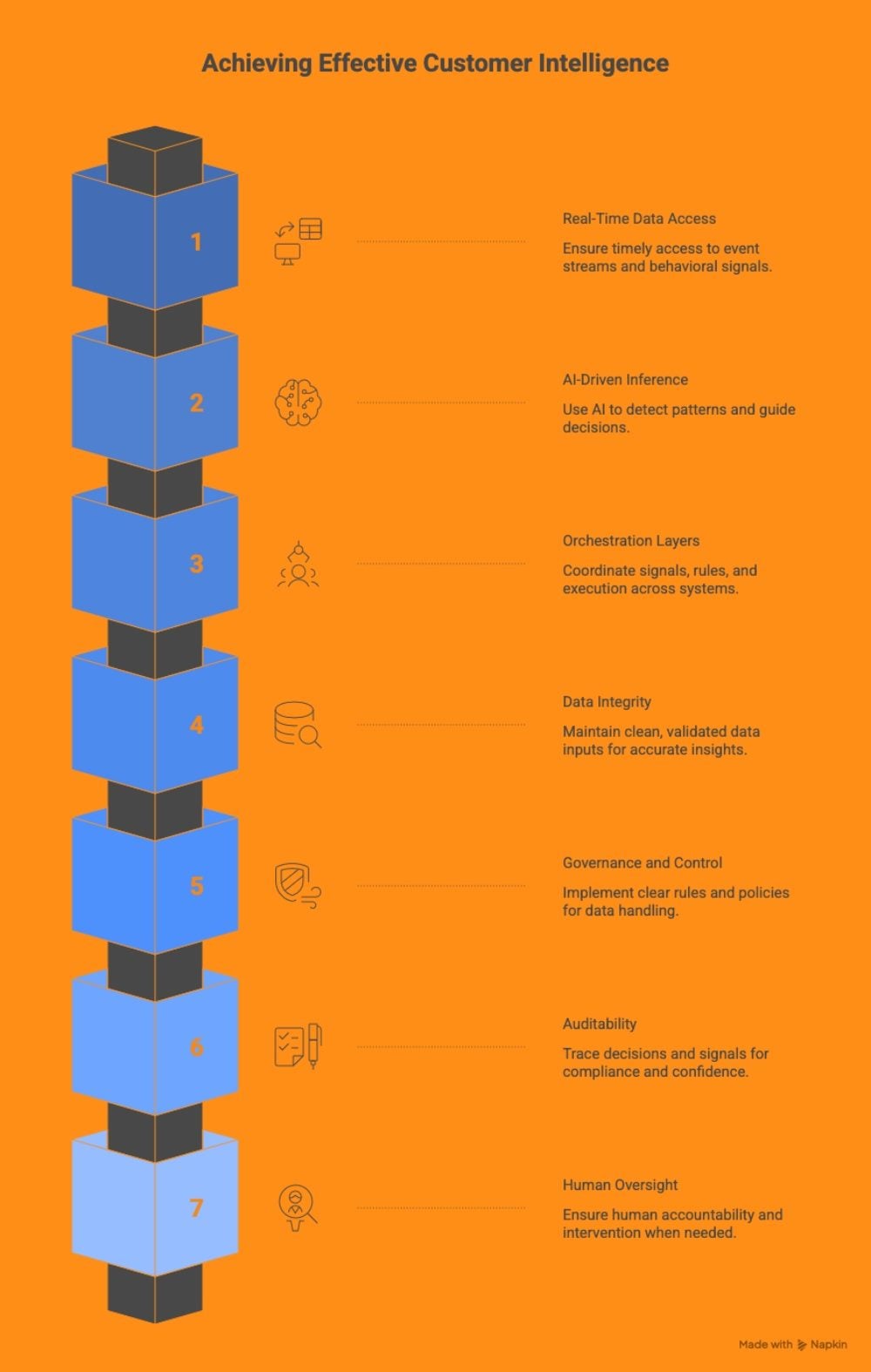
Orchestration layers and decision engines make this coordination possible. They determine which signals matter in a given moment, apply rules or AI-driven inference and route decisions to the appropriate channels or workflows. This allows brands to respond dynamically as conditions change, without forcing every decision through a single data store or activation layer.
Taken together, these shifts redefine customer intelligence as a capability rather than a destination. It is something continuously assembled and applied, not something fully built and stored. This systems-based approach reflects how modern CX actually operates, balancing historical insight with live context to support decisions that are timely, relevant and adaptable.
AI has become a critical enabler of composable customer intelligence, not because it centralizes data, but because it can detect patterns and generate inferences across fragmented signals. Rather than relying on fully unified profiles, AI models can interpret behaviors, intent and context drawn from multiple systems, allowing intelligence to emerge even when data remains distributed.
This table outlines the core capabilities that support customer intelligence when insight is assembled across systems rather than centralized in a single platform.
| Capability | What It Supports | Why It Matters |
|---|---|---|
| Orchestration Layers | Coordinating signals, rules, and execution | Ensures intelligence is applied consistently across channels |
| Real-Time Data Access | Event streams and behavioral signals | Enables timely decisions during live interactions |
| AI-Driven Inference | Pattern detection and next-best-action logic | Transforms fragmented data into actionable insight |
| Governance and Oversight | Policy enforcement and auditability | Builds trust as intelligence drives real outcomes |
This capability is especially important for real-time scoring and next-best-action logic. During live journeys and interactions, AI can weigh recent events, historical signals and situational context to guide decisions as they happen. These in-the-moment assessments support personalization, prioritization and routing without requiring every signal to be consolidated ahead of time.
As AI becomes more agentic, the biggest limiter is not model capability but the quality, consistency and timing of the data feeding those systems.
Derek Slager, CTO and co-founder at Amperity, which provides a customer data cloud, told CMSWire, "AI’s real value today is speed and clarity, not replacement. Where AI struggles isn’t with model quality. It’s with data reality. Even the best models can’t overcome fragmented identities, delayed updates or inconsistent definitions." Slager suggested that AI delivered value by accelerating insight and action, but he noted that fragmented identities and delayed data quickly undermined even strong models.
As AI is pushed closer to real-time decisioning, the integrity of the data feeding those systems becomes a defining constraint on outcomes. Without clean, validated inputs, intelligence systems risk amplifying errors rather than improving outcomes.
Jessica Hammond, senior director of product management, GenAI at Protegrity, told CMSWire, "The evolution from CDPs to customer intelligence systems shines a brighter light on the need for clean data. Many organizations put in just enough effort to make AI work, but skip the harder work of securing and validating the data behind it. AI depends on good data,” said Hammond, who added that while AI can help clean data, it can only do so to the extent that the underlying data quality allows."
However, AI effectiveness in this model depends less on model sophistication and more on orchestration and data access. Even advanced models struggle when signals are delayed, incomplete or disconnected from execution systems. Orchestration layers ensure that AI receives the right inputs at the right time and that outputs are applied consistently across channels and workflows.
In practice, this means AI does not replace the need for strong system design. Instead, it amplifies the value of well-coordinated architectures. When paired with reliable data access and disciplined orchestration, AI becomes a practical engine for customer intelligence rather than a standalone solution searching for problems to solve.
Related Article: The Case for Zero Copy in the Modern Customer Data Stack
As customer intelligence becomes more distributed, governance and control grow more complex, not less. When data and decisioning span multiple systems, businesses must manage access, enforce policies and maintain consistency across environments that were not originally designed to work together. Without clear governance, distributed intelligence can quickly introduce risk, fragmentation or unintended exposure.
Data access and policy enforcement are central to this challenge. Teams need confidence that sensitive information is handled appropriately, regardless of where it is accessed or processed. This requires clear rules around permissions, usage and retention that apply across systems, along with mechanisms to enforce those rules consistently. In a composable model, governance must travel with the data and decisions, not remain tied to a single platform.
As intelligence spreads across systems, the risk shifts from data sprawl to decision sprawl. Without explainability, businesses lose confidence in AI-driven outcomes. Kale said that as intelligence became more distributed, accountability and explainability challenges increased, adding that teams needed visibility into which signals influenced decisions and how those decisions could be audited later.
Auditability is equally important as AI-driven actions influence real outcomes. Brands need the ability to trace how decisions were made, which signals were used and why certain actions were taken. This visibility supports regulatory compliance, enables faster investigation when issues arise, and helps internal teams build confidence in systems that increasingly operate in real time.
Human oversight remains the final safeguard. Even in mature, well-orchestrated environments, not every decision should be automated. Clear escalation paths, review mechanisms and intervention points ensure that people remain accountable when intelligence drives customer-facing outcomes. In distributed models, trust is built not by removing humans from the loop, but by giving them the tools and transparency needed to stay firmly in control.
Composable customer intelligence is the ability to assemble customer insights dynamically at decision time by orchestrating data, context and inference across systems, rather than relying on a single centralized platform such as a CDP.
The move toward composable customer intelligence is reshaping how CX, marketing and data teams work together. Intelligence assembled across systems requires closer collaboration between groups that have traditionally operated in parallel. CX teams bring context about customer journeys and interactions, data teams manage access and integrity, and AI teams focus on inference and decisioning. When these perspectives align, intelligence becomes easier to apply in ways that reflect real customer behavior rather than isolated metrics.
This shift also reduces reliance on monolithic stacks in favor of more coordinated systems. Instead of expecting a single platform to handle every function, businesses are connecting specialized tools through orchestration layers that support flexibility and change. This approach allows teams to adapt more quickly as requirements evolve, but it also places greater emphasis on shared standards, communication, and system design.
As a result, skills and mindsets are changing. Teams are moving away from thinking in terms of ownership over platforms and toward responsibility for outcomes. Success depends on understanding how data, AI, and execution fit together, as well as knowing when to prioritize speed, accuracy, or control. In this environment, customer intelligence becomes a collective capability, shaped as much by collaboration and governance as by technology itself.
The shift from customer data platforms to customer intelligence systems reflects a change in where insight gets built and applied. CDPs remain valuable for identity, historical context, and segmentation, but modern CX depends on decision-time intelligence assembled across systems using live signals, analytics, and governed access.
In this model, orchestration determines which inputs matter, AI turns those inputs into usable inference, and governance ensures that decisions remain explainable and compliant. The practical implication is simple: businesses that are architected for context, speed and trust will outperform those that still optimize primarily for consolidation.
Scott Clark is a seasoned journalist based in Columbus, Ohio, who has made a name for himself covering the ever-evolving landscape of customer experience, marketing and technology. He has over 20 years of experience covering Information Technology and 27 years as a web developer. His coverage ranges across customer experience, AI, social media marketing, voice of customer, diversity & inclusion and more. Scott is a strong advocate for customer experience and corporate responsibility, bringing together statistics, facts, and insights from leading thought leaders to provide informative and thought-provoking articles. Connect with Scott Clark: 