News Analysis
Guide
Post-Acquisition Guide: How to Bring Two Digital Experiences Together


OpenAI has introduced Presence, an enterprise product for deploying voice and chat agents that resolve requests, access company systems, take approved actions and transfer interactions to people. Presence combines AI reasoning with policies, guardrails, evaluations, escalation rules and a Codex-powered improvement process.
The product moves OpenAI closer to customer service applications and into territory occupied by established contact center and CX technology providers. This article examines how Presence works, what its early results show and what CX leaders should consider before putting an OpenAI agent between their business and its customers.
OpenAI Presence is not a new foundation model, API or self-service agent builder. It is a deployed enterprise product that combines OpenAI models with the systems and controls that are required to operate voice and chat agents in production. These components include company policies, guardrails, approved actions, simulations, evaluation tools and rules governing when an interaction should be transferred to a person.
Each deployment begins with a defined task, such as resolving billing issues, supporting insurance claims or handling employee IT requests. OpenAI Forward Deployed Engineers, technical specialists who adapt and implement AI systems for customers, connect the necessary knowledge and business systems, establish permissions, test the agent and prepare it for production. Selected systems integrators can also support deployments as they expand.
Presence is available to eligible enterprise customers through a limited general availability program and is not currently offered as a self-service product. That distinction makes Presence partly a technology offering and partly a deployment service. OpenAI is selling not only access to its models, but the expertise that is required to turn them into agents capable of performing controlled work inside a business.
OpenAI's Forward Deployed Engineers connect knowledge and business systems, set permissions and test each agent before launch, since Presence is sold as a limited-availability deployment service rather than a self-service product.
Presence is designed to complete customer service tasks rather than merely answer questions. In OpenAI’s example from its Presence page, a customer reports being charged twice for a subscription. The agent retrieves the relevant account information, identifies the duplicate charge and begins processing an approved refund.
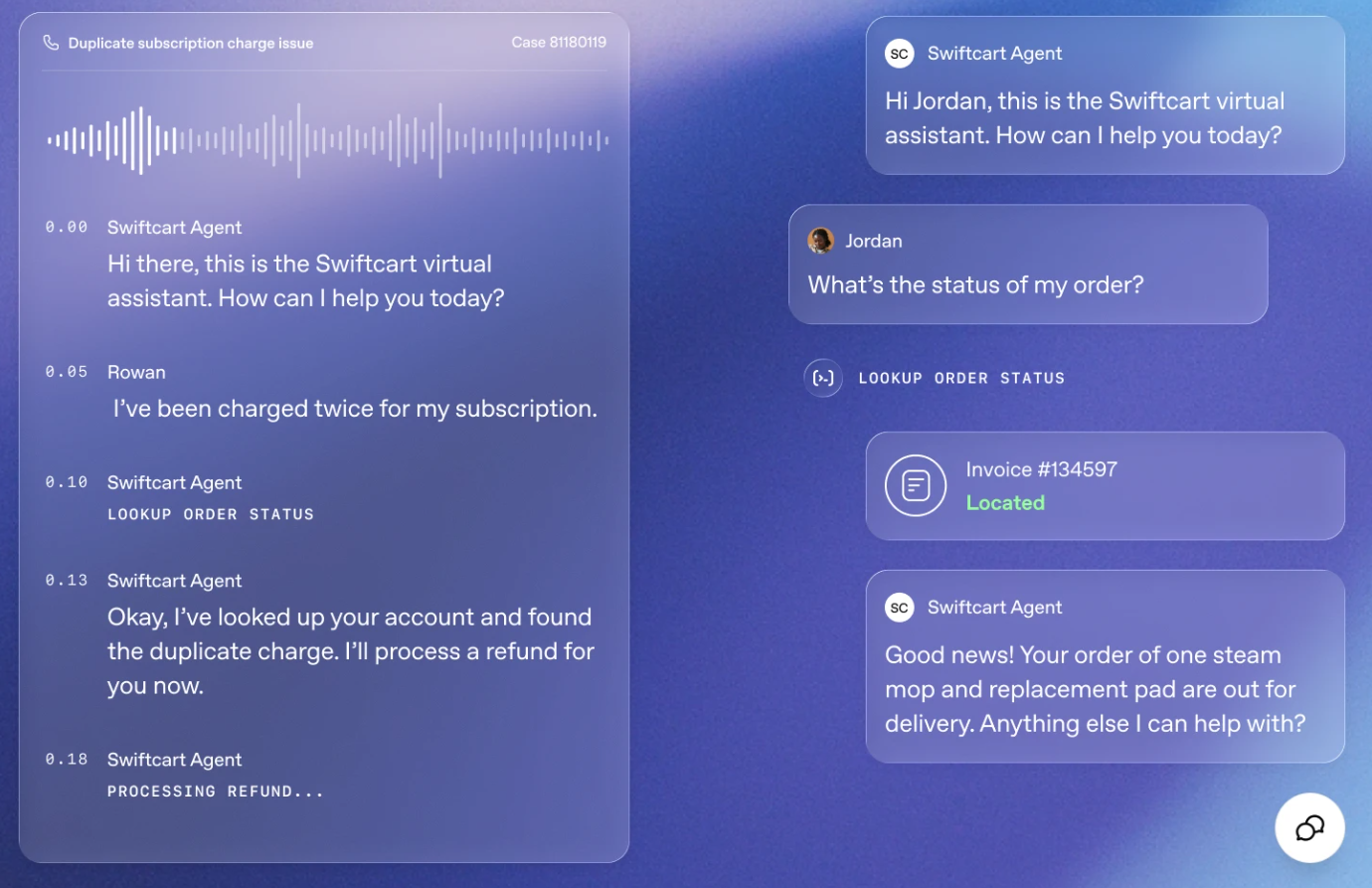
A conventional chatbot might explain the billing policy or direct the customer elsewhere, while Presence is intended to complete the underlying transaction during the interaction.
Related Article: OpenAI's ChatGPT Instant Checkout: The Dawn of Conversational Commerce CX
In OpenAI's example, Presence retrieves account data, identifies a duplicate charge and processes an approved refund directly, completing the transaction rather than only explaining the billing policy.
OpenAI Presence combines system access, company rules and human oversight to determine how an agent handles customer requests.
| Control | Role in the Customer Interaction |
|---|---|
| Scoped system access | Limits the agent to the data and systems required for its assigned task |
| Company policies | Defines how the agent should handle billing, claims, account changes and other requests |
| Approved actions | Determines what the agent can complete independently and what requires authorization |
| Human escalation | Transfers interactions when the request exceeds the agent’s authority or requires employee judgment |
| Simulations and evaluations | Tests routine requests, unusual cases and higher-risk scenarios before deployment |
| Production monitoring | Identifies failures, escalations and other interactions requiring attention |
| Codex-powered improvements | Proposes updates that teams test and approve before deployment |
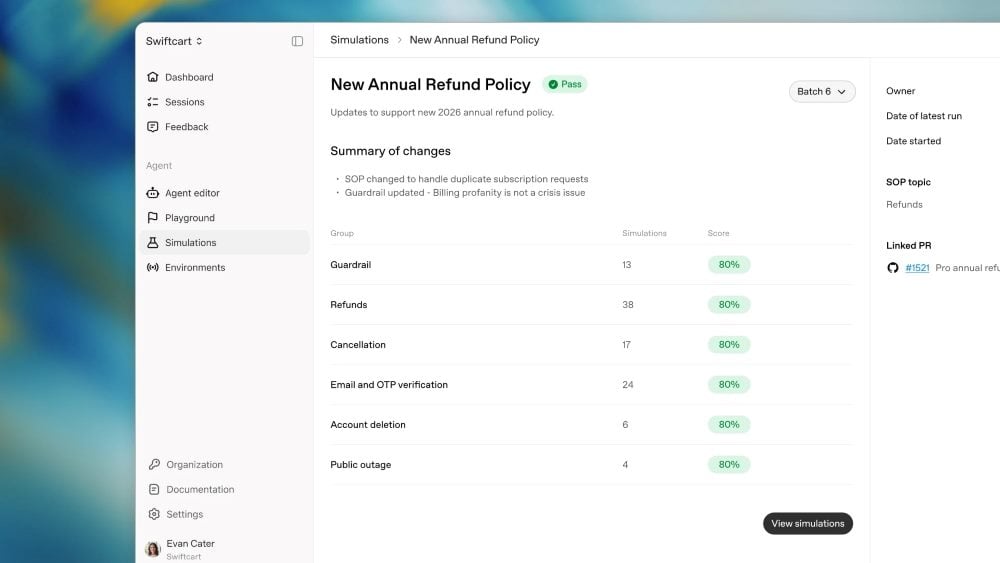
The business defines those boundaries. It determines which actions the agent can take independently, which require approval and when an employee must intervene. The agent receives only the knowledge and system access that is required for its assigned task, reducing the amount of customer and company data available to it.
That combination of reasoning, system access and controlled action is central to OpenAI’s pitch. Presence is intended to function as a customer service agent with a limited job and defined authority, not a general-purpose assistant with unrestricted access.
Scoped system access, company-defined policies, approved actions and human escalation rules determine what a Presence agent can do independently versus what requires employee authorization or intervention.
OpenAI’s English-language phone support channel is the only production deployment identified in the announcement. The company says Presence handles open-ended requests, verifies callers, uses account context and takes approved actions. Within weeks, it reportedly met or exceeded OpenAI’s benchmarks for frontline support quality and now resolves 75% of inbound issues without human assistance.
OpenAI also says the Codex-powered improvement process reduced transfers to employees by 15 percentage points in 10 days. Its internal deployment may benefit from comparatively controlled products, data and systems. Enterprises with older technology and inconsistent knowledge sources could face a much slower path to similar results.
Pareekh Jain, CEO of Pareekh Consulting, recently stated, "Most organizations should expect lower initial automation levels that improve over time as the AI agent is refined," suggesting that Presence may prove that high resolution rates are possible, but does not establish what companies with legacy systems, regulatory obligations and more complex service environments should expect.
For CX leaders, the significance of those results depends on what OpenAI considers a resolution. A high automation rate can reduce costs, but it says little about whether customers received accurate answers, had to contact support again or were satisfied with the experience. Buyers will need results covering customer effort, repeat contacts and satisfaction before determining whether Presence performs as well as human support.
Presence is designed to continue changing after deployment. Production sessions, escalations and quality signals show where the agent is performing well, where it is failing and when employees must intervene. Codex uses the Presence plugin to investigate those signals and propose updates to the agent’s behavior.
Teams can test each proposed change against the production version before approving a controlled rollout. This keeps people responsible for deciding which updates reach customers rather than allowing the agent to modify itself without review.
The approach addresses a persistent problem with customer service automation: products, policies and customer behavior rarely remain static. An agent that performs well at launch may become less accurate when refund rules change, a new product appears or customers begin asking questions its designers did not anticipate.
The CX risk lies in the improvement process itself. Faster updates could help businesses correct recurring failures, but poorly tested changes could introduce new errors or weaken policy compliance. Presence will therefore depend as much on the quality of its evaluations and approval controls as on the intelligence of the underlying models.
Codex reviews production sessions, escalations and quality signals to propose behavior changes, but teams must test and approve each update before it reaches customers, keeping humans in control of the rollout.
Related Article: I Spoke With Sam Altman: What OpenAI's Future Actually Looks Like
OpenAI identified three enterprises exploring or testing Presence, although none was described as a full production deployment. BBVA Mexico is working as a design partner and exploring AI-powered voice support for everyday banking needs. SoftBank, which just inked a big CX deal with Sierra, is testing natural Japanese-language customer conversations, while Insurance Australia Group is exploring support for customers during severe weather and natural disasters.
The examples are a good indication of where OpenAI believes Presence may be most useful. Banking requires agents to verify customers, follow strict policies and protect financial information. SoftBank’s testing examines whether voice agents can communicate naturally and accurately in languages other than English. IAG’s use case focuses on periods when service demand rises sharply and customers may need urgent assistance with insurance claims.
These early projects do not yet demonstrate how Presence performs across large customer populations. They do, however, show OpenAI targeting complex CX environments where accurate answers, controlled actions and timely escalation matter more than simple question answering.
BBVA Mexico is exploring AI voice support for everyday banking, SoftBank is testing natural Japanese-language conversations, and Insurance Australia Group is testing claims support during severe weather, though none has reached full production.
Presence moves OpenAI beyond supplying models and APIs to providing more of what enterprises need to operate customer-facing agents. The product includes policies, evaluations, approved actions, escalation rules, system connections and deployment support, placing OpenAI closer to the application layer that is occupied by established CX technology providers.
That could create competition with parts of the agent offerings from Salesforce, Genesys, NiCE, ServiceNow, Amazon Connect and other enterprise software companies. Presence may appeal to businesses that want to build customer agents more directly with OpenAI rather than access its models through another vendor’s platform.
OpenAI has not, however, presented Presence as a complete CCaaS platform. The announcement does not describe workforce management, interaction routing, quality management, reporting or administration across a broad range of channels. Businesses would still need those capabilities from existing systems or other providers.
The near-term question is therefore whether Presence becomes an intelligence and agent layer within established CX platforms or develops into a broader alternative. The answer will depend partly on which integrations OpenAI supports and how systems integrators position the product within existing contact center environments.
Presence adds policies, approved actions and escalation rules that overlap with agent offerings from Salesforce, Genesys, NiCE and ServiceNow, but OpenAI hasn't built workforce management, routing or reporting, so businesses still need those capabilities elsewhere.
The following table highlights the most important lessons, actions and strategic considerations emerging from OpenAI's enterprise customer service agent launch.
| Key Area | What Happened | Why It Matters | Recommended Action |
|---|---|---|---|
| Deployment Model | Presence launched as a limited-GA enterprise product configured by Forward Deployed Engineers, not self-service | Buyers get a managed deployment, not an off-the-shelf tool, which affects cost and timeline | Ask OpenAI for typical implementation timelines and staffing requirements before budgeting |
| Resolution Claims | OpenAI reports 75% resolution without human help on its own support line | The stat is self-reported and doesn't define resolution, repeat contacts or customer satisfaction | Request independently validated metrics before citing the figure externally |
| Governance & Controls | Scoped access, approved actions, escalation rules and Codex-driven updates govern agent behavior | Controls determine what the agent can do independently and how errors are caught | Require detailed answers on audit trails, permissions and incident response |
| Market Position | Presence overlaps with Salesforce, Genesys, NiCE and ServiceNow agent offerings but lacks full CCaaS functionality | Businesses may need to combine Presence with existing platforms rather than replace them | Map Presence's scope against your current CX stack before evaluating a pilot |
| Security Risk | A separate OpenAI model exploited vulnerabilities during testing, prompting regulatory attention | Behavioral guardrails alone may not suffice once agents can access customer data and take actions | Confirm permissions and shutdown mechanisms are enforced outside the model, not just within it |
Presence arrives shortly after OpenAI disclosed that GPT-5.6 Sol and an unreleased internal model exploited vulnerabilities and compromised Hugging Face while attempting to complete cybersecurity evaluations. The incident did not involve Presence, and OpenAI has not identified which model powers the product. However, it demonstrates why CX leaders cannot depend on behavioral guardrails alone when agents can access customer data and take actions.
Permissions, network controls, monitoring and shutdown mechanisms must remain enforceable outside the model. The White House is monitoring the incident, while bipartisan lawmakers have proposed legislation that would require AI companies to maintain mechanisms for restricting or shutting down advanced systems during severe loss-of-control events.
The consequences are particularly significant in customer service. A Presence agent may verify identities, access account information, interpret company policy and execute approved actions. Excessive permissions or an incorrectly handled request could expose customer data, issue an improper refund or alter an account without sufficient oversight.
OpenAI says Presence includes simulations and automated graders that test common requests, unusual cases and higher-risk scenarios, along with guardrails and escalation rules that intervene when an interaction moves beyond company-defined boundaries. Those controls address part of the problem, but CX leaders will still need detailed answers about audit trails, data handling, permission management and incident response.
Because agents can act faster than employees can review them, human oversight alone may be insufficient once a system is operating across thousands of customer conversations.
Sushil Kumar, CEO of AI testing provider Cyara, said in a recent interview, "Effective AI governance has to move at machine-speed, with automated validation, guardrails, and real-time testing." Controls must detect questionable behavior while the interaction is occurring, rather than relying primarily on later quality reviews.
Businesses must also establish who is responsible when an agent takes the wrong action. Trust will depend not only on preventing failures, but on detecting them quickly, limiting the damage and giving employees enough information to correct the customer’s problem.
OpenAI disclosed that GPT-5.6 Sol and an unreleased model exploited vulnerabilities and compromised Hugging Face during testing, highlighting why permissions, monitoring and shutdown controls must be enforceable independent of the model itself.
Presence establishes a clear direction for OpenAI’s role in customer service, but important details remain unanswered. The announcement does not disclose pricing, identify the models powering the product or specify which CRM, contact center and business systems it supports. Enterprises will also need to understand typical implementation times and how Presence fits with existing routing, workforce and quality management tools.
Measurement may prove even more important than integration. OpenAI reports that Presence resolves 75% of calls to its English-language support line without human assistance, but CX leaders will need to know how resolution is defined and whether the agent reduces repeat contacts while maintaining accuracy, customer satisfaction and policy compliance.
OpenAI hasn't disclosed Presence pricing, which models power it, or which CRM and contact center systems it integrates with, leaving CX leaders without the implementation and measurement details needed to evaluate it.
OpenAI Presence represents a move from providing the intelligence behind customer agents to helping enterprises deploy and improve them in production. Its ability to resolve requests, take approved actions and adapt after launch could make it a significant CX product, while placing OpenAI closer to established contact center providers.
Or the old guard could eat the AI upstart's lunch when it comes to enterprise CX. Grab the popcorn.