LGI Homes VP of Marketing Hayden Clark sat down with CMSWire Editor in Chief Dom Nicastro for this episode of CMO Circle, tracing a career arc that ran from Nick Saban's film room at Alabama to a Vanderbilt wide receivers coaching staff before landing in corporate marketing.
Clark breaks down how he's structured a five-team in-house marketing operation, what he actually looks for when hiring in 2026, and why LGI's first proprietary iOS app — built on Sitecore CDP data — may be the most important thing his team ships this year.
Host
Guest

Dom Nicastro

Hayden Clark
Breaking Down Our Chat
Table of Contents
- The Road From Tuscaloosa to Texas
- What a Marketing Hire Actually Looks Like in 2026
- Marketing to the Biggest Purchase of a Buyer's Life
- AI, Search and the Buffer Real Estate Buyers Provide
- What Sitecore Has to Do With Closing the Deal
The Gist
- Football built the framework. Hayden Clark worked on Nick Saban's staff at Alabama and coached wide receivers at Vanderbilt before pivoting to marketing — and says the team-first, competitive mindset from that world directly shapes how he hires, develops talent and runs a five-team in-house marketing operation at LGI Homes.
- Soft skills over résumé depth. Clark gravitates toward curiosity, passion and willingness to grow over years of experience, and has built a deliberate practice of hiring early-career candidates — including intern-to-full-time conversions — betting that brand loyalty and drive outpay a longer CV.
- Transparency is the product for first-time buyers. LGI's core customer is making the largest purchase of their life with limited experience and high anxiety — and Clark's team responds with one transparent price, no bidding and a relentless effort to reduce ambiguity at every stage of a complex transaction.
- Real estate has a search buffer — for now. Clark sees AI answer engines and Google's ad monetization both compressing organic search value, but believes high-intent real estate buyers still have to find a real seller, giving LGI insulation while it invests in schema and structured content to become the cited source inside AI-generated responses.
- The iOS app is the gap-closer. LGI is close to launching a proprietary iOS app that surfaces Sitecore CDP and Experience Cloud data on sales staff iPads, designed to carry the digital journey a buyer started online directly into the in-person sales center conversation.
Hayden Clark didn't set out to become a VP of Marketing. He set out to be a football coach.
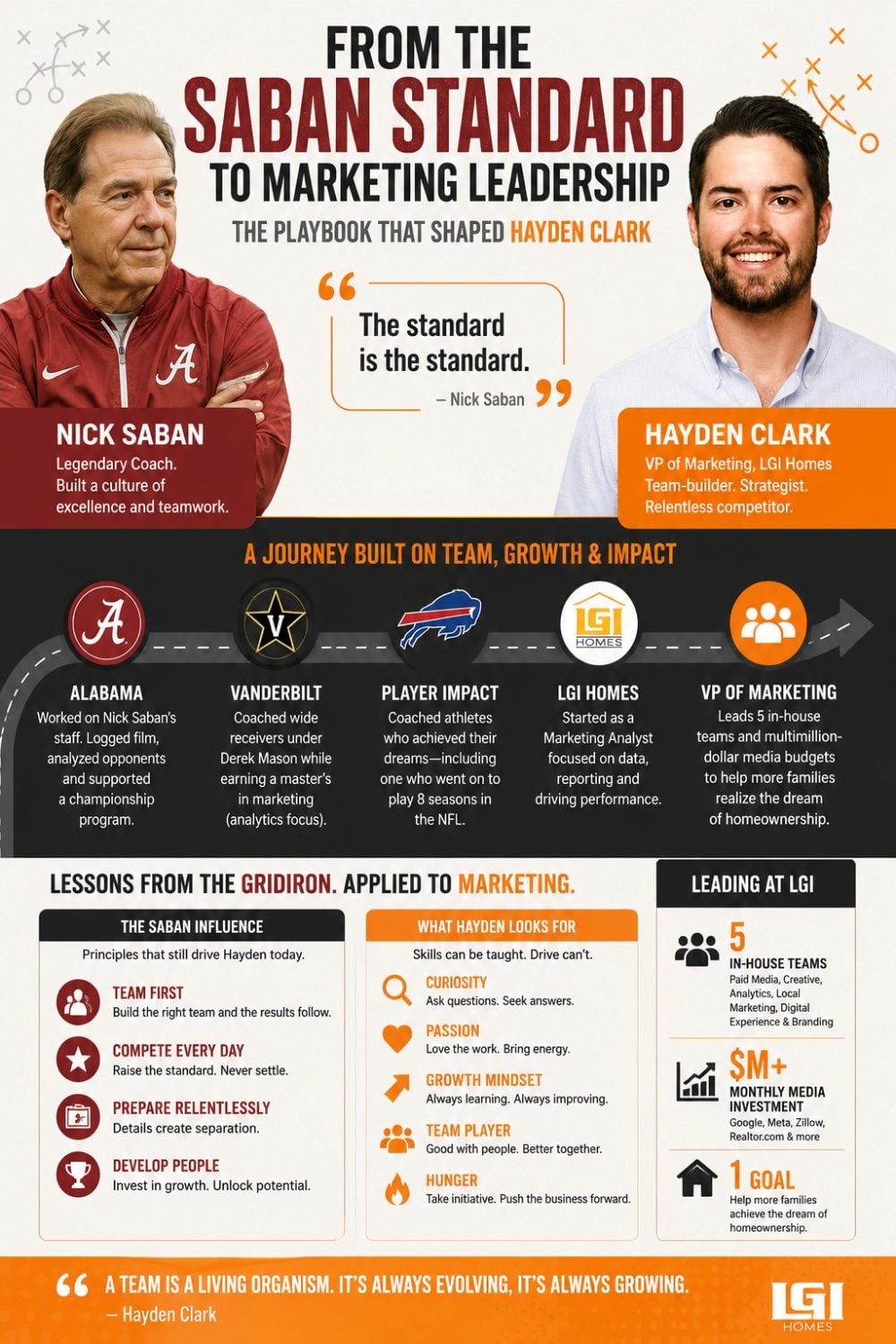
The path he took instead — from Nick Saban's film room at the University of Alabama to a wide receivers coaching role at Vanderbilt to a marketing analytics desk at LGI Homes — shaped a leadership philosophy that has little to do with job titles and everything to do with team-building, curiosity and knowing when to get your hands dirty.
Clark sat down with CMSWire Editor in Chief Dom Nicastro for this episode of CMO Circle to talk about how he's built one of homebuilding's more formidable in-house marketing operations, what he actually looks for in a hire, how LGI reaches the most emotionally charged buyers in the market, and what a proprietary iOS app has to do with closing the online-to-offline gap in customer experience.
The Road From Tuscaloosa to Texas
Clark's undergraduate years at Alabama weren't spent in a lecture hall debating brand equity. He was on Saban's staff, logging film, breaking down opponents and loading everything into the team's system so players and coaches could access it anywhere. After Alabama, he followed that work to Vanderbilt, where he coached wide receivers under head coach Derek Mason while simultaneously earning a master's degree in marketing with an analytics focus from the Owen Graduate School of Management.
One of the players he coached during that stint went on to sign with the Buffalo Bills for an eighth NFL season. Clark mentions it with obvious pride, then pivots quickly. A family decision made corporate marketing the right next move, and LGI Homes was the landing spot. He came in as a marketing analyst — heavy on reporting, channel performance, and the back-end numbers that tell you what's working and what isn't.
Nine years later, he's the VP of Marketing, overseeing five fully in-house teams: paid media, creative, analytics, local marketing and digital experience and branding. The paid media team alone is running million-dollar monthly budgets across Google, Meta and third-party real estate platforms like Zillow and Realtor.com.
"A team is a living organism," Clark said. "It's always evolving, it's always growing. Even if you have the same team members, different people are evolving on their own trajectories, they're adding new skills."
What a Marketing Hire Actually Looks Like in 2026
Clark is blunt about what he's looking for — and equally blunt about what he isn't. Three-to-five years of experience on a résumé doesn't move him. What does is harder to quantify.
"The intangibles that I personally gravitate towards — are you good with people? Are you passionate about coming to work? Are you passionate about your own growth? Do you wanna take on more than what I give you?" Clark said. "Are you always gonna be pushing and thinking about the business and like, how can we make this better?"
He's made a deliberate habit of hiring early — sometimes straight out of school, sometimes converting interns before they've hit their first work anniversary. The tradeoff is real: more training, more runway required. But Clark argues the return is worth it. Young hires who come up inside a brand they love become its most committed advocates.
"You can have some really enthusiastic, loyal brand ambassadors on your team when you go that route," he said.
He connects this back to football without much prompting. Competitive environments, he said, teach you to look for fire over credentials. The skills can be developed. The drive either exists or it doesn't. When it comes to marketing trends like AI fluency, Clark takes the same pragmatic view — push younger team members toward technical coursework wherever universities offer it, because the businesses that need those skills aren't waiting for academia to catch up.
Related Article: The Top Challenges Facing CMOs in 2026
Marketing to the Biggest Purchase of a Buyer's Life
LGI Homes operates across 21 states and has built its brand almost entirely around first-time, entry-level homebuyers. That's a deliberate positioning — and it shapes everything about how Clark's team markets.
The typical LGI buyer is at a major life inflection point: a first marriage, a new baby, kids approaching school age. It's the largest single purchase they've made, and they're navigating it with limited experience and considerable anxiety. Competing narratives swirl around them — friends who say their mortgage came in below rent, others who warn about maintenance costs they never saw coming.
"As a brand, I think it's important that you acknowledge that," Clark said. "Don't come in and be austere and like, 'well, we'll just make everything better.' Meet customers where they are, be realistic about the process."
LGI's answer to that anxiety is transparency. One price. No bidding. No ambiguity at the closing table. The goal, Clark explained, is to strip out as many variables as possible so buyers can focus on what actually matters to them — not the sticker price, but the monthly number.
"How can we make this as simple and as streamlined so that there's clarity about what you're purchasing," he said.
On the channel side, organic search driven by genuine buyer intent remains the highest-converting traffic source. But LGI also performs well through real estate aggregation platforms like Zillow, where buyers are often further along in their journey and simultaneously evaluating multiple properties. Email holds its own across a buy cycle that can stretch six months or more. And social media serves double duty — keeping active prospects engaged while also reaching buyers who haven't yet realized they're ready to buy.
AI, Search and the Buffer Real Estate Buyers Provide
Clark isn't dismissing what AI is doing to search, but he's also not treating it as an existential crisis — at least not yet. He sees two forces working in concert to compress organic search value: AI answer engines pulling clicks away from results pages, and Google's own monetization strategy pushing organic links further down the page on high-value queries.
But real estate, he argues, has a structural buffer. A buyer who has fact-found their way through AI-generated answers still eventually needs to find a seller with an actual product to sell.
"At least today, the high intent traffic isn't getting siphoned off," Clark said.
In the meantime, LGI is investing in schema markup and structured content designed to make its pages more readable to AI crawlers — not necessarily to drive clicks, but to become the cited source when AI surfaces an answer about new construction or first-time homebuying. Being there matters even when no click follows.
"We would like to be the source of truth that it sources from," Clark said, "when people ask general real estate or home buying or new construction questions."
That investment connects directly to LGI's broader digital experience platform strategy. The team still calls it SEO internally, Clark said, but the work looks different than it did five years ago.
What Sitecore Has to Do With Closing the Deal
The most forward-looking initiative Clark discussed involves a proprietary iOS app LGI is close to launching internally — one designed to carry CDP and Experience Cloud data from Sitecore into the physical sales center. Sales staff running the app on an iPad will be able to surface content a buyer already engaged with online and contextualize it in person — meeting the buyer at their actual stage in the journey rather than starting from scratch.
It's a direct response to a problem Clark has been focused on for years: LGI's purchase cycle doesn't end online. It ends in a sales center, with a human conversation, often weeks or months after the first website visit. The digital experience can do a lot of work, but it can't close the deal alone.
"Because we still have a purchase cycle that happens offline, a lot of our focus is how can we bring and narrow the gap from the online digital experience a customer begins their journey on into that sales center," Clark said.
The app is one answer to that. But Clark frames it as part of a broader philosophy — one that runs from film breakdowns in Tuscaloosa all the way to a sales agent standing in a model home in suburban Texas, iPad in hand, ready to pick up the conversation exactly where the buyer left off.