Editorial
Research Report
Building the Case for Modern Public Sector Messaging


Key takeaway: CRMC 2026 surfaced three recurring failures in retail loyalty strategy — brands that listen superficially, friction that persists because CX teams are excluded from policy decisions and disruptive ideas that die inside siloed organizations. AI tools are accelerating all three problems for brands that have not addressed the fundamentals first.
Agentic commerce is no longer on the horizon—it's here and scaling fast. This shift is forcing retailers to completely overhaul their operations to build customer loyalty and boost awareness from the ground up. Before diving in, we need to ask a critical question about every 2026 plan: Are we committing to genuine, fundamental transformation, or are we simply buying a new software package and calling it "transformation"?
That question followed me into CRMC, the Customer Relationship Management Conference, where nearly 1,000 attendees from more than 200 brands came to have a conversation about customer loyalty and what it takes to maintain it in the months ahead. The event ran June 1–3 at the Omni PGA Frisco Resort & Spa in Frisco, Texas, a championship golf resort just north of Dallas.
Ashley Travis, head of growth marketing at Pizza Hut, opened by saying customer behavior is "fundamentally changing," with expectations rising to match the best experience a customer has had anywhere, in or out of your category. This surely resonated with all the attending retail marketers who are under real pressure to deliver ROI, and every roadmap now includes an AI line item. Speed is easy to buy. Coordinated execution is not. The three keynotes CRMC selected, on loyalty, friction and disruption, converged on that gap.
Paul Epstein, the opening keynote speaker, addressed customer loyalty. Before founding Win Monday, he spent 15 years in the NFL and NBA, including a run as Chief Revenue Officer of the San Francisco 49ers, and his keynote built on a phrase from that work: every seat has a story.
The 49ers ran blanket campaigns on autopilot until Epstein's team replaced them with listening sessions that surfaced origin stories and the reasons fans stayed through losing seasons, and built personalized experiences from there. "It took an organizational year and a half of just listening," he told me earlier when I interviewed him on The Agile Brand podcast. "No activation, just listening."
While most retailers do not have a sports franchise's budget or fanbase, this method scales. Pick three customers, the most loyal, a newer one, and a prospect, and find the connective tissue in what they tell you. This is people-and-process work, where loyalty is built or lost. "
Everyone loves a blueprint that their fingerprints are on," he said.
David Avrin came at loyalty from the friction side. He helps organizations become, in the words of his book title, ridiculously easy to do business with. His finding: the strongest predictor of loyalty is effort, measured by how hard it is for a customer to do the thing they came to do.
Avrin identified two types of friction as necessary, and self-inflicted. The necessary friction includes compliance, fraud prevention and a receipt for a return. The remaining friction is often a byproduct of potentially well-intentioned but ultimately self-defeating policies and procecures: store-credit-only refunds, subscriptions that take way too long to cancel and free trials that resurface only when you get the bill.
In too many of these cases, operational policy gets written without marketing or CX in the room, and the customer ends up with a journey built for the company's convenience.
"Your customers haven't read your employee manual," he said. They arrive with expectations set by every other industry they touch. "Convenient is better than better."
Related Article: The New King of Customer Experience? McDonald's. Seriously.
Kaihan Krippendorff, founder of Outthinker and a McKinsey alum, focused on the strategic aspects of competing for customers’ attention and loyalty. Incumbents lose, he argues, when they misread what business they are in. Blockbuster built a storefront in the cloud; Netflix built entertainment as a service. The change starts with how leaders define the business.
Established organizations do not lack disruptive ideas. Risk aversion and the pressure to deliver consistently get in the way. "The best way to know your idea is disruptive is when it sparks disbelief," Krippendorff said. That disbelief gets used to shut down original ideas in favor of reasonable ones with clear implementation steps.
His finding on internal coordination is a compelling one. Across interviews with innovation officers at some of the world’s leading companies, including Amazon and Microsoft, his research found that when a customer need gets broadcast inside of a large organization, a solution already exists somewhere in the building over 70% of the time, yet that knowledge is not often enough discoverable.
The breakdown in implementing these ideas usually comes down to simple communication. To handle the pressure for immediate results, Krippendorff suggests looking at experiments as a portfolio—measuring success across the board rather than item by item—while pushing for long-term metrics like customer lifetime value. He remains pragmatic about these frameworks, often reminding his audience that while all models are technically flawed, the best ones are incredibly useful.
CRMC's differentiator as a conference is the roughly 20 curated brand case studies, presented by the operators who did the work. The same three problems kept showing up.
At Home took on the topic of listening to customers. The team admitted it had run a CRM program disguised as loyalty: a welcome, a birthday message and silence in between. Its reset started where Epstein's did, with customers talking about their actual frustrations. Disney used CRM to create a brand experience and built fandom and long-term value from it.
Suncor’s Petro-Canada addressed the challenges of friction when they discussed a paradox with their customers: high visit frequency at the pump that wasn’t converting to preference. Their fix to build greater loyalty removed friction from the digital experience.
T-Mobile took on disruption. The team traced the Un-Carrier strategy to one insight: that wireless loyalty was broken, and walked through its move from brand loyalty to customer appreciation to membership, the mindset shift Krippendorff puts at the center of staying a disruptor. J.Crew argued the other end of the spectrum. Its session, "Innovation by Inches," made the 80/20 case that the brands pulling ahead win by making the basics unmistakably better.
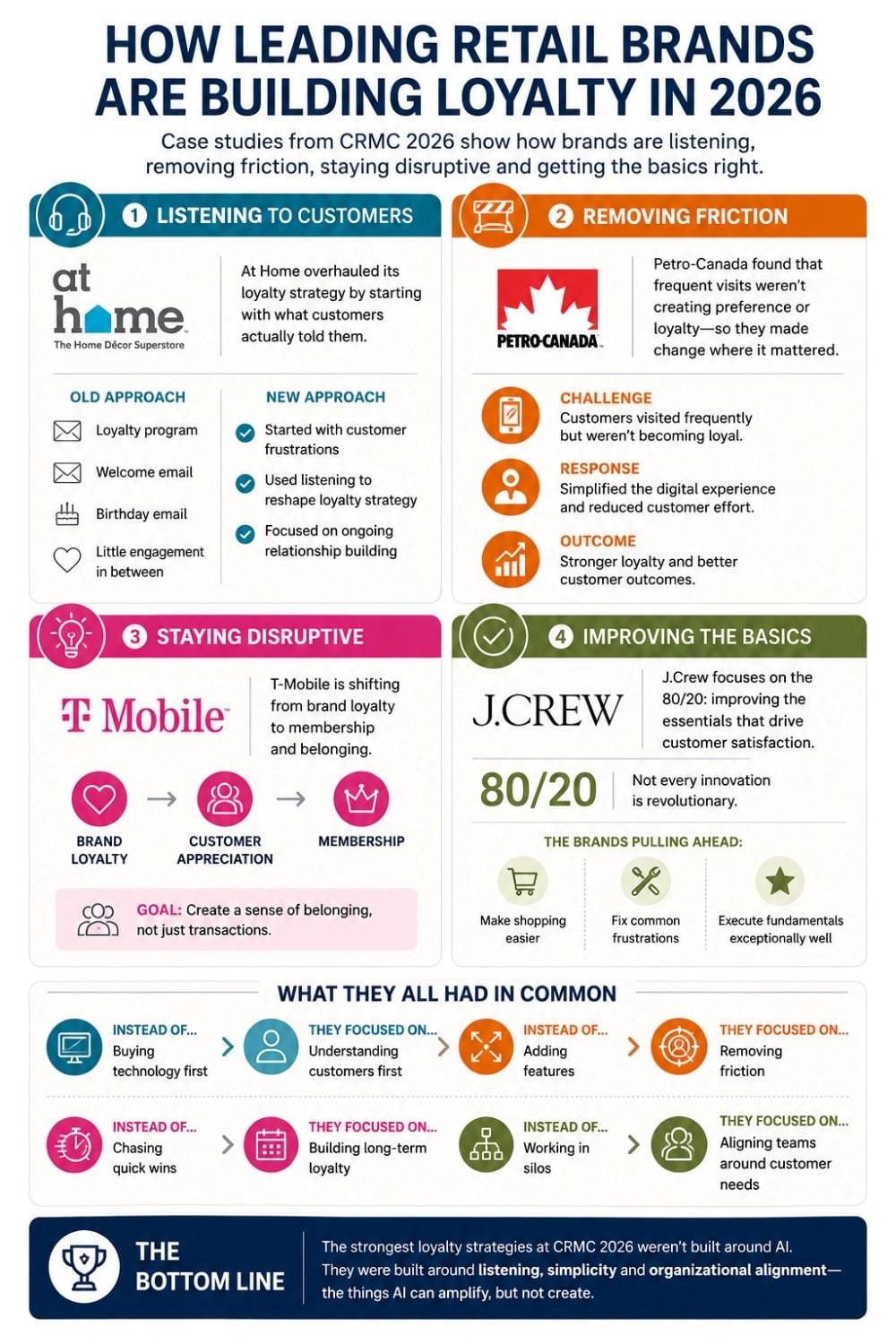
Three threads ran through the three days. Loyalty starts with internal commitment and the discipline to listen. The highest-value improvement to a retail experience is often the one that makes a small task simpler. Team and data silos become more visible as the experience goes omnichannel. None of these gets solved by buying a platform. Each takes a clear view of the experience you want and the commitment to build it.
While the tech lets everyone move faster, the real advantage is coherence across the organization, with all teams and practice areas in step with one another. By contrast, simply applying speed to a disorganized operation just scales the mess, meaning that the adoption of AI only raises the stakes since it has a tendency to accelerate.
Imagine a retailer taking the easy way out: they buy a personalization engine and launch it within a quarter. The engine successfully recommends a product, the customer buys it, but then the return goes through a store-credit-only policy that merchandising implemented without the CX team's knowledge. The recommendation engine and the returns desk operate on completely siloed data. In short, the tool functions, but it just highlights and accelerates the underlying mess.
The transformational part of any 2026 plan is the vision behind the purchase and the measurement and iteration that follow it. The software was never the transformation. Before you approve the next platform in your commerce stack, find your year and a half of listening, the friction you are inflicting on your own customers, and the capability already sitting three doors down.
 Learn how you can join our contributor community.

Greg is a best-selling author, speaker, and entrepreneur. He has worked with some of the world’s leading organizations on customer experience, employee experience, and digital transformation initiatives, both before and after selling his award-winning digital experience agency in 2017.