Editorial
Research Report
Building the Case for Modern Public Sector Messaging


Few topics in SEO start a bar fight faster than schema markup. Bring it up in a Facebook group or an SEO subreddit, and you'll get two camps screaming past each other: the true believers who swear structured data is the secret sauce, and the skeptics who think it's a decade-old security blanket.
I've sat on both sides of this at different points in my career, and the honest answer has always been frustratingly fuzzy: "It probably helps a little, somehow, maybe." Ask ChatGPT about schema markup, and it will confidently tell you that “Schema markup is one of the easiest wins for improving how search engines and AI systems understand your pages.”
The ambiguity ensues!
That's not good enough when you're spending a client's budget (and your precious time). So when two serious, data-heavy studies dropped recently, along with Google quietly killing off more structured data types, I figured it was time to stop guessing and look at what the numbers actually say.
Let's settle this.
Quick refresher for anyone who needs it. Schema markup is structured data, usually written in JSON-LD, that you embed in a page's code to help search engines understand what they're looking at. Is this a product? A recipe? A local business? A job posting? Schema spells it out in a standardized vocabulary that Google, Bing and Yahoo agreed on back in 2011 through schema.org.
Here's the part everyone conveniently forgets: schema was built to power rich results, things like star ratings, FAQs and event details. It was never designed to be a ranking signal. Somewhere along the way, the SEO community decided that because Google "wanted" structured data, adding it must earn you a reward in the rankings. That logical leap is the entire foundation of the schema-equals-rankings belief, and it has never been backed by much beyond vibes and correlation.
That's the assumption two research teams finally decided to test properly.
Related Article: SEO Sidekick: The Rise of Answer Engine Optimization
The first study comes from Jake Hundley at Evergrow Marketing, and what makes it worth your attention is the rigor. This wasn't a "we added schema to a page and rankings went up" anecdote. It was a controlled experiment with a real methodology.
Here's how it was structured. Hundley took 29 client domains across 36 locations, all in the same industry (landscaping and lawn care) to eliminate industry as a variable. He split them into a control group and a test group, stripped all schema from every site, then waited through a five-week reset period so things could settle. After that, he added "advanced" LocalBusiness schema to only the test group's homepages and tracked both groups for another five weeks across Google, Google Mobile, Bing, Yahoo, Google Maps, AI Overviews, AI Mode, Gemini, Grok and ChatGPT.
The kicker: the methodology was peer-reviewed before the results were known, by people on both sides of the debate. We're talking Jarno van Driel (basically the grandfather of schema.org), the Yoast team, folks from Moz, Local Falcon and known schema advocates and skeptics alike. To remove confidence bias, the analysis used a one-tailed Welch's two-sample t-test, only treating a result as real at 90% confidence or higher. Anything below that is statistical noise, a coin flip dressed up in a spreadsheet.
For traditional search, nothing moved. LocalBusiness schema produced no statistically confident improvement in rankings on Google, Google Mobile, Bing or Yahoo. It didn't move Google Maps rankings. It didn't move Share of Local Voice. Yahoo flickered slightly higher but stayed well under the threshold to mean anything. Across the board, the sites with schema performed no better than the sites without it.
Pro Tip: When you evaluate any SEO "study," the first thing to look for is a control group. If someone added schema, saw rankings rise and declared victory without a control group, they measured the weather, not their umbrella. Algorithm updates, seasonality and competitor moves all happen during a test. A control group is the only way to separate your change from everything else.
The Evergrow study went deep on local. The Ahrefs study went broad.
Ahrefs started where most schema arguments start: with a juicy correlation. Looking across 6 million URLs, they found that pages cited by AI were almost three times more likely to have JSON-LD than pages that weren't. Roughly 53% of AI-cited pages were running schema. That's exactly the kind of stat that ends up on a conference slide as proof that schema drives AI visibility.
To their credit, Ahrefs didn't stop there. They knew correlation when they saw it. Schema tends to live on better-maintained, more technically sophisticated sites, the same sites that publish stronger content, earn more links and do all the other things that get pages cited. Schema might be doing the work, or it might just be along for the ride.
So they ran a proper test. They tracked 1,885 pages that added JSON-LD over about seven months, matched them against 4,000 control pages with similar citation levels and measured what happened across Google AI Overviews, AI Mode and ChatGPT. They ran the analysis four different ways to make sure the answer held up.
The result? Adding schema produced no meaningful citation lift anywhere. AI Mode came in at +2.4% and ChatGPT at +2.2%, both close enough to zero to be statistical noise. AI Overviews actually showed a small decline. Four separate tests, same boring conclusion: not much changed.
There's one important caveat worth respecting. Every page in that study was already getting cited heavily by AI. So the finding is really "if you're already visible, schema won't push you higher." Whether schema helps a page that AI has never noticed get crawled and understood in the first place is a different question this study couldn't answer. Worth keeping in your back pocket.
Related Article: What Did 1 Billion Google AI Mode Users Search for Over Past Year?
Here's where it gets interesting, and where I'd push back on anyone who wants to declare schema completely dead.
Remember how the Evergrow study found nothing across Google, Maps, Gemini, and Grok? There was one glaring exception: ChatGPT.
For local businesses, adding LocalBusiness schema improved ChatGPT positioning with 92.91% confidence, bumping brands up by roughly 3.3 positions. It also lifted Share of AI Voice with 91.51% confidence, an improvement of about 10 percentage points.
In plain English: if ChatGPT was recommending you in 50% of relevant local queries, schema nudged that closer to 60%. In a three-to-five name recommendation list, moving up three spots is the difference between getting mentioned and getting ignored. I have also been testing “SameAs” schema on client’s pages when they get listed in a top business online or in XYZ city linking to that page and have seen results there. So there is still definitely some application.
Now, hold this next to the Ahrefs finding, where ChatGPT citations barely moved. Both can be true. Ahrefs measured already-cited pages across the whole web. Evergrow measured local businesses fighting for a spot in a short recommendation list. Schema appears to matter most exactly where the competition is tight and the AI needs a fast, structured way to understand who does what and where.
Nobody knows for certain why. The leading theory is the simplest one: ChatGPT doesn't run its own search index the way Google does, and JSON-LD hands it clean, pre-digested facts that are cheaper and faster to parse than crawling and interpreting a full page. That's a theory, not a finding. But it lines up with the data.
Pro Tip: If you run a local business and ChatGPT visibility matters to you, well-formed LocalBusiness schema on your homepage is one of the few places the data actually supports the effort. It's a 10-minute job. Just don't expect that same markup to do anything for your Google rankings, because the evidence says it won't.
While everyone argues about whether schema helps, Google has been quietly answering the question with its actions.
In late 2025, John Mueller announced Google was simplifying the search results page by removing features that weren't being used much or weren't adding real value to users. Translation: more structured data types are getting deprecated. On the chopping block were practice problems, dataset markup, the Today's Doodle box, nutrition facts, nearby offers and events, local bikeshare station status, the TV season selector, vehicles for sale and a handful of smaller elements most people never knew existed.
That came on the heels of an earlier round of deprecations earlier in 2025. And last month, Google deprecated FAQ rich snippets for most sites entirely. Think about that. People spent real hours implementing FAQ schema, and now it doesn't even generate the rich result it was built for.
To be fair, Google was clear that this is not the end of all structured data. Rich results aren't going extinct. But the trend line is impossible to ignore: every year, Google leans less on you to hand it structured data and more on its own ability to understand a page from the content itself. When the platform that supposedly rewards schema keeps removing support for it, that tells you something about how much it actually depends on it.
If the data is this underwhelming, why does the schema myth refuse to die? I think there are two honest reasons.
Pro Tip: Apply some healthy skepticism the next time you read a confident SEO claim, whether it comes from a LinkedIn influencer or an AI chatbot. Ask the boring questions. Where's the data? Was there a control group? Who reviewed it? The claims that survive those questions are worth your time. Most don't.
None of this means you should rip schema off your site. That would be overcorrecting in the other direction. There are absolutely places where structured data is doing real, visible work:
Product schema (for e-commerce brands): drives star ratings, pricing and availability in organic results, and it's the difference between showing up in standard search versus only in Google Shopping:

Recipes need structured data to show cook times, ratings, and ingredient details in those rich cards:

Events, hotels, and travel depend heavily on schema for the specialized results those industries live and die by:

Job postings rely on JobPosting schema to appear in Google's jobs experience:
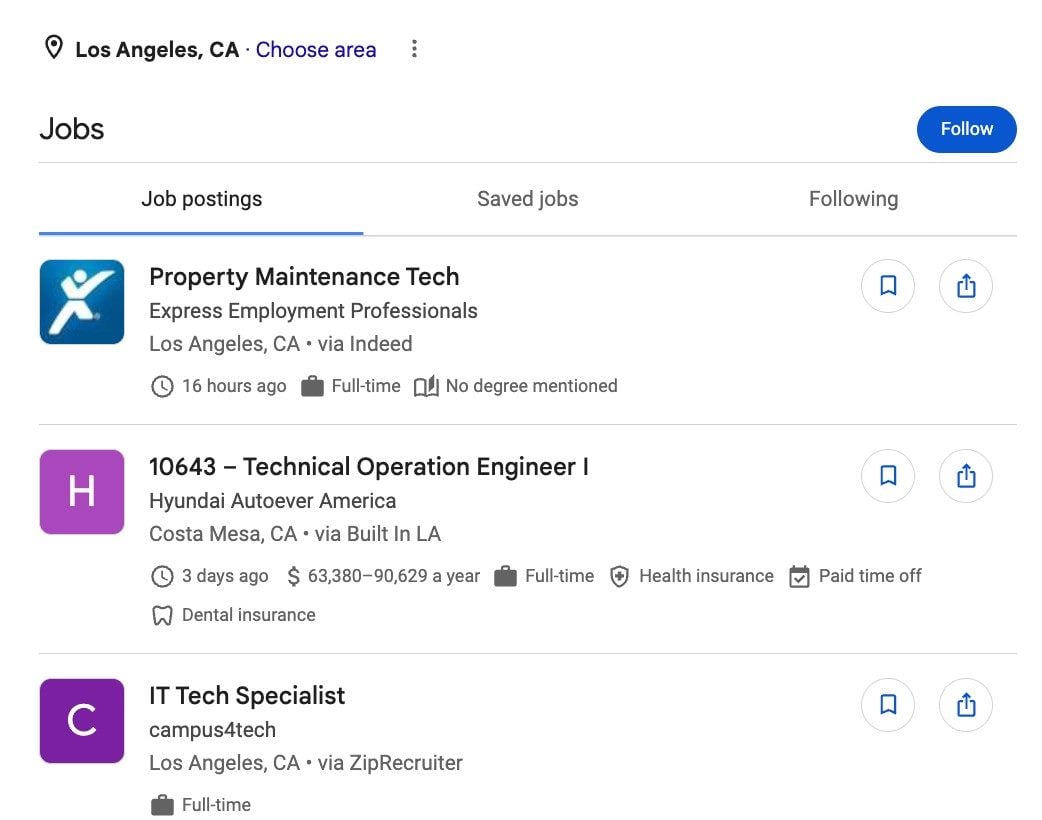
The common thread: these are cases where schema generates a tangible feature you can see in the results. That's the tell. If your markup produces a visible rich result that earns clicks, it's pulling its weight. If it's invisible niche markup you're adding because someone told you that you "need" it for rankings, you're probably stepping over dollars to pick up dimes.
Editor's note: Schema markup remains valuable for powering rich results and helping AI systems understand your content, but it is no longer a standalone SEO strategy. As marketers rethink discoverability in the age of AI search, the bigger opportunity is ensuring content is structured, authoritative and easy for both search engines and large language models to interpret. Use this checklist to evaluate whether your content is truly discoverable—not just properly marked up.
| Area | Question Marketers Should Ask | Recommended Action | Priority |
|---|---|---|---|
| Core Schema | Are we using the essential schema types our business actually needs? | Implement Organization, LocalBusiness, Product, Article, JobPosting, Event or Recipe schema where applicable. | High |
| Rich Results | Does our markup generate a visible rich result? | Focus efforts on schema that powers search features users can actually see. | High |
| AI Discoverability | Can AI systems easily identify who we are, what we offer and where we operate? | Maintain consistent entity information, business details and structured metadata. | High |
| Content Clarity | Would an AI understand this page without relying on schema? | Use descriptive headings, logical page structure and concise, well-organized copy. | High |
| Entity Signals | Are our people, products, services and locations clearly connected? | Strengthen entity relationships through internal linking and structured data. | Medium |
| Schema Maintenance | Are we still using deprecated or unsupported schema types? | Audit markup regularly and remove schema Google no longer supports. | Medium |
| Local Visibility | If we're a local business, is our LocalBusiness schema complete and accurate? | Keep business hours, address, contact information and SameAs links current. | High |
| Content Freshness | Are our most important pages current enough for AI systems to trust them? | Regularly update statistics, references and high-value evergreen content. | High |
| Measurement | How are we measuring AI discoverability beyond rankings? | Track AI referrals, answer engine citations and branded mentions alongside organic traffic. | High |
| Resource Allocation | Are we spending more time on schema than improving content quality? | Prioritize authoritative, helpful content first, using schema as supporting infrastructure—not a ranking shortcut. | Highest |
Here's my honest, no-spin take after digesting all of it.
For most websites, schema is not a ranking strategy, and you should stop selling it (or buying it) as one. Two controlled studies, multiple analysis methods and Google's own deprecation behavior all point in the same direction. If your H1s aren't localized, your content is thin, and your site architecture is a mess, schema is the last thing you should be worrying about.
But schema is also cheap, low-risk and occasionally useful. Basic Organization and LocalBusiness markup takes minutes to implement and won't hurt you. If you're a local business chasing ChatGPT visibility, the data genuinely supports it. If you sell products, post jobs or publish recipes, you need the relevant markup to show up correctly. So do it. Just do it with intention, not as a magic bullet, and never at the expense of the fundamentals that actually move rankings.
In other words: schema, yes, but keep it in its lane. We don’t include it in our scopes anymore whereas we used to have a dedicated section for custom schema that was comprehensive and thorough as a great deliverable but the results were never clear.
Editor's note: Schema markup has long been viewed as an SEO best practice, but recent research suggests marketers should rethink where it fits into their content strategy. Here are the questions marketing leaders are asking—and what the latest evidence says.
The most useful thing about these studies isn't the schema verdict. It's the reminder that our industry runs on a lot of inherited assumptions that nobody bothered to test. Schema markup got a free pass for a decade because it sounded technical, felt productive and gave us something to control. The moment someone built a proper experiment around it, the magic mostly evaporated.
That's the real lesson. In an era where AI will happily repeat whatever the internet shouts loudest, the marketers who win are the ones who ask for evidence instead of echoing the consensus. Test your own pages. Demand control groups. Be willing to kill a tactic you've defended for years if the data says it's dead weight.
Schema isn't the villain, and it isn't the hero. It's a tool. Use it where it works, skip the hype where it doesn't and put your real energy into the things search engines and AI platforms have always rewarded: genuinely useful content, a clean site and a brand worth talking about.
 Learn how you can join our contributor community.

Bradley Keys is an accomplished digital marketing expert with over a decade of experience in the industry. As the founder of All Star Digital, a boutique digital marketing firm specializing in search optimization, he has demonstrated a keen ability to drive impactful results for a diverse range of clients.