News Analysis
On-Demand Webinar
Do More with Less: Modernizing the Cloud Contact Center

SEATTLE — The conference rooms at the Seattle Convention Center this week are full of customer experience leaders who already know their biggest problem isn't data.
It's doing something with it.
That tension — between the promise of AI-powered insight and the organizational reality of actually acting on it — sits at the center of Qualtrics' Experience Management Summit as the company announces this week a broad set of new capabilities across its customer experience and market research platforms. (And some employee experience news, which we've got covered on our sister site, Reworked.co).
The announcements touch nearly every layer of the CX stack: faster omnichannel deployment, AI that automatically builds and maintains topic models, agents that intervene during live customer surveys to resolve issues in real time, always-on competitive benchmarking and a synthetic panel product that simulates consumer responses in hours at half the cost of traditional human panels.
The news this week comes one day after St. Patrick's Day. Luck of the Irish in this convention center translates to "Luck of the CX Vendor Who Operationalizes AI," and Qualtrics wants to be the lead Leprechaun. Like competitors, they'll try to answer the question every vendor in this space is wrestling with: when AI says "here's the problem and here's what to do," who in the organization is actually on the hook to do it? And which provider can be the "what" behind the AI magic engine?
The backdrop for this week's conference in the city known for fish-throwing at Pike Place Market is a favorable one for Qualtrics. The 24-year-old, Provo, Utah-based caught the big CX fish this month: hot off the analyst presses from Gartner's March 2026 Magic Quadrant for Voice of the Customer Platforms, Qualtrics sits furthest into the Leaders quadrant on both axes — completeness of vision and ability to execute. It edged out Medallia, one of its closest rivals, and Sprinklr. Five straight years now as a VoC leader. That's post-COVID winning.
Press Ganey Forsta is in the leaders' quadrant, too, but we all know Qualtrics acquired that company for $6.75 billion in October, one of the biggest CX acquisitions of all-time. Qualtrics as the acquired — Silver Lake & CPP Investments in 2023 ($12.5B) and SAP in 2018 ($8B) — beats Qualtrics the acquirer on that list, btw.
The VoC platform market itself grew from $8.7 billion in 2024 to $10.6 billion in 2025, a number Gartner expects to continue rising as vendors monetize AI features and shift to consumption-based pricing.
Here's what Gartner says Qualtrics aces:
But Gartner's strengths column for Qualtrics is paired with a set of cautions:
Qualtrics CX Suite is among the more expensive solutions in the market, and its shift to interaction-based pricing — where AI features are not included in the base platform — creates the potential for budget surprises if organizations exceed committed interaction volumes. Gartner explicitly recommends that buyers ask vendors to quote both the base and AI-enabled platforms, and to specify "excess usage" costs upfront.
Gartner notes that Qualtrics has not yet introduced model context protocol, or MCP, the technical standard that enables cross-agent orchestration between VoC platform agents and other enterprise AI agents.
Qualtrics' announced intention to acquire Press Ganey Forsta — itself fresh off acquiring InMoment — introduces what Gartner calls "potentially distracting integration work in the short term." The combination of three major vendors would concentrate market power significantly and could reduce negotiating leverage for enterprise buyers.
None of this dims the story Qualtrics is telling this week. But it adds texture to it.
Related Article: What Is Voice of the Customer (VoC)?
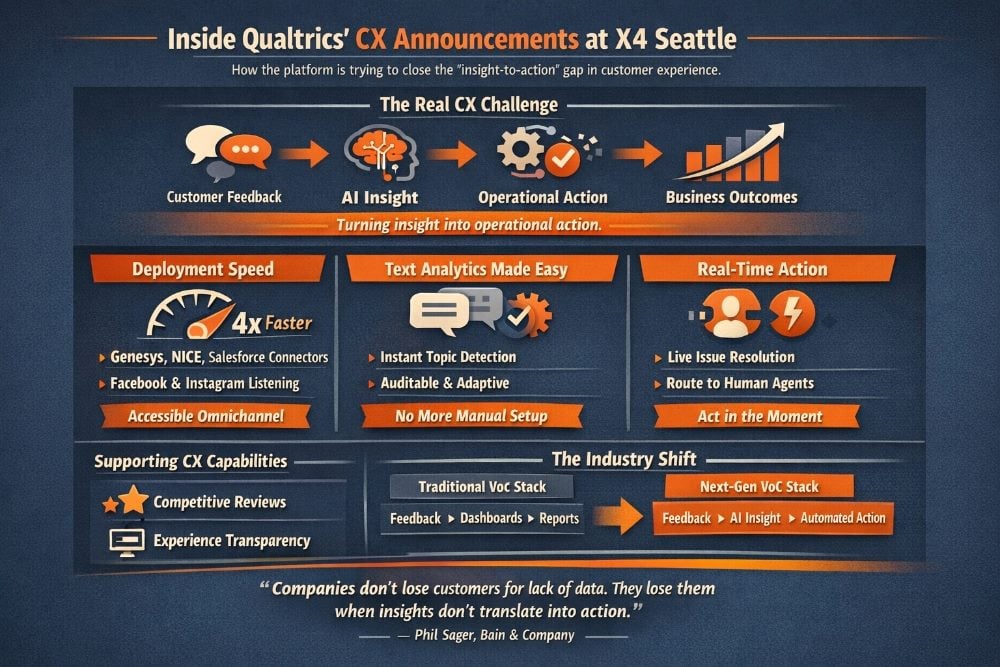
The CX announcements center on three problems that practitioners in this market have been complaining about for years.
Qualtrics says its omnichannel experience management capabilities now deploy up to four times faster than before, with point-and-click connectors for Genesys, NiCE and Salesforce bringing contact center data into the platform in weeks rather than months. New social listening capabilities add Facebook and Instagram to the mix. This matters because omnichannel CX has historically been an enterprise-only capability requiring significant technical resources; these connectors represent a genuine democratization play for mid-market organizations.
Automated Text Analytics could be, in many ways, the headline capability of this year's CX release. Historically, building and maintaining topic models — the taxonomies that organize unstructured customer feedback into usable themes — has been one of the most time-consuming and resource-intensive tasks in a VoC program.
Qualtrics says its new capability eliminates that manual setup entirely, instantly detecting and organizing emerging topics across all feedback channels and delivering results that are deterministic and auditable. The same feedback will always produce the same classification, and the system continuously adapts to each organization's industry and terminology without requiring retraining.
This is not a new capability category — Qualtrics has offered text analytics since its acquisition of Clarabridge in 2021. What's new is the degree of automation. Forrester analyst Colleen Fazio told CMSWire that despite major advances in machine learning and generative AI, "consistent accuracy in text mining remains difficult," pointing to explainability, risk management and proprietary knowledge graphs as areas where Qualtrics and similar vendors can genuinely differentiate from general-purpose AI tools.
Experience Agents for service recovery represent Qualtrics' most forward-leaning CX announcement. These agents analyze customer feedback in real time during live surveys, detect issues and either resolve them on the spot or route to a human agent with full context. Organizations in hospitality and healthcare are already using the capability.
"Companies don't lose customers for lack of data," said Phil Sager, Partner at Bain & Company. "They lose them when insights don't translate into action."
Two additional CX capabilities round out the package. Competitive Reviews delivers always-on benchmarking against nearby competitors, giving location managers visibility into what's driving their competitors' reviews — not just their own. Experience Transparency lets organizations publish first-party feedback directly to their own web properties, a trust-building move that signals confidence in the data before a customer engagement even begins.
IDC Research Director Lou Reinemann framed the broader ambition well.
"The organizations pulling ahead are listening across every channel — calls, chats, digital, social, reviews — using AI to understand what that data means in context, and enabling teams and agents to take the right action in the moment," he said. "The companies that get this right are seeing it show up in retention, revenue, and margin."
Related Article: Qualtrics Names Jason Maynard CEO Amid AI Push
| Capability | What It Does | The Problem It Solves |
|---|---|---|
| Omnichannel Deployment (4x faster) | Point-and-click connectors for Genesys, NiCE, Salesforce; Facebook/Instagram social listening | Omnichannel CX was enterprise-only; takes months to deploy |
| Automated Text Analytics | AI instantly detects and organizes feedback topics across channels; deterministic, auditable results | Building topic models manually takes weeks; breaks when business changes |
| Experience Agents for Service Recovery | Detects issues in live surveys; resolves on the spot or routes to human agent with context | Organizations learn about problems after the customer is already gone |
| Competitive Reviews | Always-on benchmarking against nearby competitor reviews | Location managers can't see what's driving rivals' ratings |
| Experience Transparency | Publish first-party feedback to owned web properties | Customers distrust brands before they engage |
Qualtrics' market research announcements are a separate but connected story, and they may carry more long-term strategic significance than the CX news.
The centerpiece is Synthetic Panels for US Consumers — a purpose-built large language model that simulates how consumers would respond to research questions in hours at half the cost of human panels. Qualtrics claims the model delivers 12 times better accuracy in matching human responses than general-purpose AI. The company is planning to extend the capability to UK, Canadian and Australian populations later this year, with self-serve options that let teams extend human panel research with follow-up synthetic responses and conversation-based experiences that allow brands to essentially live-chat with audience segments to stress-test ideas in real time.
Brad Anderson, president of products, engineering, user experience and security at Qualtrics, pointed to the institutional ambition behind the research suite.
"The best research organizations build institutional knowledge that delivers strategic impact, which compounds over time," he said. "With a deep understanding as the greatest differentiator in business, we started with the hard problem first: building validated synthetic panels that deliver research-grade data."
A Gabb case study is the sharpest illustration of the value proposition in production. The company, which makes safe tech products for kids, used synthetic panels alongside a human panel for product and marketing decisions. The results: insights 98% faster, at half the cost, with findings that matched the human panel data.
"Synthetic data became our 'cultural radar,' cutting research timelines from a week to hours while giving us confidence to test messaging against emerging trends," said Garred Sheppard, marketing research director at Gabb. "The blended approach lets us move faster on early-stage testing, then validate high-stakes decisions with human panels."
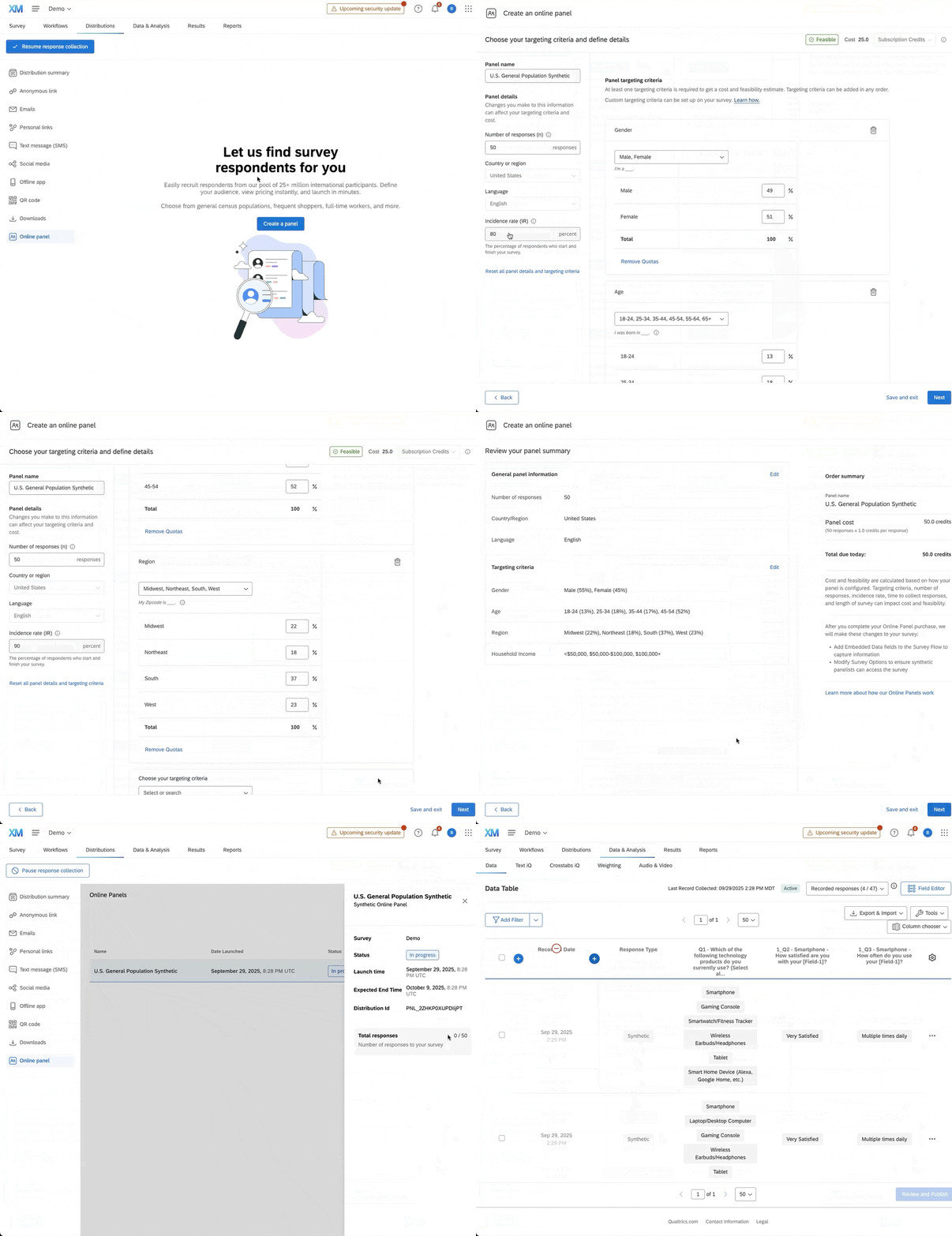
Gartner's analysis of the synthetic data market provides important context. Gartner predicts that by 2030, synthetic data will completely overshadow real data in VoC AI models — a trajectory that makes Qualtrics' early investment in validated synthetic panels look more strategic. Gartner analyst Michael Maziarka was clear about where the guardrails sit, however. "Synthetic feedback should never replace real, observed customer VoC data," he told CMSWire. "It can serve as a starting point for, and augment, real data."
Maziarka outlined in his research five validation requirements CX leaders should demand from any synthetic data vendor: data sourcing and quality, comparative testing against first-party VoC data, conclusion similarity testing, hallucination checks and bias mitigation. Organizations that skip this validation layer risk building decisions on simulations that feel confident but aren't grounded.
The second research announcement, Research Hub, addresses a different but equally chronic problem: the institutional knowledge trap. Most organizations have years of accumulated research scattered across departments, formats and file systems. Research Hub transforms that body of work into a conversational answer engine — teams can ask questions across their entire research history and receive evidence-backed answers in seconds.
Forrester's Senem Guler Biyikli, who covers experience research platforms, noted to CMSWire that user expectations in this space have risen sharply.
"When AI is involved, customers expect conversational experiences and nuanced analysis that they can trust to inform their decisions," she told CMSWire. "In other words, high-level AI-generated summaries are no longer sufficient. Users compare their experiences to the genAI tools that they already use and expect more depth and speed in analysis."
| Capability | What It Does | Why It Matters |
|---|---|---|
| Synthetic Panels (US) | Simulates consumer responses in hours; 12x more accurate than general-purpose AI; half the cost of human panels | Enables fast concept testing, persona development, and message testing without full research cycles |
| Synthetic Panel Expansion | UK, Canadian, Australian populations coming; live-chat with synthetic audience segments | Extends reach to global markets and enables real-time scenario testing |
| Research Hub | Conversational answer engine across entire body of research; AI surfaces evidence-backed answers in seconds | Turns fragmented institutional knowledge into an accessible organizational asset |
The technology Qualtrics announced this week is genuinely impressive. But the most important signal at a conference like this one isn't what's on the stage — it's what's in the hallways.
Forrester's Fazio put it plainly.
"How to move from 'insight to action' is one of the most common questions I get from our clients," she said. "And as much as we all want an AI 'easy button' — the unlock is still very human. Organizations that take action on CX insights do so because there is a culture and process that supports doing so."
How to move from 'insight to action' is one of the most common questions I get from our clients. And as much as we all want an AI 'easy button' — the unlock is still very human. Organizations that take action on CX insights do so because there is a culture and process that supports doing so.
- Colleen Fazio, senior analyst
Forrester
That observation sits in direct tension with how both Qualtrics and its competitors are marketing their AI capabilities. The promise is that AI can find the problem faster, classify the root cause automatically and surface a recommended action — all without the weeks of manual analysis that used to precede any meaningful decision. What it cannot do is make an organization's finance team care about NPS, or get a frontline manager to actually read the insights summary, or align a product roadmap to what customers are saying they want.
In other words, will all this software razzle dazzle impress the critical business functions NOT named CX?
Fazio raised a separate question that CX leaders at this week's conference might want to bring back to their organizations. As AI agents increasingly handle customer interactions without human involvement, how do experience platforms measure and improve those interactions?
"Are customer perceptions and outcomes different when they interact with AI agents vs. human agents for support?" she asked. "How are customer expectations changing around AI and automation? These are the big thorny questions that CX teams are uniquely positioned to help organizations navigate."
Gartner's Maziarka pointed to a near-term capability worth watching: the Business Outcome Simulator, which enables organizations to run real-time "what-if" simulations to prioritize investments that will maximize revenue, loyalty and cost savings. It's exactly the kind of capability that bridges insight and action by attaching a dollar value to a CX decision — the language that tends to get a CFO's attention.
So how does Qualtrics stack up to its closest rivals? It's been a busy Q1 for customer experience software, for sure.
Medallia held its own Experience '26 conference in Las Vegas last month, announcing conversational analytics, Smart Topic Builder, and Enhanced Action Planning.
Sprinklr, meanwhile, just closed its fiscal year 2026 with $857 million in full-year revenue, up 8% year-over-year, and a CEO making an increasingly bold claim about the future of CX software. Sprinklr CEO Rory Read said on the company's recent earnings call, "We are defining unified customer experience management — one platform that connects insights, predictions, and actions across the entire customer journey."
All three companies hold Leader positions in Gartner's March 2026 Magic Quadrant for Voice of the Customer Platforms. All three are racing toward a world where AI doesn't just surface insights but triggers action.
And all three are being evaluated against a market category that Forrester itself is in the middle of redefining. In December, Forrester announced it is retiring its separate Customer Feedback Management Solutions Wave — the last of which in November 2024 placed Qualtrics and Medallia as co-leaders (with an edge to Medallia), with Sprinklr as a Strong Performer. Forrester is pivoting to a new, broader category it calls Customer Feedback Management and Analytics Solutions.
The reason, as Fazio and colleague Boris Evelson explained, is that the lines between text mining platforms, CFM solutions and conversation intelligence tools have blurred beyond the point where separate evaluations make sense. "Functions such as surveys and dashboards have become mostly commoditized and aren't driving buying decisions," they wrote in December. "Even newer genAI-driven summaries are no longer differentiating."
But these providers are betting on meaningfully different architectural paths.
Qualtrics is leaning into breadth — a platform spanning CX, EX and market research, with synthetic data capabilities perhaps no pure-play CX vendor can match and a research foundation built on two decades of human preference and behavioral data.
Medallia is leaning into agentic depth — "Frontline-Ready AI" with over seven million weekly users as of last month, an emerging architecture of agentic calls within its product stack and a new partnership with AI bot provider Ada.
Sprinklr is making the horizontal unification argument — one data layer, one AI engine and one governance model processing more than 180 billion customer conversations annually across social, contact center, VoC, and marketing.
The analyst community sees genuine differentiation in some areas and table stakes in others. Fazio noted that conversational querying and plain-language analytics have become standard across the VoC landscape. The sharper differentiator, she said, is in what vendors do beneath the surface: "Qualtrics and similar vendors offer differentiation via generative AI explainability, risk management and proprietary semantically rich ontologies and knowledge graphs."
The one area where the competitive gap is clearest and most consequential is synthetic data. Neither Medallia nor Sprinklr has boasted anything comparable to Qualtrics' synthetic panel capabilities. With Gartner predicting that synthetic data will dominate VoC AI models by 2030, and Qualtrics already in production with US panels and an international roadmap underway, that is a meaningful head start.
Gartner does note Qualtrics has not yet implemented MCP for cross-agent orchestration, while Medallia is actively building toward it. Qualtrics does say it provides an MCP server for each of the APIs documented on its API site.
| Dimension | Qualtrics | Medallia | Sprinklr |
|---|---|---|---|
| Analyst Standing (Gartner VoC MQ, March 2026) | Leader — furthest right and highest | Leader | Leader |
| Forrester CFM Wave, Nov. 2024 (retiring) | Leader | Leader — furthest right and highest | Strong Performer |
| Revenue / Scale | Private (Silver Lake/CPP) | Private (Thoma Bravo) | $857M FY2026, public |
| AI Flagship Capability | Automated Text Analytics; Experience Agents; Insights Explorer | Insights Assistant; Smart Topic Builder; Smart Response | Sprinklr Copilot; AI Agents; Contact Center Intelligence |
| Synthetic Data | Qualtrics Edge — US panels in market; international roadmap; 12x accuracy claim | No announced equivalent | No announced equivalent |
| Agentic Architecture | Experience Agents in CX; autonomous agents on roadmap | Agentic calls within Medallia architecture; Ada partnership; MCP investment underway | No-code AI Studio; 100+ system connectors; specialized AI agents |
| Data Foundation | Two decades of human preference and behavioral data; Clarabridge text analytics | Total Experience Profiles connecting 100% of direct, indirect and inferred signals; 7M+ weekly users | 180B+ customer conversations annually across 30+ digital channels |
| Market Research Depth | Full platform: MaxDiff, Conjoint, synthetic + human panels, Research Hub | Not a core focus | Not a core focus |
| Primary Differentiator | Breadth — CX + EX + research unified; synthetic data lead | Frontline scale and speed to operational action | Horizontal unification across social, contact center, VoC, and marketing |
| Key Analyst Caution | Pricing complexity; MCP gap; M&A integration risk | Implementation timeline; total cost of ownership; self-service limitations | Potential configuration complexity; pricing transparency; partner ecosystem still maturing |
| Customer Sweet Spot | High-transaction businesses; public sector; organizations wanting research + CX unified | Complex global enterprises needing to unify signals across all touchpoints | Large enterprises with heavy social and contact center volumes seeking platform consolidation |
Fazio offered a frame for evaluating what comes out of this week's conference that cuts through the product announcements. This comes back to the razzle-dazzle of product innovation vs. what kind of change management support CX leaders get in their organizations.
"I will be listening for the hallway conversations — are organizations attending the event ready to adopt the AI advances Qualtrics is sure to announce — or are attendees still struggling with things that are not AI-related?" she said. "Our research shows that the biggest hurdles for CX leaders are not technical — they are related to getting stakeholders to work together to take action on CX initiatives."
The VoC platform market grew 22% on average in 2025, according to Gartner, driven by AI monetization and consumption-based pricing. But Gartner's own data shows that most customers' CX programs have not kept pace with vendor AI advancements and remain largely survey-driven — a roughly 20% increase in customer usage of AI features between 2024 and 2025, concentrated mostly in basic tasks like feedback summarization and survey creation.
The gap between what vendors can do and what most organizations are actually doing with those capabilities remains wide. Qualtrics is betting that making AI easier to access — through faster deployment, automated analytics, conversational interfaces and synthetic panels that remove the friction of traditional research — will help close it.
"Customer experience is on the threshold of a profound shift, driven by AI-powered change, a hyper-competitive market, and customers' expectations for trust and value," said Abby Schlatter, CEO and co-founder of commonFont, a Qualtrics partner. "The leaders pulling ahead are building operating systems grounded in customer value — prioritizing fixes based on relationship economics and using automation with discipline to resolve pain points at speed."
Dom Nicastro is editor-in-chief of CMSWire and an award-winning journalist with a passion for technology, customer experience and marketing. With more than 20 years of experience, he has written for various publications, like the Gloucester Daily Times and Boston Magazine. He has a proven track record of delivering high-quality, informative, and engaging content to his readers. Dom works tirelessly to stay up-to-date with the latest trends in the industry to provide readers with accurate, trustworthy information to help them make informed decisions. Connect with Dom Nicastro: 