Feature
Guide
Post-Acquisition Guide: How to Bring Two Digital Experiences Together


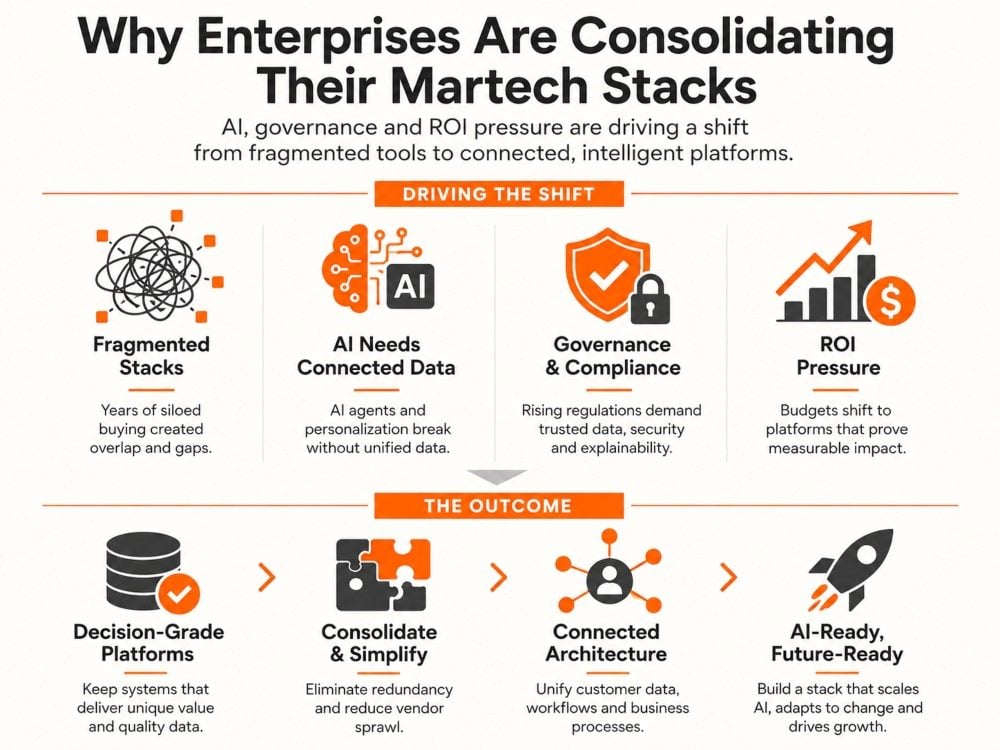
For years, businesses expanded their martech stacks by adding specialized tools for every new customer experience challenge. Today, many enterprises are moving in the opposite direction. The rise of AI, growing governance requirements and pressure to demonstrate a return on investments are exposing the costs of fragmented technology environments.
Rather than simply reducing software licenses, businesses are rethinking how their digital experience stacks are organized so AI, customer data and business workflows can operate more effectively together.
This article examines why enterprises are consolidating fragmented martech stacks and how AI, governance and connected customer data are reshaping the architecture of modern digital experience platforms.
Editor's note: These questions address common reader queries about why enterprises are consolidating digital experience platforms and how AI is reshaping stack architecture decisions.
The complexity of today's digital experience stack did not emerge overnight. Over the past two decades, enterprises invested in specialized platforms to solve individual customer experience challenges as they arose. Marketing automation, web content management, customer data platforms, analytics, digital asset management, ecommerce, customer feedback and dozens of other technologies each promised to improve a specific aspect of customer engagement. Individually, many of those investments delivered value.
According to ADAPT's CIO Edge Survey 2025, however, 68% of CIOs are planning vendor consolidation, with many targeting a 20% reduction in vendors. AI, growing governance requirements and pressure to demonstrate return on investment are exposing the costs of fragmented technology environments.
Integration became the next challenge. Every new application required additional APIs, connectors, middleware or custom development to exchange customer information with existing systems. Although cloud platforms and integration technologies made those connections easier to build, many businesses continued adding complexity faster than they eliminated it.
Vendor expansion further blurred the boundaries between product categories. It became increasingly common for businesses to discover that they owned several products that were capable of performing many of the same tasks, even as important customer data and workflows remained fragmented.
The result is a digital experience stack that often reflects years of incremental technology decisions rather than a deliberately designed architecture. AI is now exposing the limitations of that approach by requiring customer data, business rules and decision making to move more freely across systems that were never designed to operate as a coordinated whole.
ADAPT's CIO Edge Survey 2025 found 68% of CIOs plan vendor consolidation, with many targeting a 20% reduction, as fragmented buying across marketing, sales, service and IT left overlapping tools and disconnected customer data.
Technology consolidation is not a new idea, but artificial intelligence is changing the reasons that businesses are pursuing it. Previous consolidation efforts often focused on reducing software costs, simplifying vendor management or eliminating redundant licenses. While those goals remain important, AI is exposing a deeper challenge: disconnected technology environments make it more difficult for intelligent systems to deliver consistent customer experiences.
AI systems such as recommendation engines, agents and personalization tools depend on accurate customer profiles, interaction history and current context, which disconnected platforms cannot reliably provide.
Artificial intelligence is changing why enterprises consolidate technology. Traditional rationalization focused on reducing costs and simplifying software management. AI is shifting the emphasis toward connected data, governance and coordinated decision making.
| Traditional Stack Strategy | AI-Driven Stack Strategy |
|---|---|
| Reduce software costs | Enable AI across connected systems |
| Optimize individual applications | Coordinate customer context enterprise-wide |
| Integrate platforms as needed | Build connected, AI-ready architecture |
| Evaluate products by feature lists | Evaluate platforms by AI readiness and interoperability |
| Department-focused technology | Enterprise-wide customer experience |
| Application-centric architecture | Data- and AI-centric architecture |
AI depends on connected customer data. Recommendation engines, AI agents, conversational assistants and personalization systems all require access to accurate customer profiles, interaction history, business rules and current context before they can generate reliable recommendations or take action.
The rapid expansion of AI assistants is adding another layer of complexity. Many enterprises are now deploying multiple copilots and AI agents across marketing, sales, customer service, commerce and analytics, rather than limiting AI to isolated productivity tools. While each may improve productivity within its own domain, businesses now face the challenge of coordinating multiple AI systems that rely on different data sources, follow different business rules and may produce conflicting recommendations.
Businesses are also discovering that many software platforms now provide similar AI capabilities. Content generation, workflow automation, predictive analytics, conversational interfaces and customer insights have become standard features across a growing number of enterprise applications.
Related Article: Why Martech Consolidation in 2026 Requires Fixing Workflows, Not Just Cutting Vendors
AI governance is becoming another powerful driver. As AI assumes greater responsibility for customer interactions and business decisions, enterprises need consistent policies governing data quality, security, privacy, regulatory compliance and human oversight.
That pressure becomes more acute as businesses move from AI assistants that generate recommendations to AI agents that read data and take action across customer-facing systems.
Sandip Patel, enterprise AI and cloud security expert and senior cloud solution architect at Microsoft, told CMSWire, "Cost is the excuse, AI is the reason. AI agents need to read and act across the entire customer journey, and they break the moment data and permissions are scattered across 40 point tools. Every fragmented tool is a surface an agent either cannot see or cannot be trusted to touch."
Cost remains an important consideration, but it extends beyond software licenses. Every additional platform requires integration, administration, security reviews, user training and AI governance.
Years of SaaS expansion left many businesses managing overlapping platforms, duplicated capabilities and disconnected customer data.
Alys Reynders, CMO at Quickbase, told CMSWire, "Martech consolidation has long been a story of convenience, and the potential for operational simplicity to deliver results at lower costs. While AI has become a key component in delivering simplicity, it's not the underlying cause of the trend. The dominant share of pressure stems from bloated spending throughout the SaaS landscape.”
AI is therefore changing the conversation from “How many platforms do we own?” to “How well do those platforms work together?” For many enterprises, that question is becoming the primary driver of digital experience stack consolidation.
Microsoft's Sandip Patel says AI agents must read and act across the full customer journey and break when data and permissions are scattered across dozens of point tools; Quickbase's Alys Reynders adds that bloated SaaS spending, not AI itself, is the dominant pressure behind consolidation.
Martech consolidation does not necessarily mean eliminating entire software categories. Instead, businesses are reevaluating which platforms should become strategic systems of record, which capabilities can be consolidated into broader platforms and which standalone tools continue to provide unique value. AI is accelerating those decisions because it depends on connected data, consistent governance and coordinated workflows across the DX stack.
Several experts also suggested that consolidation often comes down to distinguishing between platforms that provide durable business intelligence and those that duplicate existing capabilities.
Jessica Arredondo Murphy, co-founder and CEO at True Fit, told CMSWire, "AI is raising the bar for what belongs in the stack." Murphy said AI is forcing businesses to evaluate which technologies are truly "decision-grade," capable of informing high-value customer and business decisions through trusted data, measurable outcomes and specialized intelligence.
Murphy explained that AI is exposing which platforms contribute durable business intelligence and which simply duplicate existing functionality. She said technologies grounded in proprietary data, measurable outcomes and specialized expertise are more likely to remain strategic investments, while generic capabilities become easier to consolidate as AI matures.
True Fit's Jessica Arredondo Murphy says AI is raising the bar for what belongs in the stack, with "decision-grade" platforms defined by trusted proprietary data, measurable outcomes and specialized intelligence rather than generic features.
As enterprises simplify their DX stacks, the goal is rarely to reduce the number of software platforms for its own sake. Instead, technology leaders are reassessing each platform according to the role it plays in supporting AI, customer engagement and long-term business strategy. The question is no longer whether a tool performs its intended function, but whether it continues to justify its place within the broader digital experience architecture.
Technology leaders are shifting from asking whether a tool performs its intended function to whether it still justifies its place in the broader digital experience architecture.
Technology leaders are no longer evaluating platforms solely on features or market leadership. AI is shifting attention toward architecture, governance and the ability to support connected customer experience.
| Evaluation Area | Why It Matters |
|---|---|
| Business value | Demonstrates measurable customer and financial impact. |
| AI readiness | Supports AI agents, copilots and intelligent automation. |
| Integration | Enables customer data and workflows to move across systems. |
| Data quality | Improves AI accuracy and customer context. |
| Governance | Supports compliance, security and explainable AI. |
| Architectural flexibility | Allows the stack to evolve as business and AI requirements change. |
Kuber Sharma, senior director of product marketing at UiPath, told CMSWire, "The question I'd start with is not whether a tool has an AI feature. That's marketing. The real question is whether it can expose its data and actions to an AI layer cleanly. Can it serve as a node in an orchestrated workflow? If yes, integrate. If it's a closed environment that only works through its own interface, you're looking at eventual replacement."
The following table highlights the most important lessons, actions and strategic considerations emerging from this shift toward AI-driven martech consolidation.
| Key Area | What Happened | Why It Matters | Recommended Action |
|---|---|---|---|
| Fragmented buying | Departments purchased platforms independently over two decades | Created overlapping tools and disconnected customer data | Audit platform ownership and map overlapping capabilities across departments |
| AI agent readiness | AI agents now need to read and act across the full customer journey | Fragmented permissions and data block reliable agent action | Evaluate whether each platform can expose data and actions to an AI orchestration layer |
| Governance requirements | AI is assuming more decision-making responsibility | Requires consistent policies on data quality, security, privacy and oversight | Establish enterprise-wide AI governance standards before further AI rollout |
| Decision-grade platforms | Not all platforms provide durable business intelligence | Some duplicate capability rather than add unique value | Prioritize retention of platforms with proprietary data and measurable outcomes |
| Vendor lock-in | Consolidating more data and capability into fewer platforms | Increases dependence on a single vendor's roadmap and pricing | Weigh integration simplicity against long-term switching cost before consolidating further |
Consolidating the digital experience stack can simplify enterprise architecture, but it also introduces important tradeoffs. Reducing the number of platforms may improve data consistency, governance and AI coordination, yet businesses that move too aggressively risk creating new dependencies that are difficult to reverse. Successful rationalization requires balancing simplification with the flexibility to integrate new AI capabilities, adapt to changing business needs and avoid creating tomorrow's legacy stack.
Some industry leaders cautioned that every additional platform creates costs that extend well beyond software licensing, making technology decisions as much about long-term complexity as immediate functionality.
Wanda Cadigan, CMO at WandaGTM, told CMSWire, "Every tool promises value. Every tool also creates a tax." Cadigan said each additional platform introduces integration, governance, maintenance and adoption overhead that is often overlooked during procurement. She argued that businesses should evaluate whether a platform's unique value outweighs the complexity it adds to the broader technology environment.
WandaGTM's Wanda Cadigan says every additional platform adds an overlooked "tax" of integration, governance, maintenance and adoption overhead, and vendor lock-in grows as more customer data and AI capability concentrate in fewer platforms.
The digital experience stack is unlikely to become dramatically smaller overnight, but it is becoming more intentional. Rather than maintaining multiple applications with overlapping functionality, businesses are identifying which platforms should serve as the primary sources for customer data, content management, customer engagement and AI-enabled decision making. Point solutions will continue to have a place when they deliver unique business value, but they will increasingly be expected to integrate into a connected enterprise architecture.
The defining characteristic of the modern martech stack is not the number of platforms it contains, but how effectively those platforms share trusted customer context. AI agents, automation and decisioning systems depend on consistent access to customer data, content and business processes across marketing, sales, commerce, customer service and analytics. Businesses that build connected, AI-ready architectures will be better positioned to adapt as both enterprise AI and customer expectations continue to evolve.
The defining trait of the modern stack isn't platform count but how effectively platforms share trusted customer context across marketing, sales, commerce, service and analytics.