News
Research Report
Building the Case for Modern Public Sector Messaging


Pantheon built its reputation on WordPress and Drupal. Now it wants a seat at the table for what comes next — and it's betting that table is being set by Next.js.
The San Francisco-based managed hosting platform announced April 13 that Next.js hosting is now generally available, opening the capability to all customers at its Gold tier and above after months in private beta.
According to company officials, this unified approach eliminates the operational friction of split hosting — such as syncing environments across two providers and managing separate support queues.
Next.js ranked as the fourth-most popular web framework in the 2025 Stack Overflow Developer Survey. Organizations running production sites on it include Nike, Netflix, OpenAI, Ticketmaster and Marvel.
The launch comes as Vercel — the company that created and maintains Next.js — has signaled it is preparing for a public market debut.
“The total addressable market of infrastructure has now grown, and it simply has no ceiling,” Vercel CEO Guillermo Rauch said at the HumanX conference.
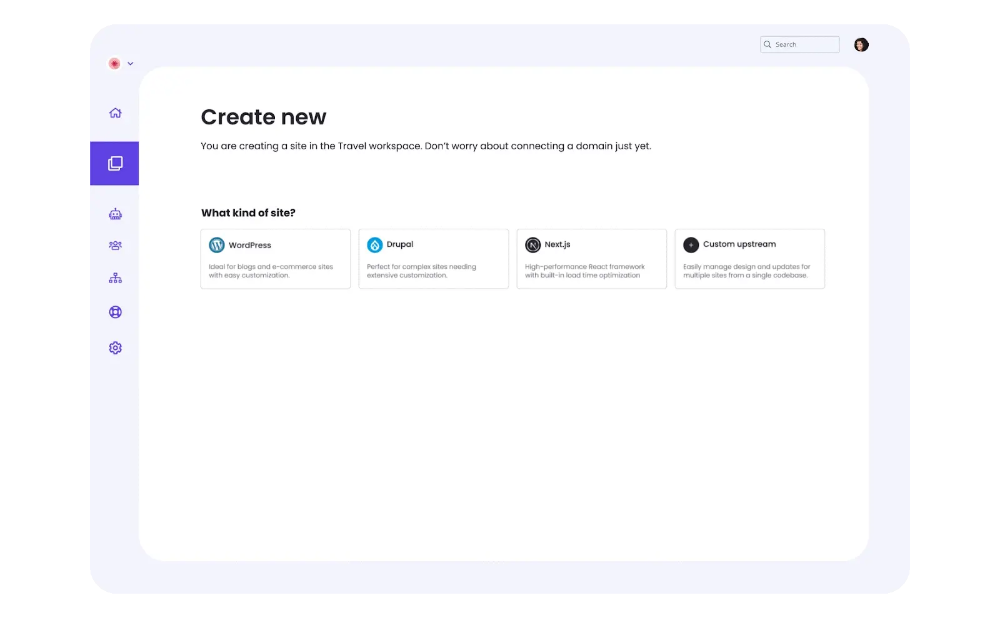
Pantheon is now positioning itself on its ability to run a Next.js frontend and a WordPress or Drupal CMS backend on the same platform, under the same workflow infrastructure.
The GA release includes a managed container runtime on Google Cloud Run, a global CDN, persistent caching with support for Incremental Static Regeneration (ISR), and full support for HTTP Streaming and Suspense boundaries. New sites default to Next.js 16.
On the developer workflow side, Pantheon is extending its existing Git-based Dev/Test/Live model to Next.js. Every pull request spins up a live Multidev environment with a shareable URL. Builds trigger automatically from GitHub commits. Secrets management lives in the dashboard with per-environment overrides. Rollbacks are available through the Terminus CLI.
Pricing follows Pantheon's standard site plan model: contract-based, no bandwidth overages, no per-invocation charges. For decoupled architectures, Pantheon recommends sizing the Next.js frontend plan for traffic and running the CMS backend on a smaller, lower-cost plan.
Pantheon's central argument is one of consolidation. Running a Next.js frontend and a CMS backend on separate platforms introduces coordination overhead that compounds over time: keeping dev, staging and production environments synchronized across two hosts, managing deployment dependencies that can silently break a frontend when a content model changes, and dealing with split support queues when something goes wrong.
For teams already running WordPress or Drupal on Pantheon, the company says the transition is incremental. Content teams keep the editorial tools they know. Engineers get the modern frontend stack they want. The CMS stays in place; Next.js improves what visitors see.
"Pantheon's Next.js solution is reliably assisting us scale with confidence," said Joe Cady, Strategic Website Operations at SPS Commerce. "The support that they've proactively given us has been invaluable."
The release bundles infrastructure, workflow and pricing features under one platform.
| Capability | Description |
|---|---|
| Managed container runtime | Runs on Google Cloud Run with horizontal scaling |
| Incremental Static Regeneration | Cache revalidation by tag, time and path |
| Multidev environments | Every pull request gets a live preview URL |
| Predictable pricing | Contract-based; no bandwidth overages or per-invocation fees |
| Anthropic MCP support | Structured data and Model Context Protocol integration |
Beyond developer workflow, Pantheon is framing the Next.js launch as an AI-era architecture play. The company argues that headless, API-first sites with structured content and edge-cached responses are better suited for consumption by AI agents, LLM crawlers, and AI-powered search engines — the machine audience that increasingly shapes how people discover content on the web. Pantheon also cited support for Anthropic's Model Context Protocol (MCP) as part of what it describes as an AI-ready foundation.
The release also highlights a pairing with Content Publisher, Pantheon's tool that connects Google Docs and Microsoft Word directly to a Next.js frontend. The integration lets content teams draft, preview and publish without logging into a CMS or opening a developer ticket — a pitch aimed squarely at marketing teams and media organizations that prioritize content velocity.
This table outlines the core infrastructure features and corresponding performance benefits included in Pantheon’s Next.js hosting environment.
| Capability | Benefit |
|---|---|
| Google Cloud Run Managed containers | Zero infra ops No servers to manage |
| Global CDN Edge delivery worldwide | Fast everywhere Low latency for all users |
| Persistent shared cache Tag · time · path revalidation | Fresh + fast Content stays current at speed |
| Horizontal scaling Auto-scaled containers | Handles any traffic Scales up without thinking |
| ISR + streaming Suspense boundaries | Instant page loads Progressive rendering |
| Next.js 16 default Latest framework version | Modern by default No upgrade headaches |
For CX and marketing practitioners evaluating hosting infrastructure, the Pantheon GA is less a technical story than an operational one. The value proposition is a single platform for frontend and backend: one support queue, one workflow system, one set of environment controls. For enterprise teams managing multi-site portfolios — universities, franchise brands, media companies — that consolidation can translate to meaningful reductions in coordination overhead and deployment risk.
The larger backdrop is the infrastructure race Rauch described in San Francisco. Next.js ranked as the fourth most popular web framework in the 2025 Stack Overflow Developer Survey, and its production footprint spans Nike, Netflix, Hulu, OpenAI, and Ticketmaster, among others. As AI agents accelerate app creation and the volume of deployable software grows, the platforms positioned to host that output are playing for significant long-term share.
Pantheon's Next.js GA is the company's bid for a piece of that market — with an enterprise wrapper.
Pantheon released a public preview of Content Publisher on Sept. 16, 2025, enabling teams to publish content directly from Google Docs to websites running on Drupal, WordPress or Next.js in less than three minutes. The tool addresses a fundamental workflow disconnect — Pantheon's research found that 90% of writers work in Google Docs, MS Word and similar tools rather than CMS interfaces.
The release included Google Vertex AI-powered metadata creation, and by February Pantheon had introduced a beta MCP server for the tool, allowing AI agents like Claude and ChatGPT to orchestrate content workflows.
Pantheon's broader platform strategy has moved toward a unified WebOps vision spanning WordPress, Drupal and Next.js. In November 2025, the company opened a private beta for Next.js, and by March 2026 had made Next.js 16 the default for new site creation.
Enterprise vendors have aligned more closely with React and Next.js through headless delivery models, starter kits and official integrations. While headless solves architectural problems, it does not automatically resolve operational ones. Organizations discover that decoupling the CMS is straightforward — operating headless at enterprise scale requires disciplined operational design.
Organizations that separate platform operations from delivery execution maintain momentum, reduce risk and avoid the next re-platforming cycle. This architectural discipline becomes especially critical as organizations adopt digital experience platforms that must support evolving customer experience requirements.
Pantheon, founded in 2010, offers a WebOps platform integrating managed hosting, developer workflows, security and governance for Drupal, WordPress and Next.js sites. The company serves enterprises, higher education institutions and digital agencies requiring high-availability, scalable web properties.
 Have a tip to share with our editorial team? Drop us a line: