Editorial
Research Report
Building the Case for Modern Public Sector Messaging


In the early stages of scaling a business, "alignment" is an organic byproduct of proximity. When you’re a team of 10 in a single room, everyone hears the same conversations and breathes the same mission. However, as an organization moves from a startup to a scale-up (and eventually to an enterprise) silos don’t just appear, they solidify.
Marketing chases leads, operations optimizes for efficiency, and HR focuses on retention. Without a unifying framework, these departments begin to operate as independent nations with different languages and conflicting borders.
The result is a fragmented experience for the customer and a disconnected, often frustrating, environment for the employee.
We have reached a critical inflection point where customer experience (CX) and employee experience (EX) can no longer be treated as parallel tracks. They’re the same coin. If your internal culture is fractured, your external product will eventually mirror that brokenness. And if your business goals are not rooted in the actual journeys of your people and your customers, those goals are merely "soulful" numbers on a spreadsheet.
The modern leader’s mandate is the journey-led mandate: You must lead through the journey. This requires synchronizing CX and EX with your overarching business objectives to create a self-sustaining loop of growth.
Editor’s note: Key questions surrounding how journey-led leadership aligns customer experience, employee experience and business outcomes to drive sustainable growth.
Start by picking one specific business goal (e.g., reducing client churn). Map the customer journey for that specific segment, then map the internal employee processes that support it. Identify the "friction gap" where the two journeys misalign. Information management ensures that the right data is available to the right people at the right time. When employees have seamless access to customer data and internal knowledge, they can provide faster, more accurate and more empathetic service. The Double Helix approach is the simultaneous mapping of the customer journey and the employee journey. It recognizes that for every external touchpoint, there’s a corresponding internal process, and the health of one directly impacts the success of the other.
Journey-led leadership is a strategic management approach where business decisions, technology investments and operational changes are governed by their impact on the end-to-end experience of customers and employees. Rather than optimizing for departmental KPIs in a vacuum, journey-led organizations prioritize the "Double Helix" of interaction: the realization that every customer touchpoint is powered by an internal employee process.
In a market defined by "Total Experience" (TX), the traditional "customer-first" mantra is evolving. Research consistently shows that companies leading in EX see a significant uplift in CX and, subsequently, a 2-3x increase in long-term profitability. When CX, EX and business goals are in sync:
For decades, the industry championed customer obsession. While well-intentioned, this often led to a toxic “at all costs” mentality. When you prioritize the customer journey while ignoring the employee journey, you create a "veneer of excellence" supported by burnout and administrative sludge.
True digital workplace maturity occurs when leaders realize that employees are the primary architects of the customer’s reality. If an account manager is fighting legacy software, clunky workflows or a lack of clear information management, they cannot provide a premium experience. They’re too busy surviving the system to serve the client.
The shift: Stop viewing CX and EX as cost centers or soft metrics. Start looking at them as the engine of your business goals.
To synchronize these elements, map them in tandem. I call this the Double Helix Approach. For every touchpoint in the customer journey, there’s a corresponding action, tool and emotional state in the employee journey.
If the customer's onboarding feels sluggish, it’s rarely because the employee "doesn't care." It’s almost always because the internal journey for that employee is riddled with friction – siloed data, slow approvals or redundant entry.
Actionable Advice: Conduct a "journey friction audit": Bring your CX leads and HR/operations leads into the same room. Map your top three customer pain points and look directly at what the employee is doing at that exact moment. You’ll often find that the "CX problem" is actually an "EX bottleneck." Solving the employee's friction is the most direct path to improving the customer's satisfaction.
Related Article: Why Organizations Benefit by Embracing CX and EX Synergy
"Empathy" is often dismissed as a soft skill, but in a high-growth environment, it must be operationalized. This means using data to understand where people (inside and outside your organization) are getting stuck.
In the information management space, we have more data than ever, but it’s rarely synthesized. We look at CSAT (customer satisfaction score) in one dashboard and eNPS (Employee Net Promoter Score) in another. To sync your goals, you need a unified experience dashboard.
Your high-level business goals (e.g., "Increase Revenue by 20%") should be decomposed into synchronized metrics:
When employees see that their day-to-day ease of work is directly tied to the company's growth, they move from clocking in to owning the outcome.
This is where many leaders fail. They purchase a "best-in-class" CX tool and a "best-in-class" HR tool, then wonder why the data doesn't talk. Your tech stack should be the bridge, not the barrier.
Digital customer experience (DCX) is fueled by access to information. If your team is hunting through five different applications to answer a simple customer query, you‘ve failed both the customer and the employee.
At the enterprise level, information management is the secret of synchronization. Technology should fade into the background so the human connection can take center stage. This requires:
By removing "administrative sludge," you’re making a team more efficient and giving them the mental bandwidth to actually care about the customer.
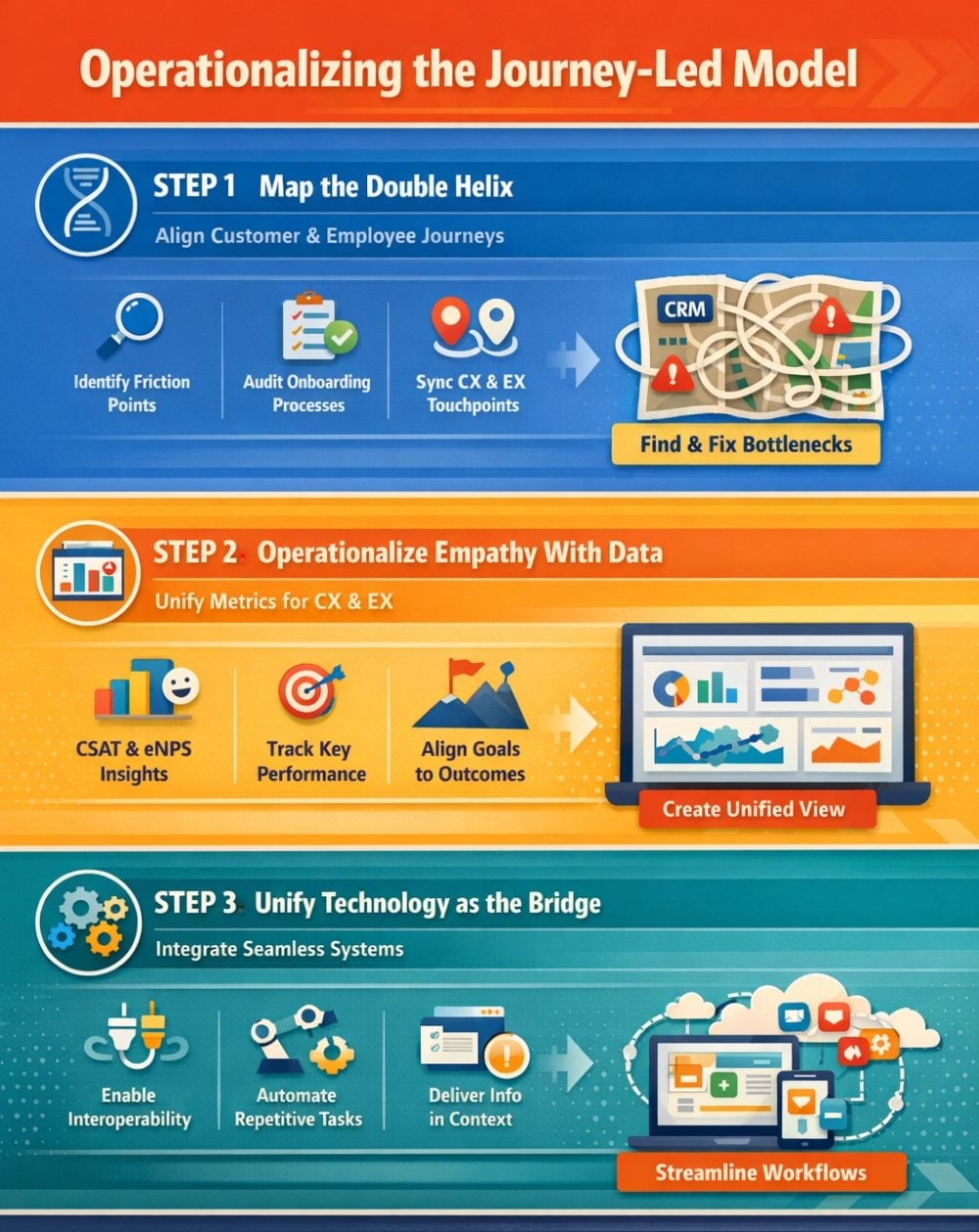
This table breaks down the three-step framework for aligning customer experience, employee experience and business outcomes into a single, scalable operating model.
| Step | Focus | What It Means | Example | Action for Leaders |
|---|---|---|---|---|
| Step 1 | Map the Double Helix | Align customer touchpoints with corresponding employee actions, tools and friction points. | Onboarding delays often stem from internal issues like siloed CRM data, slow approvals or manual provisioning. | Run a “Journey Friction Audit” by mapping top CX pain points alongside employee workflows to uncover EX bottlenecks. |
| Step 2 | Operationalize Empathy With Data | Use unified data to connect CX, EX and business metrics into one performance view. | Reduce time-to-value (CX) and document retrieval time (EX) to increase account manager capacity (business outcome). | Build a unified experience dashboard that ties customer and employee metrics directly to business goals. |
| Step 3 | Unify Technology as the Bridge | Ensure systems work together to eliminate friction and deliver information seamlessly. | Disconnected CX and HR tools force employees to search across systems, slowing service and degrading experience. | Invest in interoperability, automate administrative “sludge,” and enable contextual, in-flow information delivery. |
Synchronizing these three pillars requires a specific type of leadership. It means being humble enough to listen to the front lines and confident enough to pivot when the data shows the old way isn't working.
It’s easy to talk about business growth in terms of EBITDA and market share. It’s harder to talk about it in terms of "How does it feel to work here?" and "How does it feel to buy from us?"
However, the reality is that the market is too competitive for OK experiences. Customers have too many options, and talent is too mobile. If you don't sync your CX and EX with your business goals, your competitors (the ones journey-led) will inevitably outpace you.
| Pillar | Focus Area | Key Question |
|---|---|---|
| CX | Value & Ease | Is the customer achieving their goal with minimal friction? |
| EX | Empowerment & Access | Does the employee have the tools and data to succeed without "sludge"? |
| Business | Scale & Sustainability | Are the journey improvements driving long-term ROI and retention? |
The 'journey-led mandate' isn't a one-time project. It’s a permanent shift in how you view your organization.
If you want to scale effectively, you must build on a foundation of synchronized experiences. When your people feel empowered by the right technology and your customers feel valued by the resulting service, business growth isn't something you have to chase – it’s something that happens naturally.
The mandate is clear: Lead through the journey, or be left behind by it.
 Learn how you can join our contributor community.

Adam Povlitz is CEO & President of Anago Cleaning Systems, one of the world’s leading franchised commercial cleaning brands and a leader in technological advances relating to business operations and facilities services.
Adam is an experienced business writer and industry thought leader with more than a decade of published work in top-tier outlets.