Feature
Research Report
Building the Case for Modern Public Sector Messaging


The 2026 Meltwater Digital Global Overview Report highlights the continued growth of digital adoption, but the more important story is how people are using it.
Digital behavior is no longer shifting from one platform to another, it’s expanding across them. With more than 6 billion people online, over two-thirds of the global population are using social media and more than a billion are now engaging with generative AI tools.
The modern customer journey has become layered rather than linear. People are not abandoning search for AI, or social for video, they are using all of them, often within the same interaction. This article examines how these shifts are reshaping customer behavior, and what they mean for marketing and customer experience leaders.
Editor’s note: Key questions surrounding how expanding digital behavior and AI-driven interactions are reshaping the customer journey and marketing strategy.
For years, each new wave of digital technology has been framed as a replacement for what came before it. Social media was expected to diminish the role of traditional websites. Mobile apps were supposed to reduce reliance on browsers. More recently, generative AI has been positioned as a potential successor to search.
The data in the Digital 2026 Global Overview Report suggests a different reality. Rather than replacing existing behaviors, new platforms are being layered on top of them.
The report reinforces this point, pointing out that newer platforms are not replacing established ones, but rather, are joining them. TikTok has not replaced YouTube or Facebook, and generative AI tools such as ChatGPT are not replacing search engines, but they are expanding the types of questions users ask and the ways they seek answers.
This pattern is visible across the world’s most widely used digital services, as shown in a recent Statista report. Platforms such as YouTube (2.5 billion monthly active users) and Facebook (3.0 billion monthly active users) continue to maintain massive global audiences, even as newer entrants such as TikTok (1.6 billion monthly active users) have captured significant amounts of user attention.
A similar dynamic is now playing out with AI. A recent Sedestral report revealed that AI-driven interactions now represent close to 30% of all information discovery behavior, with users frequently switching between Google and ChatGPT in the same task.
What’s changing is not the underlying intent, but the number of pathways available to fulfill it. People still go online to find information, stay connected and solve problems, but they now have more ways to do so than ever before. A single question might start as a search query, continue through a social feed and end with a conversational AI response. Each platform plays a different role, and users have become increasingly comfortable moving between them. This consistency is reflected in the report’s data, which shows that finding information remains the primary reason people go online, even as they turn to a broader mix of platforms and tools to meet that need.
As digital behavior expands across platforms, businesses are no longer engaging customers through a single dominant channel, but across a mix of environments that require coordination rather than substitution.
Alys Reynders, chief marketing officer at Quickbase, told CMSWire, "Your business should be prepared to interact with customers on every possible platform, from on-site to socials to AI-powered shopping apps. Only those who are proficient in all interfaces will be able to secure fragmented leads."
For businesses, this layering effect complicates what was once a more predictable model of digital engagement. There is no longer a dominant channel that reliably anchors the customer journey. Instead, attention is distributed across a growing mix of platforms, each contributing to different moments in the experience. Success depends less on optimizing for a single touchpoint and more on understanding how these touchpoints connect.
The implication is straightforward but significant. Digital strategy can no longer be built around channel substitution. It must account for coexistence. Businesses that continue to treat emerging platforms as replacements risk overlooking how customers actually behave, while those that recognize the additive nature of digital adoption are better positioned to design experiences that align with real-world usage.
Related Article: AEO, GEO, SEO: What's the Best Search Playbook?
If digital behavior is expanding rather than replacing, the most immediate impact shows up in the shape of the customer journey. What was once modeled as a sequence of stages has become far less predictable. Customers no longer move cleanly from awareness to consideration to purchase. They enter and exit at different points, often looping back or skipping steps entirely based on what they need in the moment.
This chart illustrates how customer journeys have evolved from predictable, step-by-step paths into fluid, multi-entry experiences. It reinforces the article’s core argument that customers now move between platforms based on intent, not sequence, which increases the need for coordination across touchpoints.
| Journey Stage | Traditional Linear Journey | 2026 Multi-Entry Journey |
|---|---|---|
| Entry point | Search or direct website visit | Search, social, AI assistant, video or referral |
| Discovery | Search results and brand website | Short-form video, social feeds, AI summaries |
| Consideration | Product pages and reviews | Search, community forums, AI comparisons |
| Engagement | Email or website interaction | Chatbots, messaging apps, AI assistants, social DMs |
| Support | Call center or email | AI support, live agents, search, community content |
| Flow | Sequential and predictable | Non-linear, looping and cross-platform |
| Customer expectation | Channel-specific experience | Continuous experience across channels |
The growing number of entry points available to them largely drives this shift. A product discovery might begin with a TikTok video, move to a Google search for validation, continue through customer reviews on Amazon and end with a question posed to an AI assistant. In another scenario, a customer might start with a support query in a chatbot, escalate to a human agent and then return to a search engine or community forum to confirm the answer. These paths are not exceptions. They are becoming the norm.
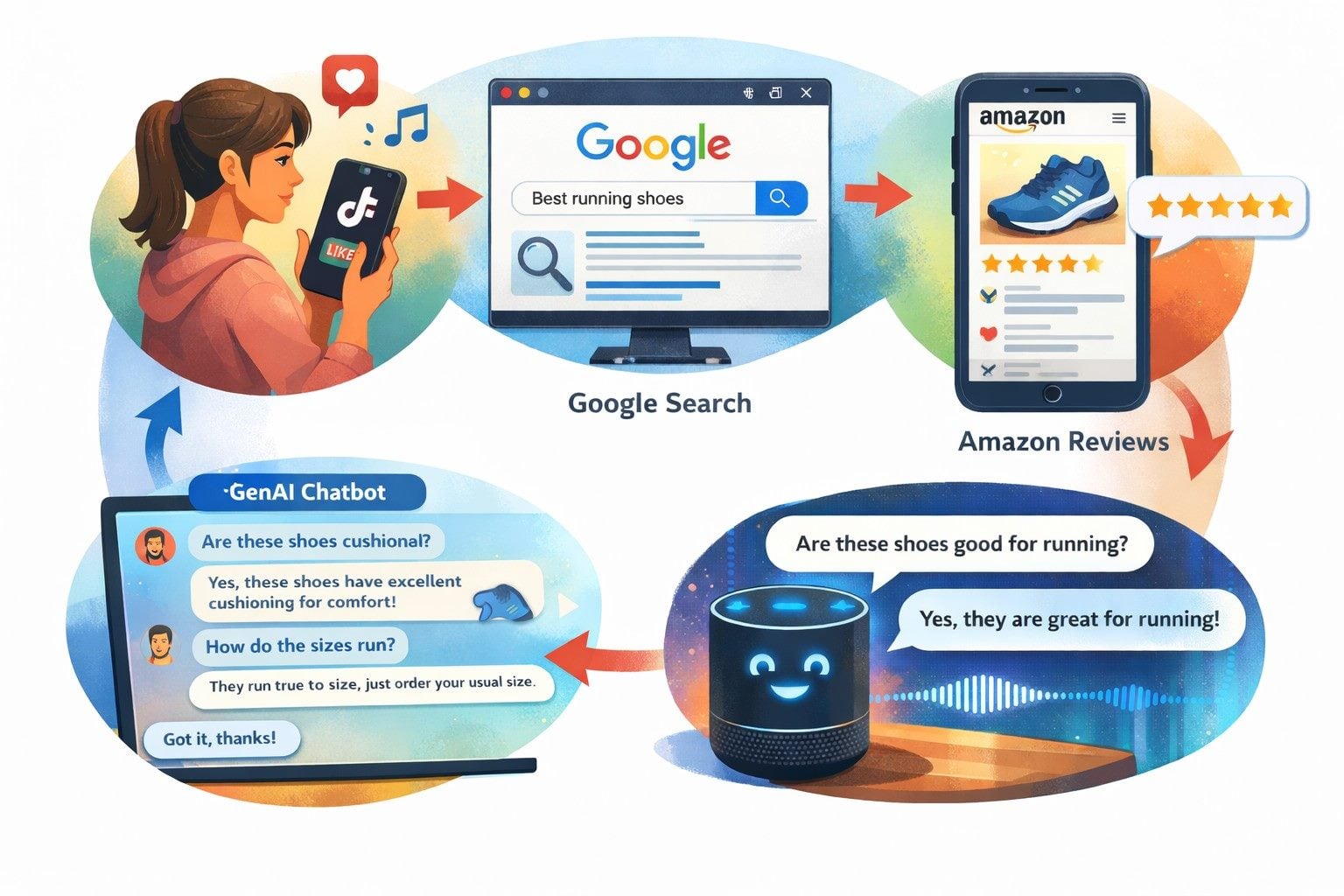
As customer journeys become less predictable, the traditional funnel model is giving way to a more fluid, moment-driven experience that is shaped by how customers move between platforms.
Vance Morris, president and chief experience officer at Deliver Service Now Institute, told CMSWire, "Today's customer doesn't move through your funnel, they bounce ... and then decide in about 11 seconds whether you're worth a phone call." Morris suggested that businesses should focus less on controlling the path and more on shaping the experience at each interaction, and emphasized the shift from structured journeys to dynamic, intent-driven engagement.
What ties these interactions together is intent, not channel. Customers are less concerned with where they are engaging and more focused on whether they are getting useful, relevant responses. As a result, they move fluidly between platforms, expecting continuity and consistency even when the underlying systems are disconnected.
This expectation creates new challenges across discovery, engagement and support. In discovery, brands can no longer assume that search or social will serve as the primary entry point. In engagement, messaging must remain consistent even as the context shifts between platforms. In support, customers expect to pick up where they left off, regardless of whether they are interacting with an AI system or a human agent.
As customer journeys become less structured, behavior increasingly reflects a pattern of exploration, return visits and delayed decision-making across platforms.
Paige Maguire, director of UX and research at Fueled, told CMSWire, "A customer might find you through a Reddit thread, circle back via a YouTube ad three weeks later, and finally convert through a Google search they ran at 11 p.m."
The underlying issue is that most businesses are still structured around channels, while customers are not. Bridging that gap requires a shift from managing individual touchpoints to designing connected experiences. As journeys become increasingly multi-entry and non-linear, the ability to maintain context across interactions becomes a defining factor in how customers perceive the experience.
Related Article: Here's What I Learned About Customer Experience From One Pharmacy Trip
Much of the conversation around AI has focused on interfaces, whether conversational tools will replace search engines or reshape how people access information. The data suggests a more nuanced shift. AI is not simply introducing a new interface, it is changing the nature of what people ask and how they expect answers in return.
Rather than replacing search, AI is expanding the range of questions users feel comfortable asking. Traditional search has often required users to translate their needs into keywords and phrases. AI removes that constraint. People can now ask more complex, contextual questions, request summaries, compare options or explore ideas more iteratively. This changes not just the format of queries, but the expectations attached to them.
The Global Overview Report noted this shift, suggesting that AI tools are enabling users to address a broader range of needs than traditional search alone, reinforcing their role as a complement rather than a replacement.
As AI reshapes how users interact with information, the goal of content is shifting beyond driving traffic toward being included in generated responses. Maguire suggested, "Brands are no longer just trying to get clicks; they are also trying to get into the answer." Maguire noted that this shift places greater emphasis on clarity and structure, as content must be easily interpreted by AI systems that are increasingly mediating how users discover information. Ultimately, even with AI, content is still king.
Those expectations are rising quickly. Users increasingly expect direct, synthesized answers rather than a list of links. They expect systems to understand nuance, maintain context across follow-ups and adapt responses based on prior interactions. In many cases, AI is becoming the first stop for exploration, with search, social and other platforms used to validate or expand on what was initially discovered.
As AI becomes a primary interface for discovery, it introduces a new layer to the customer journey that operates independently of traditional marketing channels.
Carmen Hughes, founder at Ignite X, told CMSWire, "When someone asks ChatGPT or Perplexity for a product recommendation, there's no landing page, no retargeting pixel, no funnel. The AI either recommends you or it doesn't." As such, Hughes pointed out that businesses must now consider how AI systems interpret and present their brand, reinforcing the idea that AI is not simply a new interface, but a new decision-making layer within the customer experience.
For customer experience leaders, this introduces both opportunity and pressure. On one hand, AI enables faster resolution, more personalized interactions and the ability to handle more complex inquiries. On the other hand, it raises the bar for accuracy, consistency and trust. If an AI system provides incomplete or misleading information, customers are more likely to notice and less likely to tolerate it.
This shift also has direct implications for content strategy. Content is no longer created solely for ranking or visibility within a single channel. It must be structured, accessible and context-rich enough to be interpreted and discovered by AI systems that are increasingly acting as intermediaries. That means prioritizing clarity over volume, depth over surface-level coverage and consistency across sources.
In this environment, success depends on more than adopting AI tools. It requires understanding how AI is reshaping user intent, and ensuring that both experiences and content are designed to meet those evolving expectations.
Related Article: An AEO Content Strategy With Actual Results
As customer behavior expands across platforms, the complexity behind the scenes has grown just as quickly. Most enterprises now operate across a mix of marketing platforms, CRM systems, support tools and emerging AI layers, each capturing a different piece of the customer experience. The result is a fragmented environment where data, decisions and interactions are often disconnected, even when they are part of the same journey.
This table connects directly to the article’s business implications, showing how priorities are shifting from managing individual channels to coordinating experiences across systems. It helps justify why orchestration, unified data and cross-functional alignment are now required.
| Area | Channel-Centric Approach | Orchestration-Centric Approach |
|---|---|---|
| Strategy focus | Optimize individual channels | Coordinate end-to-end journeys |
| Customer view | Fragmented by platform | Unified across touchpoints |
| Data usage | Siloed within tools | Shared and integrated across systems |
| Measurement | Channel-level metrics | Journey-level outcomes and impact |
| Technology role | Independent platforms | Connected ecosystem with shared logic |
| Ownership | Function-specific | Cross-functional accountability |
| Customer experience | Inconsistent across channels | Continuous and context-aware |
This fragmentation becomes more visible as customers move fluidly between channels. A conversation that starts with an AI assistant, continues through a support agent and ends with a purchase should feel like a single interaction. In reality, it often does not. Context is lost, data is incomplete and customers are forced to repeat themselves. The gap between how customers behave and how systems are structured becomes harder to ignore.
As customer interactions span multiple platforms, the ability to unify data becomes essential to delivering consistent experiences.
Audrey Patterson, president at Ark Marketing, told CMSWire, "Consistent data across splintered channels is only possible if you are able to create a single, unified data infrastructure."
Closing that gap requires more than incremental improvements. It demands orchestration. This means connecting systems so that data flows in real time, aligning decision logic across channels and ensuring that each interaction reflects a consistent understanding of the customer. It also requires a shift in how businesses think about ownership. Customer experience can no longer sit within a single function. It must be coordinated across marketing, product and service, with shared accountability for outcomes.
This is where orchestration becomes critical. It does not happen organically. It requires clear ownership, defined experience standards and alignment across systems and teams. Without that level of coordination, even well-funded digital initiatives can result in disjointed experiences that erode trust.
In practice, orchestration is what turns digital capability into business performance. It enables faster resolution, more relevant interactions and a more consistent experience across touchpoints. As the number of channels and systems continues to grow, the ability to coordinate them effectively is no longer a competitive advantage. It is a requirement.
The idea of a primary channel has quietly broken down. For years, businesses could anchor their strategies around search, social or email, optimizing performance within a defined lane. That model no longer holds. Customers are now entering and moving through journeys across multiple platforms at once, which makes it far more difficult to predict where influence begins or where decisions are made.
This shift forces a change in how leaders approach both marketing and customer experience. Optimizing individual channels in isolation delivers diminishing returns when those channels are no longer the center of attention. The focus instead needs to move toward coordination, ensuring that messaging, data and interactions remain consistent as customers move between platforms. That requires a broader view of the journey, one that accounts for how different touchpoints contribute to a single experience rather than treating each interaction as a separate event.
Measurement becomes significantly more complex in this environment. Traditional attribution models were built around clearer entry points and more linear paths to conversion. As journeys become more fragmented, it becomes harder to assign value to any one interaction. Each step plays a role, but no single touchpoint tells the full story and the ability to fully control or predict every interaction becomes less realistic.
Jonathon Narvey, CEO at Mind Meld PR Inc., told CMSWire, "The solution is to recognize they will not be able to quantify, measure and systematize everything to remove the chaos." Narvey suggested that rather than attempting to eliminate complexity, businesses should focus on adapting to it, reinforcing the need for flexible, multi-channel strategies that align with how customers actually behave.
For leaders, this creates both a challenge and an opportunity. The challenge lies in moving beyond familiar metrics and models that no longer reflect how customers behave. The opportunity is in building a more complete understanding of the journey, using integrated data and cross-channel insights to guide decisions. In this context, success depends less on maximizing performance within individual platforms and more on how effectively those platforms work together to support the customer experience.
The Digital 2026 Global Overview Report makes it clear that the future of digital engagement will not be defined by which platforms win, but by how effectively businesses connect them. As customer behavior continues to expand across search, social and AI-driven interactions, the advantage shifts to those who can translate that complexity into coherent experiences.
For marketing and customer experience leaders, the path forward is less about choosing where to compete and more about ensuring that every interaction, regardless of where it occurs, contributes to a consistent and meaningful experience.