Product Review
Buyer's Guide
Your Legacy Systems Aren't the Problem. Leaving Them Alone Is.

AURORA, Colo. — The Gartner Marketing Symposium/Xpo show floor told a different story than the keynotes. While analyst sessions focused on AI agents, orchestration and the future of marketing, vendor conversations revealed a more practical reality: success still depends on foundations.
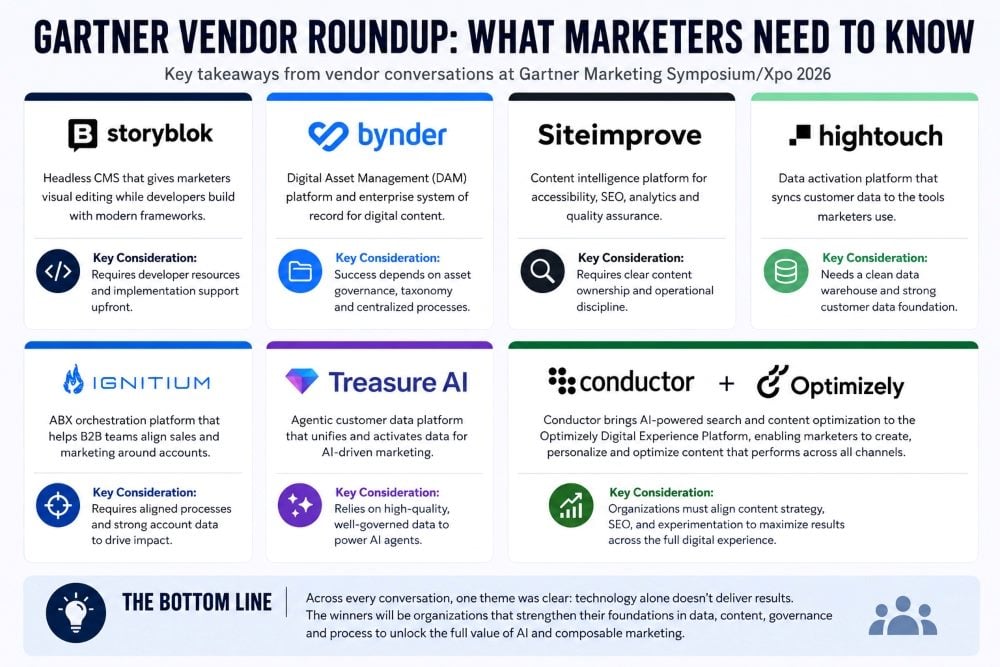
Over two days in Aurora, Colo., I met with leaders and reviewed stories from Storyblok, Bynder, Siteimprove, Hightouch, Ignitium, Treasure AI and Optimizely and Conductor.
The technologies varied widely, from headless CMS platforms and digital asset management systems to composable CDPs, agentic customer data platforms and answer engine optimization tools.
Yet nearly every conversation came back to the same challenge. The promise of AI is advancing faster than most organizations' operational readiness. Whether the topic was content governance, customer data, accessibility, account-based marketing or AI-driven activation, the strongest vendors were often the most transparent about what customers still need to put in place before these technologies can deliver meaningful value.
In many cases, the limiting factor was not the platform. It was the organization's data quality, governance model, integration maturity or internal processes.
Here is a closer look at the vendors I observed — and what marketing leaders should understand before making the investment.
I met with Dominik Angerer, Founder and CEO of Storyblok, and I will admit something. At first, I did not fully get why a marketer would need a headless CMS. A traditional CMS lets teams manage content and publish it to a website. Why complicate that with a system that separates the content back end from the front-end presentation layer?
Here is the practical definition. A headless CMS stores and manages content separately from the website, app, or digital interface where that content appears. Instead of one platform controlling both the content and the presentation, the CMS sends content through APIs to whatever front end the organization builds or connects. That can include websites, mobile apps, commerce experiences, digital displays, product interfaces or future channels that do not fit neatly into a standard web page.
After gaining this understanding ... I finally got it.
Storyblok is built for teams that need that flexibility. It gives marketers a visual editing experience while giving developers the ability to build front ends with their preferred frameworks. For a global brand, ecommerce company, media business or enterprise with many digital properties, that separation can be extremely valuable. It prevents the CMS from becoming a bottleneck when content needs to move across many experiences headless CMS versus traditional CMS.
But this is also where the Marley Evans test matters (see what she told us in our other piece from the Gartner conference). Storyblok is powerful, but power requires preparation. Storyblok's own documentation acknowledges that "headless CMSs require more setup and developer involvement upfront, and some features may need custom implementation." That is not a criticism of Storyblok, it is an honest description of the model.
Storyblok seems to understand this better than many vendors. Standard support includes the Discord community, in-app help center, documentation and a support team, but their support does not become your implementation team. At the enterprise tier, Storyblok can provide a customer success manager, and companies can add a designated solutions architect to reduce delivery risk, remove engineering blockers and keep complex implementations on track. The hands-on build work still falls to the customer's team or to certified partners, which is the honest division of labor.
That is why I came away more positive on Storyblok than I anticipated. It is not pretending that a headless architecture is plug-and-play for every marketer. It is saying that for organizations with developer capacity, partner support, and a real need to distribute content across channels, the payoff can be flexibility and future-proofing. For teams without that technical capacity, a traditional CMS may still be the more practical starting point, and that is not a failure.
Related Article: Storyblok & OtterlyAI Partner for AI Search Optimization
Next, Bynder. Bynder is a digital asset management platform, usually shortened to DAM. A DAM is a central system where companies store, organize, govern, retrieve and distribute approved digital assets, such as images, videos, logos, documents, campaign files and creative variations. It matters more in an AI-heavy marketing environment because AI should not be pulling from a random swamp of outdated files, off-brand images and unapproved creative.
Quick aside, every time I hear DAM, I think of Cousin Eddie in National Lampoon's Vegas Vacation at Hoover Dam asking, "where can I get some damn bait?" I laugh every time. Anyhoo, back to enterprise content operations.
I met with Richard Heitmann, CMO of Bynder, and his framing was one of the clearest vendor conversations I had. He talked about the "massive proliferation of content" and the pressure on companies to deliver more personalized content experiences. He described Bynder as "really an enterprise system of record for their digital content." He also emphasized the importance of creating the taxonomy, centralizing approved assets and distributing content to systems and teams from a single platform.
That system-of-record idea is crucial. Heitmann said, "A DAM doesn't operate in isolation. Bynder is composable." He added that "being a system of record is really the key" because upstream and downstream martech can feed off it. In other words, the DAM is not just where files live. It becomes the trusted content layer that other systems depend on.
Richard also said something I wish more AI vendors would say. "AI needs to be human-led. You can't let AI take control. We don't believe in 'human in the loop' where it is just doing the work and letting you know." That distinction matters. A human-led model starts with governance, approval and intentional control, rather than letting automation race ahead and then notifying a person after the fact.
Bynder appears to provide guided onboarding and services, but the customer still has homework. Centralizing assets from many sources requires decisions about taxonomy, permissions, governance, deduplication, metadata and what counts as the approved version. Bynder's own services and migration materials point toward a structured process, not magic cleanup Bynder services. That is the right model, but it means a DAM implementation can still stall if the organization has never decided how its content should be governed.
Related Article: From Lane Assist to Marketing Copilot: Why AI Agents Still Need a Human Behind the Wheel
Editor's note: The strongest vendors at Gartner were often the most transparent about prerequisites, implementation requirements and customer responsibilities.
| Vendor | Primary Value | Biggest Readiness Requirement |
|---|---|---|
| Storyblok | Headless content delivery | Developer resources and implementation support |
| Bynder | Content system of record | Asset governance and taxonomy strategy |
| Siteimprove | Content intelligence and accessibility | Content ownership and operational discipline |
| Hightouch | Data activation | Clean warehouse and customer data foundation |
| Ignitium | ABX orchestration services | Structured account and buying committee data |
| Treasure AI | Agentic customer data platform | Stack-wide integrations and governance |
| Optimizely + Conductor | Answer Engine Optimization | High-quality, governed content operations |
I then spoke with Jeff Coyle, SVP of Strategy for Siteimprove. Siteimprove is an agentic content intelligence platform focused on helping teams move from compliance to performance across their digital estates. In practical terms, it helps organizations evaluate, improve and govern digital content across areas like accessibility, quality, search performance and now AI-driven content workflows. Its relevance to this article became clearer the more Coyle talked.
The day I interviewed Coyle, Siteimprove had launched two new AI agents. The first was a writing and optimization agent. Coyle explained that teams can take content plans and briefs, and the system understands the existing digital estate so users can cooperatively author or improve content. The goal is to make content more successful in AI search engines while also making it higher quality.
The second launch was a PDF accessibility agent. Coyle aid it looks at PDFs and, no matter how complex they are, remediates them to make them fully compliant. He described computer vision technology that performs attribute analysis, such as scanning images to write relevant alt text. That is not a flashy marketing toy, it is a real operational pain point for organizations with years of inaccessible PDFs sitting across their sites.
What I appreciated most was that accessibility sits at the center of Siteimprove's story. When was the last time you heard a content engine, DAM or CMS lead with accessibility? Coyle connected accessibility to AI search in a way that made sense. He said, "AEO is an amazing world where we're getting answers that are synthesized by AI, the foundation of accessibility."
AEO means Answer Engine Optimization. It is the practice of structuring and improving content so AI-powered answer engines can understand it, select it and synthesize it accurately. Coyle's point was that accessibility, technical SEO, AI search and machine readability share fundamentals. "Making sure your content can be read by machine readers, the one-in-five humans in the world that need to use assistive technologies, some of the best practices from accessibility have overlap with technical SEO," he said.
Siteimprove also stood out because it seems to have a more mature support posture than many companies selling into this shift. It offers professional services and onboarding help to get teams running. Woo hoo, we found one. I do not know the full economics of those packages, but it is meaningful that the support is not treated as an afterthought.
Coyle also described three modes of AI involvement, "Human in the loop, human on the loop, human out of the loop." That is a useful operating distinction. Human in the loop means the person is actively involved before output is finalized. Human on the loop means the system can act with monitoring and intervention. Human out of the loop means automation proceeds without direct human involvement, which should be reserved for lower-risk, tightly governed use cases.
I was very interested to meet Hightouch. Hightouch is a composable customer data platform, or CDP. A CDP is a system that helps companies collect, unify, segment and activate customer data across marketing and business systems. A composable CDP usually sits on top of a company's existing data warehouse rather than forcing all data into a separate packaged database.
I have historically been skeptical of CDPs because many of them sit on top of databases and present themselves as the answer to data problems they do not actually fix. Hightouch is different in a way I respect. It is highly focused on activation, meaning it helps teams take data from a warehouse and push audiences, attributes and triggers into channels where campaigns actually run. That input-output motion, where activity in one system can trigger action in another, is genuinely powerful.
I met with Nate Wardwell from the product marketing team. Wardell said that if a client has dirty or disparate data, Hightouch can help "get them there" so they can use the system. I believe that is true in the practical sense that good implementation teams often help customers navigate messy realities. But this is where the concern begins.
Hightouch is an activation engine, not a data preparedness engine. Its own materials emphasize the data warehouse layer and the preparation needed for migration and activation data warehouse layer. Documentation around migration preparation reinforces that customers need to do meaningful work before data flows cleanly into activation use cases preparing for migration. That is not a flaw, but it is a crucial boundary.
This boundary matters because many potential clients have customer data spread across legacy systems, old CRMs, ecommerce platforms, spreadsheets, event tools, email platforms, call centers and databases that have not been cleaned in decades. Some have records dating back to the 1990s. If the organization has conflicting IDs, stale fields, missing consent, duplicate customers and no trusted warehouse model, Hightouch cannot simply activate its way out of that problem. The tool can be excellent and still be downstream of the hard part.
That is the difference between vendor fit and vendor fantasy. Hightouch may be a strong fit for organizations that already have a capable data warehouse, data engineering support and clear activation goals. It is a weaker fit for organizations that are still debating what counts as a customer record. The product can help operationalize data, but the organization still needs data worth operationalizing.
Related Article: Hightouch Announces $80M Series C at $1.2B Valuation to Bring AI Decisioning to Marketers
Next up was Ignitium, and my conversation with Erick Agnew. Ignitium, founded in 2010 and based in Spokane, Wash., is an enterprise ABX orchestration agency. ABX means Account-Based Experience, an evolution of Account-Based Marketing that focuses not just on targeting accounts, but on coordinating meaningful experiences across the buying committee. In practice, Ignitium helps B2B revenue teams orchestrate account-based programs, messaging, workflows and engagement motions ABX orchestration.
Agnew made a similar argument to Coyle. You need the fundamentals in place to benefit from AI. That means good data, sound infrastructure and a clear view of the audience you are trying to reach. As he put it, one of the ways Ignitium helps clients is "mapping out buying committees and then target them one-by-one."
That is a practical description of what many AI conversations skip. In B2B, the buyer is rarely a single person. There are economic buyers, technical evaluators, users, blockers, influencers, procurement teams and executive sponsors. If you do not know who those people are and what they care about, AI-generated personalization is just more output aimed at a blurry target.
Agnew said Ignitium can manage hundreds of thousands of messages across clients, with personalized and relevant messaging down to the individual recipient level. He also said one of the most impressive things AI can do is support "research at scale, which helps you craft your messaging." By research, he was referring to CRM records and the ability of tools like Claude to reduce tedious manual work by appending information about companies, teams and individuals.
Ignitium scores high on my list because it is more service-based. That matters for companies that need help translating strategy into execution. However, Ignitium also depends on an ecosystem. Agnew said partnerships with 6sense and Demandbase constitute around 90% of their client base, and those platforms provide account-level insights and orchestration signals.
That dependency is not a problem, but it is another reminder that the future is stack-level, not vendor-level. 6sense and Demandbase are among the more mature, AI-forward martech platforms available today, and they still need structured first-party data to deliver on their promise. They are precisely the kinds of tools that would need to be fully operational before any CMO could connect a martech stack to an enterprise-wide data fabric by 2030, as Gartner predicted last week. If the inputs are not structured, no amount of AI sophistication at the platform layer fixes it.
I also joined a demo of Treasure AI, formerly Treasure Data. Treasure Data announced its move to Treasure AI in 2026, positioning itself around an Agentic Experience Platform and the promise of delivering "10x Value to Marketers in 10 Minutes." The company has long operated in the customer data platform space, with products designed to connect, manage and activate customer data customer data platform. In this conference context, it was one of the more technically sophisticated platforms I saw.
I met with Michael Duarte from the solutions engineering team, and he was generous with his time. I liked his role because it sits at the intersection of use case and technology. He focuses on aligning client needs to what the platform can actually support. That is the kind of role more vendors need, because the AI conversation falls apart when use case and capability drift away from each other.
Duarte described Treasure's AI approach as "empowering users to get the most out of the Treasure ecosystem, reduce the barrier of entry, and to make sure that anyone can see success as we think about those core use cases that we're seeing users employ day-to-day." He named examples like building segments, sending those segments downstream to engagement channels, and building journeys. I was impressed with the interface. I also appreciated that Treasure set up a sandbox so I could click around and test the tool myself.
Treasure gets credit because its system is built to handle dirty data better than many platforms. That puts it closer to Gartner's 2030 vision than most of what I saw. It also has an integration hub, which matters because customer data platforms live or die on their ability to connect to other systems integration hub. Still, the holistic picture matters more than the single platform.
Treasure can help manage customer data, build segments and activate downstream use cases. But it still needs connections to CRM, sending platforms, analytics tools and other parts of the martech stack. Those systems have their own setup requirements, permissions, data models and workflow constraints. It is great if one company is easier to work with, but the organization still needs the broader stack to be ready.
One limitation I noticed was the segment-building logic. This is not unique to Treasure, and it is common across many marketing platforms. Still, it stood out because the platform is strong in other areas, while the segment builder appeared limited for more complex Boolean logic. Marketers can usually build basic rules, such as opened an email and clicked a link, or donated in the last 90 days, but the problem starts when conditions need to be combined more precisely.
That is where nested logic matters. Nested logic means placing one set of rules inside another set of rules, similar to how a math equation uses parentheses to control the order of operations. A marketer may want donors who gave in the last year and either clicked a recent advocacy email or attended an event, but who did not already receive a renewal message. Without nested logic, the platform may force the marketer to flatten the rules into a simpler structure, changing the audience.
For a non-technical marketer, the easiest way to understand nested logic is this, it tells the platform exactly which conditions belong together. "A and B or C" can produce a different audience than "A and (B or C)." That difference matters because segmentation determines who receives a message, who is excluded and how relevant the campaign feels. When nested logic is missing, marketers lose precision and may need analysts, spreadsheets, or outside tools to build the audience the platform should support on its own.
Optimizely and Conductor were both at the xPo, and I have to admit, Optimizely feels a bit like an old friend. I am an Optimizely fan. The company has been building around digital experience, experimentation, content and personalization for years. Conductor, meanwhile, has long been known for search, content intelligence and organic marketing performance.
Their partnership announcement fit the conference almost too perfectly. Optimizely and Conductor announced a partnership and AEO platform launch on June 10, the day after the Gartner keynote I attended. AEO, again, means Answer Engine Optimization. It is the discipline of helping content become understandable, credible, and selectable by AI answer systems.
This announcement is useful evidence because it shows vendors are not waiting for 2030 to reposition around AI search and agentic discovery. The market is moving now. Content platforms, SEO platforms, DAMs, CMSs and analytics tools are all being pulled into the same gravitational field. If customers increasingly get answers from AI systems rather than traditional search result pages, vendors must help brands structure content for that reality.
But the same caution applies. AEO is not just a new label to slap on content strategy. It requires content quality, technical structure, governance, credibility signals, accessibility and a clear understanding of which sources AI systems can read and trust. If a company has 10,000 pages of outdated content, inconsistent metadata, inaccessible PDFs, and no ownership model, an AEO platform may expose the problem before it fixes it.
That is why I found the Siteimprove and Optimizely-Conductor thread so interesting together. Siteimprove connects accessibility, quality, and AI search fundamentals. Optimizely and Conductor connect experience platforms with answer engine visibility. Both point to the same conclusion, AI search is not a channel tactic. It is a content operations discipline.
Brian Riback is a dedicated writer who sees every challenge as a puzzle waiting to be solved, blending analytical clarity with heartfelt advocacy to illuminate intricate strategies. Connect with Brian Riback, 2025 Contributor of the Year: 