News
Research Report
Building the Case for Modern Public Sector Messaging


Unified AI visibility. Optimizely and Conductor integrate AI traffic and content data.
Actionable analytics tools. Marketers receive agents to identify and close content gaps.
Enterprise marketer impact. Platform improves content discoverability and AI optimization workflows.
Software providers that offer Digital Experience Platforms (DXPs) are racing to the bots. Or, better yet, racing to provide tech that helps customers find the bots.
Optimizely is the latest, and this one comes with a partner specializing in Answer Engine Optimization (AEO). On June 10, it launched a full AEO platform that combines AI search visibility tools with pre-built agents to help enterprise marketers act on content discovery insights. The release introduced Agent Visibility Analytics and a new partnership with Conductor, an enterprise AEO platform provider.
According to Optimizely, the platform brings together log-based AI traffic data, generative engine optimization (GEO) and AEO intelligence, and autonomous agents in a single environment. The partnership integrates Conductor's SEO, GEO and AEO intelligence — built on what the companies described as millions of search queries and AI discovery signals — directly into Optimizely.
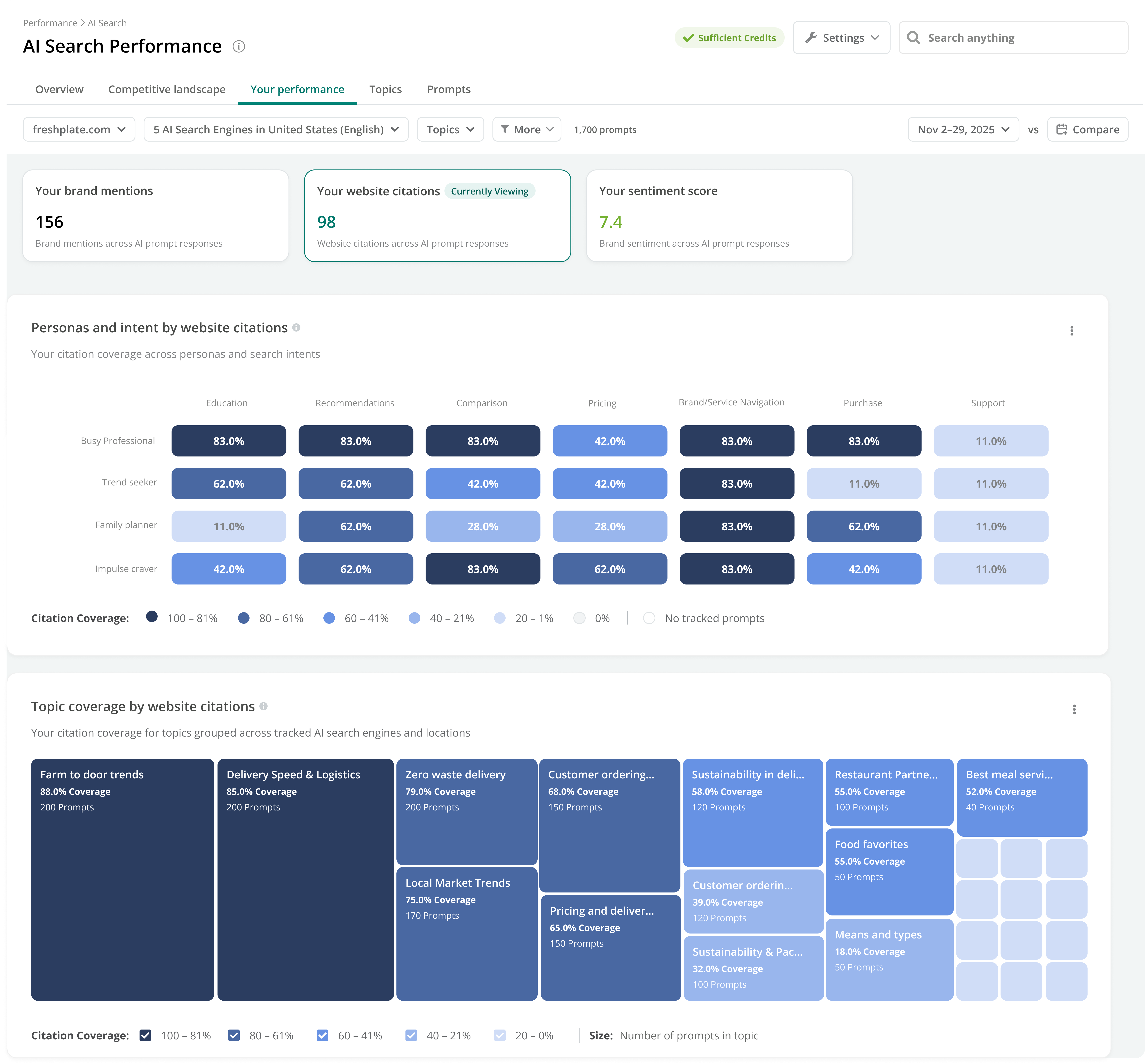
Agent Visibility Analytics, built inside Optimizely Analytics, uses log-level data from an organization's own site to surface how AI agents interact with content. Optimizely said teams can classify requests by intent — including retrieval, indexing and training — and analyze visibility trends by business dimensions such as funnel stage, topic area or content category.
Capability | Description |
|---|---|
Agent Visibility Analytics | Log-based data showing actual AI agent and crawler activity on-site |
Conductor AEO/SEO/GEO Integration | Enterprise search and AI discovery intelligence in one dashboard |
Opal-Powered Enrichment | Adds business context to AI request data for optimization workflows |
AEO Gap Finding Agent | Identifies content gaps and delivers a prioritized action plan |
Competitive AI Share of Voice Agent | Benchmarks AI search visibility against competitors by topic |
Enterprise marketers were already wrestling with a crisis of confidence well before Optimizely's June 10 announcement. Brands are struggling to reconcile declining organic traffic with an AEO discipline that lacks the measurement frameworks and vendor maturity SEO built over two decades. The anxiety is well-founded: Google's own AI search guidance, published in May, confirmed that while SEO fundamentals still apply, the rules governing how content gets surfaced in AI-generated results are being rewritten in real time.
The scale of that rewrite is now quantifiable. Google's AI Mode surpassed 1 billion monthly active users in its first year, with queries more than doubling every quarter since launch. The average AI Mode query is triple the length of a traditional search query. Follow-up queries have grown more than 40% per month in the U.S. Searches starting with "which" — decision-stage queries — are growing 40% faster than overall AI Mode volume.
And more than one in six AI Mode searches are now multimodal, with image-based queries among the fastest-growing input types. For enterprise marketing and web teams, the signal is unambiguous: the audience has already moved. The question is whether the tools have.
Optimizely enters a market that has been moving without it. Several enterprise platforms launched AEO capabilities in the months leading up to the June 10 announcement, establishing early positions in a space that is shifting from experiment to strategic requirement.
Siteimprove announced its Advanced AEO Insights at Adobe Summit in April. The capabilities — built within its Siteimprove.ai Search solution — give enterprise teams the ability to track AI citations, prompt performance, share of voice and sentiment across answer engines in a single platform.
Conductor launched AgentStack as a dedicated AEO suite, delivering native LLM apps for ChatGPT, Claude and Microsoft Copilot alongside APIs and a Model Context Protocol server for custom agent development. It is the same Conductor that Optimizely has now partnered with to power its AEO intelligence layer.
HubSpot introduced AEO capabilities as part of its Spring 2026 Spotlight release, pairing visibility tools with expanded AI agents designed to help go-to-market teams compete for brand presence in AI-generated results. HubSpot's own research showed AI-referred sessions had grown 527% year-over-year — still roughly 1% of total traffic, but converting at 4.4 times the rate of organic search.
Webflow made its AEO product generally available to enterprise customers on May 21, pairing analytics that track brand presence in AI-generated answers with agents that recommend and help execute technical site improvements — creating what the company described as a closed loop from measurement to action. Webflow's own research found 93% of marketing leaders consider AEO important for brand success over the next two years.
Last month, Adobe announced plans to acquire SEMrush, bringing search, content marketing and online visibility capabilities into its digital experience portfolio.
Meanwhile, Sitecore acquired Scrunch, a startup focused on helping brands monitor and improve their presence in AI-generated search results. Together, the moves reflect a growing consensus among DXP and marketing technology vendors that AI search visibility is becoming a strategic discipline alongside traditional SEO. The move signaled that AEO capability is increasingly being treated as a core platform requirement rather than a point-solution add-on.
Also this month, Conductor expanded its reach through an OEM agreement with Acquia, embedding Conductor's AI-powered content optimization capabilities directly into Acquia CMS to help marketers create content aligned with both traditional search and emerging AI discovery models. The deal signaled growing demand for tools that can influence how content is surfaced by AI assistants and search engines.
AEO platforms are maturing fast, with new launches and funding reshaping how marketing teams compete for visibility in AI-powered channels.
AI-referred sessions saw a 527% year-over-year increase, though they still represent roughly 1% of total traffic. Gartner projected traditional search volume would drop 25% by 2026 as AI chatbots absorb more queries.
Large language model (LLM) visitors convert 4.4 times better than organic search visitors — a figure reshaping where marketing analytics teams direct optimization budgets.
Vendors are positioning agentic infrastructure as the core AEO capability at scale. Conductor's AgentStack suite delivers native LLM apps for ChatGPT, Claude and Copilot, alongside APIs and a Model Context Protocol (MCP) server for custom agent development.
Beyond visibility tracking, CMOs also need to know what agents are actually doing on their sites. The next phase of AEO has to be grounded in real behavior: which AI agents are showing up, what content they are pulling, and where those signals connect to business priorities. Optimizely's AEO platform gives marketers a real data-grounded foundation and connects to the workflows they already use to improve digital experiences.
— Shafqat Islam, President at Optimizely
Optimizely has aggressively repositioned itself as an AI-first digital experience platform over the past year, displacing Adobe atop the Gartner Magic Quadrant for Digital Experience Platforms in early 2025 and ending Adobe's five-year reign. The company also earned Leader status in the 2026 Gartner Magic Quadrant for Personalization Engines.
Opal AI is the engine behind that momentum. A May 2025 upgrade deepened integration across the Optimizely One suite, and at Opticon 2025 the company unveiled AI agent orchestration tools, including a specialized agent library and a no-code workflow interface. Optimizely also introduced what it called the industry's first GEO-ready CMS.
Commercial traction has accelerated into 2026. In April, Optimizely launched a Remote MCP Server enabling teams to manage experiments from Claude and ChatGPT. On May 20, the company reported 42% quarter-over-quarter ARR growth for Opal, with nearly 1,700 customers — including Salesforce and Zoom — executing more than 172,000 agent runs.
 Have a tip to share with our editorial team? Drop us a line:

Sheryl Hodge is assistant managing editor at Simpler Media Group, where she plays a vital role in keeping the editorial operations running smoothly across the company’s three sites: CMSWire, Reworked and VKTR. Known for her organizational skills and attention to detail, Sheryl acts as the glue that binds the publications together, ensuring that workflows remain seamless and deadlines are met.