Feature
Research Report
Building the Case for Modern Public Sector Messaging


Before becoming a marketing analyst, I spent much of my career launching new businesses and rescuing startups and large organizations that struggled with their messaging and audience reach.
It was often heroic work—and sometimes it paid off. When I read and reviewed Denise Persson’s and Chris Degnan’s "Make It Snow," I honestly felt a twinge of envy. The companies I worked with were doing many of the same tactics, but Snowflake succeeded because they got the fundamentals right, from the start.
After reading Bruce Cleveland’s "Market Engineering," I understand better what Snowflake and other winners do differently. They didn’t need someone to come in later, because they built their company on the right foundation from day one. They didn’t have to retrofit personas, messaging, and industry positioning after the fact. Those pieces were built into the business DNA from the start.
Cleveland opens with a sharp question: how can two companies launch similar products on the same day, with smart teams and cutting-edge technology, yet 18 months later one is worth a billion dollars while the other quietly disappears? His answer is market engineering—the disciplined work of shaping not just their product, but the market around it.
He defines market engineering as the sum of category design, market validation and an orchestrated go-to-market motion. Success isn’t accidental, it has to be built. Cleveland’s core argument is too many companies make a fatal mistake at their outset: they focus on demand engineering first. They try to get customers to buy, without first making the market understand why it matters. I have seen this too many times in my career.
So many organizations spend heavily on campaigns, tactics and lead generation, only to get weak response rates and miserable conversions. They push harder, spend more, and still get little in return. Cleveland’s point is blunt: until a company engineers its market and establishes itself as the thought leader within that space, it’s wasting time and capital. Companies fail not because the product is bad, but because the market doesn’t understand, care, or believe in it. The story gets lost. The positioning drifts. The category gets defined by someone else. Once that happens, the market rewards a different company.
For Cleveland, market engineering is the systematic creation of the conditions that make a company’s success feel inevitable. It sits in the space between the founding team and the CMO, and in many ways it defines what a great CMO should be. It starts with category design, then moves through positioning and messaging, storytelling, and thought leadership.
These levers determine who wins — whose definition of the market goes viral, whose language becomes the default, and whose story investors, customers, and analysts repeat. They help determine whose IPO gets talked about and whose company fades into the background. That's true whether you are the CMO of a startup trying to create a market from scratch or the leader of a legacy company using AI and digital offerings to reposition value in a changing market.
Category creation starts with a mental map. Not a product map, not a feature chart, but a way of drawing the market itself. It's winning the right to define how buyers think, what they value, and what kind of solution makes sense. That map becomes the ground on which the game is played.
This is why category design is so consequential. As Christopher Lochhead argued, 76% of a category’s profits typically flow to the leader. Enter an existing category and the incumbent usually sets the terms of competition. Unless you redefine the category, you are playing by someone else’s rules, on someone else’s field, with someone else’s advantage already built in.
Related Article: 11 Marketing Leaders on What Stays, What Goes and What Scales in 2026
At its core, category creation is the strategic construction of context. It defines what matters, why it matters, and to whom. It architects new language and reframes the buyer’s problem so a company’s approach feels not merely differentiated, but a logical answer to a newly clarified need. Category design does more than position a product—it writes or rewrites the rules of the market around it.
A well-formed category crystallizes two questions at once: what is the problem, and how does this solution uniquely address it or redefine it? To own a category, an organization must out-define the market and engineer it. The goal is to name and define a space so clearly the company is seen as an obvious pioneer rather than just another vendor with a slightly better offering.
A classic example of category invention is Red Bull. It recognized many young consumers wanted something other than soda or coffee and gave that demand a name: the energy drink. Marketo offers a different lesson. It didn’t merely sell marketing software; it redefined the space in a way that shifted the conversation and ultimately took momentum from Eloqua.
For CMOs, the lesson is both practical and strategic. Cleveland argues cementing a category in the market’s mind takes roughly 12 to 18 months,. It often requires less capital than many assume and the long-term payoff can be enormous. Own the category and you write the rules, shape margins, and become the standard to which others are compared.
Al Ries and Jack Trout, authors of "Positioning: The Battle for Your Mind" got to the heart of it: positioning is not what you do to a product, but what you do to the mind of the prospect. Positioning is the mental real estate a company owns—their book is on my shelf. It’s the deliberate act of defining and occupying a uniquely advantageous space in the mind of a target audience, especially in relation to competitors, alternatives, and the status quo.
In practice, positioning answers a simple but brutal question: where should this company or product sit against everything else in the market? Done well, it claims territory. It tells buyers who this is for, against whom it competes, why they should pick it, why they should change now, and why staying with the old solution is no longer good enough. Strong positioning doesn’t just describe an offering; it shapes the comparison before the buyer ever makes one.
I saw this firsthand at Alation. Internally, there was a belief larger vendors owned self-service BI and its place was mainly with business analysts. But when I interviewed CIOs, a different picture emerged. They saw data catalogs not as tools just for analysts, but as enablers of broader business self-service around data. That insight didn’t require redefining the category. It required redefining the messaging. The company didn’t need a new market; it needed a sharper claim on the one it was already in.
The power of positioning is it inoculates against commoditization. Clear positioning supports premium pricing, shortened sales cycles, reduced churn, and even helps recruit talent, because people want to join companies that stand for something specific. Fuzzy positioning does the opposite. It forces companies to compete on price, disappear into a sea of similar solutions, and waste money on endless sales training, message corrections and periodic rebrands to fix confusion they never should have created.
Patagonia is a classic example of strong positioning. It owns a distinct place as an eco-conscious adventure brand. That positioning makes the brand immediately legible: who it is for, what it stands against, and why its customers see it as different from the many other companies selling jackets, fleeces and backpacks. The product matters, of course, but the meaning attached to the product matters just as much.
This helps explain why so many billboards crowd places like San Francisco. They’re not selling products, but fighting for mental territory. In saturated markets, visibility alone isn’t enough; companies are trying to lodge a specific association in the buyer’s mind before someone else does. The winners are rarely those with the most words. They’re the ones with the clearest answer to: for whom, against whom, why us, why now, and why not stay where you are.
Messaging is where strategy meets language. It is what the world remembers about you. More than a marketing layer added after the fact, it is the narrative architecture through which a company defines itself to customers, employees, investors, and partners. Done well, messaging aligns teams, sharpens execution, shortens sales cycles, attracts talent, and helps fend off competitors before the battle even starts.
Positioning tells the market where you fit. Messaging tells the market how you stand out. It translates value proposition, differentiation, and strategic intent into crafted statements, stories, and proof points people can actually understand and repeat. Great messaging is not sloganeering. It is usually captured in a living source-of-truth document, often a messaging matrix, that organizes the essentials: category framing, value articulation, differentiation and proof or social validation.
Planet Fitness built messaging around being a “judgement-free workout zone,” a clear contrast to traditional gyms many people experienced as intimidating or exclusionary. The message made the brand legible and emotionally resonant. It framed not just what Planet Fitness offered, but why it mattered.
Most companies get messaging wrong in familiar ways, leading with a tech-first bias, relying on inward-looking language, drifting into inconsistency across teams, or mistaking clever taglines for strategic clarity. Cleveland’s point is effective messaging does not emerge from wordsmithing alone but from a disciplined process: understanding the audience’s problem, framing the category, articulating unique value, and backing claims with proof. That's how messaging stops being decoration and starts becoming a strategic asset.
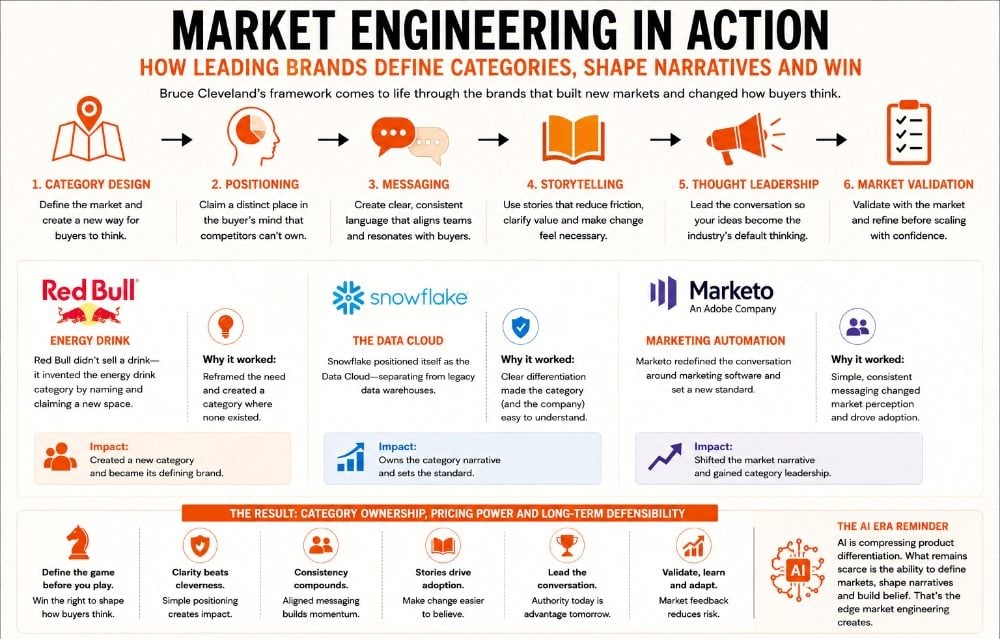
Category-defining companies don’t just dump content into the market they tell stories that expose what is broken, make the customer the hero and show a better outcome. That is why Cleveland’s line lands: no story, no traction; no traction, no company. In crowded markets, story is the oxygen of market engineering.
Stories work because they do strategic labor--reframing the problem, reducing adoption friction, and scaling through partners, customers, and broader ecosystems. More importantly, they shape how people interpret risk, hope, and urgency. A strong story helps buyers feel change isn’t reckless, but necessary. It makes the unfamiliar feel legible and turns a product from an object into an idea people want to join.
Nike understood this early, building a story around greatness, effort, and the belief ordinary people could push beyond their limits. “Just Do It” was powerful not because it was clever, but because it invited people into an identity. Steve Jobs did something similar with the iPod. “A thousand songs in your pocket” was not a feature dump but a vivid narrative that instantly translated technology into personal possibility.
This is how products become movements and users become evangelists. The best category creators do not just explain what their offering does, they tell a story that helps the market see the world differently. When that happens, customers are no longer buying a solution, but a new way of thinking and living--that's where magic begins.
Thought leadership, at its best, elevates a company far beyond brand awareness. It isn’t vanity content or executive self-promotion but a systematic lever for market entry, market expansion, and long-term defensibility. True thought leaders do more than comment on an industry. They influence the language people use, the metrics markets adopt, the investments others make, and even the regulatory conversations that shape the field—this is the instantiation of the magic described above. Thought leadership is one of the most powerful ways to define a category before others do it for you.
Effective thought leadership helps companies create domain language, generate earned media, and own the conversation before competitors can catch up. Cleveland argues it turns a founding team into market magnets by giving them a provocative, future-oriented worldview others want to follow, debate, and build around. Warby Parker didn’t just sell glasses; it advanced a broader point of view around access to eye care and transparent pricing. That narrative elevated the company from retailer to category shaper. The real power of thought leadership is it makes a company not just visible, but defining.
Editor's note: Bruce Cleveland's framework emphasizes building market understanding before demand generation accelerates growth.
| Component | Primary Goal | Business Outcome |
|---|---|---|
| Category Design | Define buyer understanding | Market leadership potential |
| Positioning | Claim mental territory | Reduced commoditization pressure |
| Messaging | Create consistent language | Shorter sales cycles and alignment |
| Storytelling | Reduce adoption friction | Higher engagement and advocacy |
| Thought Leadership | Shape industry conversation | Category authority |
| Market Validation | Confirm buyer response | Stronger go-to-market execution |
In an agentic era, product advantage is fleeting. Features are copied faster, interfaces are abstracted away, and what once looked like innovation quickly becomes table stakes. That's the trap for product-led companies: without a deeper market strategy, they risk sliding into commodity status. In this environment, market engineering can no longer sit at the edge of the business as a marketing function. It has to become a core discipline for CEOs, CMOs and product leaders alike.
What remains scarce, valuable, and defensible is not just the product, but the context around it: the narrative, the belief system, and the meaning a company creates in the market’s mind. The companies that survive this shift will not simply ship faster. Winners will define the language, frame the problem, and create the map others follow. The biggest prize is not to be one more option in a crowded field, but to become the landmark, the company whose name turns into a verb.
Building a category does not begin with a launch. It begins with disciplined discovery: brainstorming the category, pressure-testing the market blueprint, and creating a messaging matrix that becomes the company’s universal source of truth. From there, the real work is alignment. Internally, teams need onboarding into the language, the narrative, and the stakes. Externally, customers, partners, media, and investors need to hear a clear, consistent story often enough it starts to feel inevitable. Category creation isn’t a campaign but a coordinated process of teaching the market how to think.
That process unfolds over roughly 18 months. The first six months are about category discovery, messaging, and early validation: identifying the problem, framing the space, and finding proof that the market responds. The next six months shift toward thought leadership, content scaling, and meaningful market tests that sharpen the narrative and build credibility.
The final stretch, from months 12 through 18, is where category launch, evangelism and the hard work of market leadership begin in earnest. This is when companies spread the gospel, measure what’s landing, and turn signals of interest into durable momentum. The goal is not simply to introduce a new idea, but to build it into market leadership before someone else does.
Cleveland’s deeper point is markets do not simply reward the best products. They reward companies that define the problem, name the category, frame the comparison, and give buyers language they can believe in, and an experience the buyer wants to repeat. That is why market engineering matters. It is a strategic discipline that shapes how a company is understood long before a sales team makes its pitch.
In an era when AI can narrow product advantages almost overnight, that discipline becomes even more decisive. Features can be copied. Pricing can be matched. Interfaces can be abstracted away. But the company that owns the narrative, the category and the market’s mental map owns something far harder to dislodge. That is Cleveland’s real lesson for CMOs and founders alike: winning isn’t just about building the product right but building the market so your company becomes the name that defines it.